
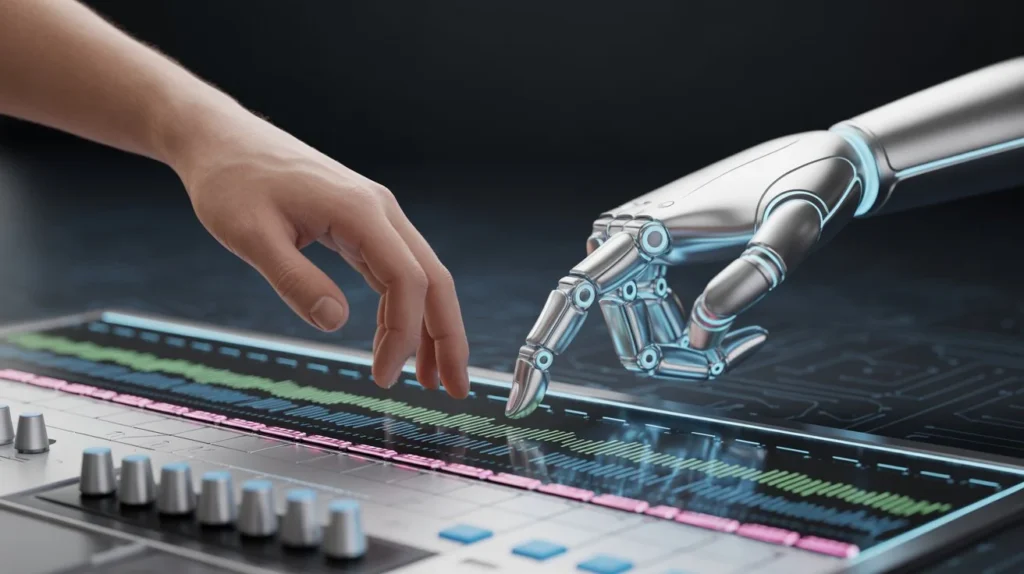
The rise of artificial intelligence with AI Music Tools in the studio represents the single most revolutionary shift in music production since the introduction of MIDI. For years, producers have relied on analog gear, synthesizers, and dedicated sample libraries, but the modern Digital Audio Workstation (DAW) is now becoming intelligent along with AI Music Tools. From generating complex MIDI melodies to perfecting a final master, AI Music Tools are rapidly integrating into every stage of the process.
This explosive technological leap has ignited a fierce debate: are AI Music Tools truly a creative collaborator, or do they simply represent cheating, diluting the craft? This question strikes at the core of what it means to be a modern producer. Navigating this ethical gray area is no longer optional; it is essential for maintaining integrity, protecting your legal rights, and securing your future career.
This ultimate guide provides a clear, actionable framework for ethical AI Music Tools integration. We will unpack the controversy, outline the legal landscape, and reveal 7 essential secrets to ensure your use of AI Music Tools remains a creative advantage, not an ethical compromise.
The Core Debate: Why Producers Fear AI Music Tools
The anxiety surrounding AI Music Tools is real and deeply rooted in a fear of creative obsolescence. For decades, the process of music creation—the hours spent sound designing, programming complex drums, and meticulously mixing—was the producer’s moat. AI Music Tools threatens to drain that moat overnight.
The Anxiety of Devaluation: Is a Prompt Enough?
Many veterans argue that if a novice can simply type a text prompt and generate a complex, radio-ready 8-bar loop, the value of traditional skill is decimated. This sentiment often defines AI Music Tools as “cheating” because they bypass the years of dedicated practice required to understand harmony, rhythm, and arrangement. The perception is that effort, not just output, defines artistic worth.
The Job Displacement Concern
The economic impact is perhaps the greatest source of producer anxiety. Recent analysis from the global organization CISAC suggests that up to 24% of creators revenues are at risk by 2028 (CISAC), a cumulative loss potentially reaching billions of Euros. This risk stems from AI’s ability to create substitute content—such as stock music, background scores, and advertising jingles—faster and cheaper than a human can. The UK Music Report also revealed that a significant 66% of creators believe AI poses a threat to their careers (UK Music Report). This AI Music Tools replacement effect is especially pronounced in technical, execution-focused roles like mixing and basic mastering, leading to the fear of widespread job displacement.
The Homogenization of Sound
A less discussed but equally important concern is the risk of aesthetic sameness. If millions of producers are feeding the same general prompts into the same algorithms, the output could become homogenized, leading to a “blurring” of genres and a lack of true artistic differentiation. The challenge for the ethical producer, therefore, is to use AI Music Tools to generate novelty, not copies.
7 Essential Secrets for Ethical AI Music Production
The solution to the dilemma is not to reject AI Music Tools, but to master its use with a clear, proven ethical framework. These seven secrets transition your mindset from resisting the change to leading it.
Shifting from Creator to Curator
The role of the producer is evolving. While the machine can generate, only the human can curate, select, and imbue the work with meaning. The ethical producer must view AI not as a replacement, but as an advanced instrument that requires skillful direction.
The Importance of Process Documentation
In a world where algorithms can mimic, your integrity is your competitive edge. Documenting your creative process—from the initial prompt to the final human-performed modifications—is vital for both legal protection and ethical transparency.
Secret 1: The Principle of Augmentation Over Automation
The difference between a creative tool and cheating lies in your intention. Augmentation means enhancing your existing abilities; automation means delegating your creative responsibilities entirely.
The 80/20 Rule: Human Touch, AI Foundation
Apply the 80/20 rule: allow AI Music Tools to generate the complex 80% of the foundational material—the initial chord progressions, the deep basslines, or the layered percussion—but reserve the final 20% for indispensable human input. This critical 20% includes mixing decisions, subtle arrangement changes, effects automation, and human performance elements. It is the signature that makes the track yours.
Using AI for Repetitive Tasks, Not Creative Decisions
The ethical use of AI Music Tools is targeted. Use it to automate tasks that are necessary but not creatively central, such as:
- Generating multiple variations of a hi-hat pattern.
- Cleaning up unwanted noise (audio restoration).
- Creating basic first-draft masters for quickly testing mixes.
Never delegate the primary artistic choices, such as harmonic direction or overall emotional arc.
Hybrid Studio Setups and the Analog Vibe
Even with sophisticated AI Music Tools, the interaction with physical gear grounds the sound in the real world. Many producers integrate analog synths or external compressors into their workflow to process AI-generated audio with AI Music Tools. Using advanced sidechain compression techniques allows you to inject human-controlled dynamics into the mix, ensuring that the final output sounds organic and not mathematically sterile.
Secret 2: Understanding AI Music Copyright and Ownership
This is the most critical area for any producer to master, as the legal landscape is rapidly changing. In the United States, the legal cornerstone remains the human authorship requirement for US copyright (U.S. Copyright Office).
The Human Authorship Requirement
As of early 2025, courts and copyright offices globally have reinforced the principle that purely AI-generated compositions, where a producer simply types a prompt and accepts the raw output, are not eligible for copyright protection. Copyright exists to protect human creativity. This means that if you cannot demonstrate a tangible record of your creative choices—such as arranging, modifying melodies, or applying unique processing—your work may fall into the public domain.
Hybrid Works and Partial Protection
The concept of the “hybrid work” is essential. When you significantly transform the AI Music Tools output, you are asserting human authorship. Examples of meaningful creative contribution include:
- Writing original lyrics over an AI-generated beat.
- Reworking the entire structure of the AI-generated arrangement.
- Recording live instrumentation or vocals.
It is your input, the “human intervention,” that secures your intellectual property rights. Understanding music licensing and intellectual property for hybrid works is necessary to protect yourself and your work.
Licensing and Indemnification (Platform TOS)
Always read the Terms of Service (TOS) for AI Music Tools. While some models grant you full commercial rights to the output (even if the underlying content is not copyrightable), others retain ownership or impose limitations. Platforms often include indemnification clauses that attempt to shift legal liability onto the user if the AI Music Tools output infringes on existing copyrights due to its training data. Transparency on the AI Music Tools training data—what copyrighted material it was fed—is also a major concern, as regulatory acts in Europe, such as the EU AI Act (effective from August 2025), begin to mandate this disclosure.
Secret 3: The DAW as a Creative Tool: Integrating AI into Your Workflow
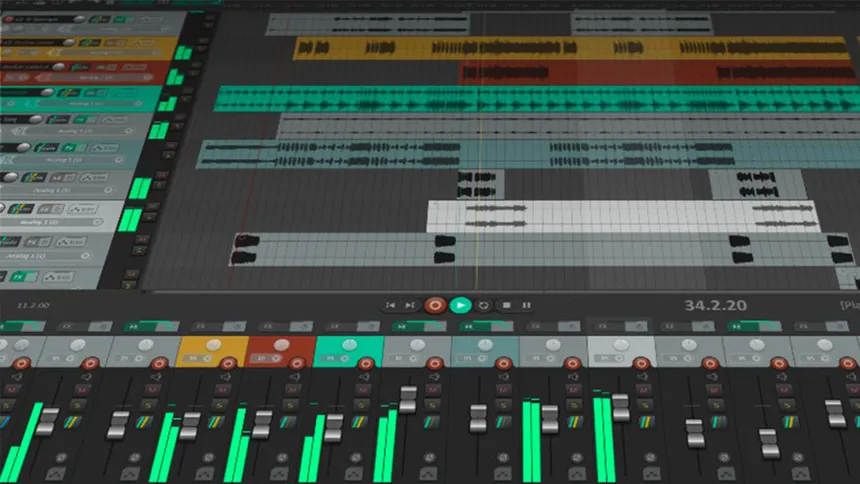
The true power of AI Music Tools is realized when they are integrated seamlessly into the DAW (Digital Audio Workstation) as a collaborator, enhancing your AI music production workflow, not disrupting it.
AI Drum Generators and Groove Refinement
AI drum generators can provide complex, humanized grooves instantly. Ethically, a producer should treat this AI-generated pattern as a starting point. Your job is to refine the ghost notes, adjust the swing percentage, and apply saturation or distortion to give the drums character and avoid a machine-gun feel. This refinement elevates the AI’s output from generic to professional.
Using Generative MIDI Kits for Inspiration
Generative music VSTs can produce endless streams of unique melodies and chord progressions. For the ethical producer, this is not a final product; it is an ideation engine. Use the AI to break writer’s block, then immediately customize the MIDI data. Rearrange the notes, shift the key, or use the generated pattern as a counter-melody for your own original hook.
AI Mixing Assistants: Enhancing, Not Replacing, the Engineer
Many DAWs now include AI-driven mixing plug-ins that can set a preliminary balance or suggest starting EQ curves. This is an enhancement tool. The final, subjective decisions—such as the exact placement of the lead vocal in the mix, the reverb decay time, or the amount of saturation—must be human-controlled. Your emotional connection to the music is the element no algorithm can replicate.
Secret 4: Redefining Skill: The Role of the AI Curator
The myth is that AI eliminates the need for skill. The reality is that it changes the type of skill required. The future-proof producer is not a musician, but an AI Curator.
The Skill of Prompt Engineering
The quality of AI output is directly proportional to the quality of the input. Prompt engineering is now a specialized skill that requires deep musical literacy. You must be able to specify not just a genre, but an emotional tone, a specific era’s compression style, or a unique rhythmic displacement. This demands a greater understanding of music history and technical sound design vocabulary than ever before.
The Art of Selection and Arrangement
The hardest part of production is not creation, but selection. AI may generate 100 possible melodies in seconds. The curator’s job is to listen, filter, and choose the one with the most emotional impact. Furthermore, arranging these components into a compelling narrative arc—knowing when to build tension, drop the chorus, or introduce a bridge—is a fundamentally human art.
AI’s Dependence on Music Theory Knowledge
Guiding a generative algorithm requires knowing what to ask for. To effectively select or modify AI-generated MIDI, you need foundational knowledge of how music theory influences the melody selection. Understanding modes, chord voicings, and dissonance is what allows the producer to take a generic AI sequence and make it harmonically interesting and unique.
Secret 5: The Line in the Sand: Creative Tool or Cheating?
Where exactly is the ethical line? The line is not static; it is defined by the producer’s intent and transparency.
The Intention Test: Purpose vs. Delegation
Ask yourself: Am I using the AI to learn, to expedite, or to delegate?
- Learning/Expediting: Ethical. (E.g., “Use AI to analyze how a certain genre structures its dynamics.”)
- Delegating: Unethical/Cheating. (E.g., “Use AI to create the entire song so I don’t have to.”)
The creative tool producer views AI as a pencil; the cheating producer views it as a ghostwriter.
The “Turing Test” for Producers
If a respected peer listened to your track and asked you to explain your process, could you coherently articulate the 20% of creative decisions that you, and only you, made? If the answer is purely, “The prompt did that,” you have crossed the line into creative delegation. The goal is to pass the producer’s Turing Test: for the listener to believe that your human artistic direction is the core driving force of the work.
When to Disclose AI Use
Transparency is paramount. While you don’t need to shout about every plug-in in your chain, disclosure becomes ethically necessary when:
- Copyright is at Stake: Documenting human contribution to secure ownership.
- It is for Commercial Commission: Clients deserve to know the level of human authorship they are paying for.
- It is a Fully AI-Generated Work: Labeling is becoming an industry standard.
Secret 6: Building a Responsible AI Music Tools Checklist
To ensure your practice remains ethical and defensible, adopt a concrete checklist before integrating any new AI tool.
Dataset Transparency Requirements
The most significant ethical debt in the AI world is uncompensated training data. Before adopting a new generative model, check their policies:
- Did they license their training data ethically?
- Do they offer an opt-out for human creators?
- Is their training process transparent, or is it a “black box”?
The Ethical Training Data Opt-Out
Many organizations, like Sony Music Group, have made their stance clear, issuing a declaration to explicitly reserve their works from being used for data mining by AI models. As a producer, you must respect this opt-out. Using platforms that openly disregard content creators’ rights is an ethical lapse.
Practical Steps for Creative Integrity
- Limit Generation: Generate a starting point, then unplug the tool and finish the track manually.
- Transform the Core: If the AI provides a melody, make a significant change—shift the rhythm, change the instrumentation, or flip the harmonic context.
- Credit the Influence: Internally, and sometimes externally, acknowledge the AI Music Tools that provided the initial spark.
Secret 7: The Future of AI Music Production is Already Here
The debate will not end; it will only become more complex. The future of music production is a hybrid ecosystem where human and machine creativity intertwine.
Market Growth Projections and Investment
The market for generative AI in the creative industries is experiencing explosive growth, projected to reach billions in the next few years (McKinsey, Allied Market Research). This investment ensures that AI will not fade away; it will become more sophisticated, personalized, and integrated directly into the DAW operating system. Embracing the ethical framework now prepares you for this certainty.
New Roles: Prompt Engineer and AI Audio Director
The job market is shifting, but not disappearing. New, high-value roles are emerging:
- Prompt Engineer: Specialists who know how to communicate complex sonic ideas to the machine.
- AI Audio Director: The person responsible for maintaining creative vision and ethical standards across AI-assisted projects.
To survive, the producer must evolve from being a mere operator of the DAW to a high-level conceptualizer.
A Call for Industry-Wide Regulation
The ultimate solution requires industry-wide policy. The EU AI Act and recent US Copyright Office rulings are just the beginning. Producers must stay informed and support legislative efforts that require transparency in training data and ensure fair compensation in a future where AI is ubiquitous. By proactively adopting a robust ethical guide, you position yourself as a leader in this new creative world.
Conclusion: Your Commitment to AI Music Production Ethics
The question of whether AI Music Tools are a creative tool or cheating is no longer a philosophical debate—it is a business and ethical challenge. By embracing the 7 essential secrets—prioritizing augmentation, understanding copyright, curating the output, and demanding transparency—you move beyond the fear of cheating. You solidify your integrity, future-proof your career, and ensure that technology serves your unique artistic vision.
Mastering this new frontier requires continuous learning and a commitment to human-led creativity. Take the next powerful step in your production journey today.
Frequently Asked Questions (FAQ)
Is using AI Music Tools considered cheating in the music industry?
The consensus is shifting from “cheating” to “tool.” If a producer uses AI to expedite repetitive tasks (like vocal tuning or basic drum patterns) while retaining creative control over the arrangement, melody, and final mix, it is widely considered an essential tool. If, however, the producer delegates the entire creative process to the AI without meaningful human intervention, it borders on cheating and may legally lack copyright protection.
How can a producer ensure they own the copyright for AI-assisted music?
To own the copyright, the producer must demonstrate substantial and meaningful human authorship. The US Copyright Office requires documentation showing that a human made key creative choices in the melody, harmony, arrangement, or sound design that transformed the raw AI output. Simply providing a text prompt is usually insufficient to claim copyright protection.
What are the main ethical concerns regarding AI training data?
The primary ethical concern is that many AI models are trained on vast datasets of copyrighted music without permission or compensation to the original creators. This raises concerns about unauthorized use and potential infringement. Ethical producers should prioritize using AI Music Tools from companies that disclose their training data sources and have clear licensing or opt-out policies for human artists.
Can AI replace human record producers and mixing engineers?
AI is currently highly effective at automating technical execution (e.g., leveling, preliminary EQ). However, it cannot replicate the emotional intelligence, subjective decision-making, artistic vision, and client-facing communication skills of a seasoned human producer or engineer. AI will transform these roles into “AI Curator” and “Master Integrator,” but it is unlikely to replace them entirely.
What is the difference between AI augmentation and automation in the DAW?
Augmentation is using AI Music Tools to enhance human capabilities, like using an AI helper to suggest a chord progression which the human then modifies and arranges. Automation is delegating the entire creative task, such as telling the AI to generate a complete song and accepting the raw output without modification. Ethical practice focuses on augmentation.