
Negative space in music production is the most powerful technique most producers never deliberately use. Every professional track you admire has it. Every amateur track you have abandoned halfway through is probably missing it.
The instinct when producing is to fill every moment. Another hi-hat layer here. Another pad there. One more element to cover that uncomfortable silence. This instinct is the single most common reason productions feel crowded, exhausting, and ultimately forgettable. The empty space you are afraid of is not a problem to fix. It is a tool to master.
This guide covers 7 powerful secrets behind using negative space in music production intentionally, across arrangement, rhythm, melody, harmony, dynamics, and mixing. These are the principles that separate tracks that breathe from tracks that suffocate, and by the end of this article you will never hear silence in music the same way again.
What you do not play is as important as what you play. In some cases, it is more important.
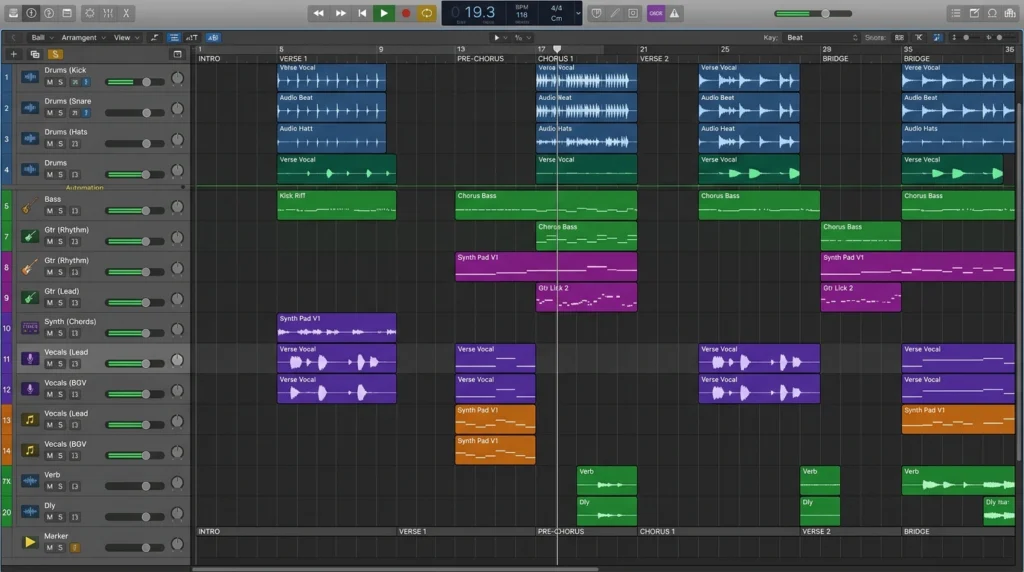
What Is Negative Space in Music Production and Why It Changes Everything
Negative space in music production is the deliberate use of silence, rest, and sparse arrangement to create emphasis, contrast, and emotional impact. It is not the absence of ideas. It is the disciplined choice to let certain moments be empty so that other moments carry maximum weight.
The concept comes from visual art, where negative space refers to the area around and between subjects. In painting and design, negative space defines the subject as much as the subject itself does. In music, the silence around a note defines the note. The empty bar before a drop defines the drop. The stripped arrangement in a verse defines the power of the chorus.
Understanding this principle changes how you approach every production decision. You stop asking what should I add here and start asking what should I remove.
The Psychology of Musical Expectation
Music psychologists have documented extensively that human brains process silence in music as a form of anticipation. The research from the Music Perception journal demonstrates that brief silences in music activate the same neural circuits as the sounds that precede and follow them. The brain fills expected silence with the memory of what came before and the anticipation of what comes next.
This means silence is not neutral. It is emotionally active. A well-placed rest in a melody is not the absence of music. It is a moment of suspended musical energy that the listener experiences physically as tension and expectation.
Why Dense Arrangements Feel Exhausting
When a production has no negative space, the listener’s nervous system has no place to rest. Every element is competing for attention simultaneously. The brain, faced with too many simultaneous inputs, reduces its engagement and shifts into passive rather than active listening. This is the production equivalent of someone who talks without pausing. The more they say, the less you retain.
Productions with deliberate negative space allow the listener to fully register each element before the next one arrives. This increases emotional impact, improves perceived clarity, and generates the quality producers describe as the mix feels wide and breathing.
The Difference Between Accidental and Intentional Space
Most producers have some negative space in their tracks by default. What separates professional use from accidental omission is intention. Intentional negative space is placed at specific moments for specific reasons. It has a relationship to the element that precedes it and the element that follows it. It is shaped with the same care as a played note.
Accidental negative space is just an area that has not been filled yet. It produces uncertainty rather than tension. The listener feels the gap rather than experiences it.
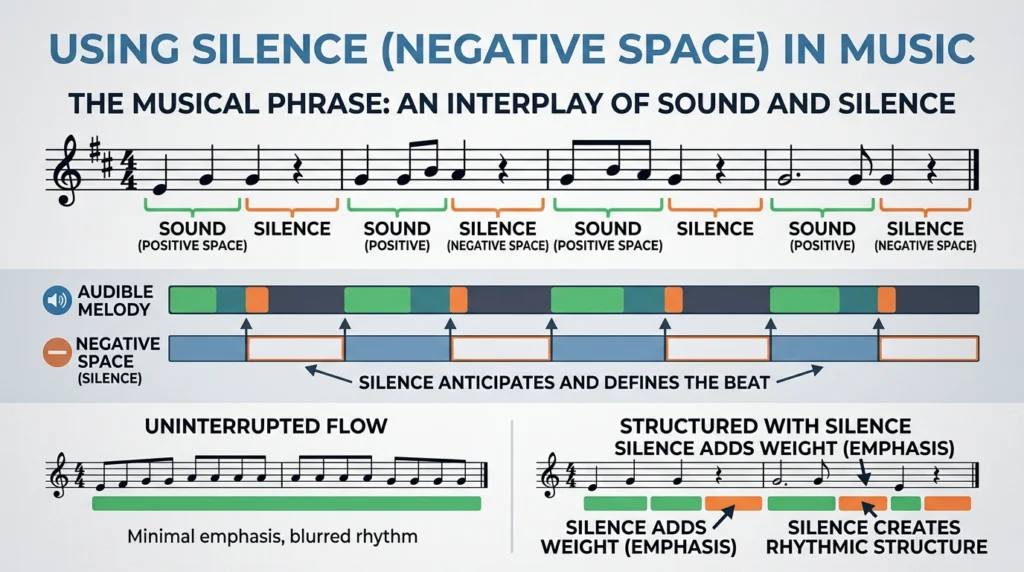
Secret 1: Negative Space in Arrangement Is Your Most Powerful Structural Tool
Arrangement is the highest level at which negative space in music production operates. The decisions you make about which sections are full and which sections are stripped are the decisions that create the emotional arc of the entire track.
Every professional release in every genre uses arrangement-level negative space to create contrast. The verse is sparser than the chorus. The breakdown strips everything before the drop restores it. The bridge introduces a completely different texture that makes the final chorus feel larger than it did the first time. These are all applications of negative space at the arrangement level.
The Contrast Principle in Track Structure
The perceived power of any full section in a track is directly proportional to how empty the section before it was. A chorus that follows a fully arranged verse sounds like a chorus. A chorus that follows a stripped, minimal pre-chorus with half the elements removed sounds like an event.
This contrast principle is the single most reliable technique for creating moments that generate physical response in listeners. The brain registers the shift from sparse to full as a burst of energy. Producers who understand this engineer that shift deliberately rather than hoping it happens organically.
The professional song structure blueprint covers how to map these contrast moments across a full track, ensuring that every section serves a distinct role in the overall emotional architecture.
Building Breakdowns With Intentional Removal
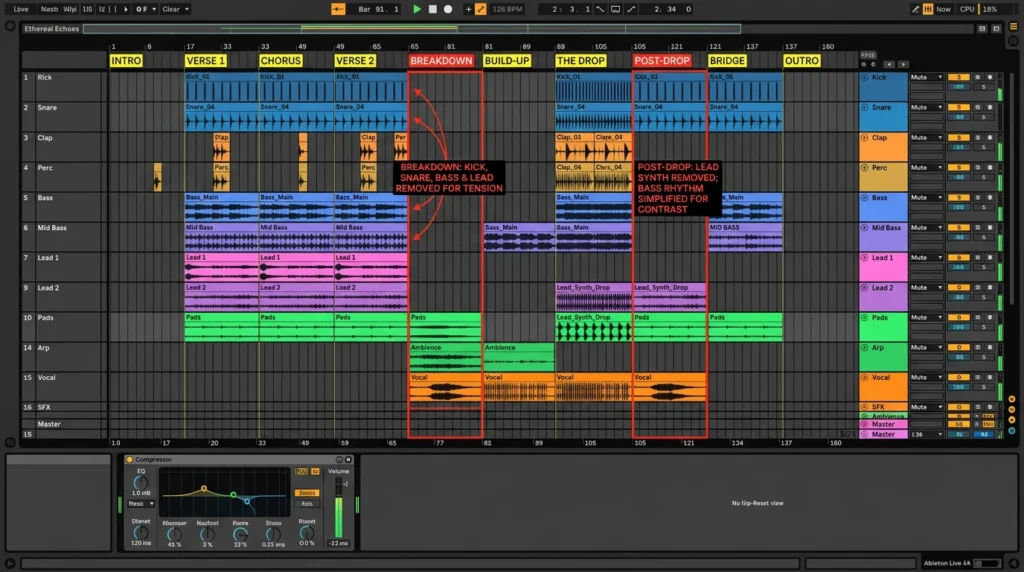
A breakdown is not just a section with fewer elements. It is a section where specific elements have been removed for specific reasons. The most effective breakdowns remove the elements that carry the most physical energy, typically the kick, the 808 or bass, and the mid-range harmonic density, while retaining or emphasizing elements that carry emotional or melodic information.
This creates a breakdown that still communicates the track’s harmonic and melodic content while removing the physical density that defines the full sections. When those physical elements return, they hit with maximum impact because the body has been waiting for them.
Pre-Chorus Stripping as an Impact Multiplier
The pre-chorus is the section most consistently misused by independent producers. Most producers treat it as a transition and fill it to prevent it from feeling empty. Professional producers treat it as a build and deliberately thin the arrangement to increase contrast with the chorus that follows.
A pre-chorus that reduces the track to bass, a single melodic element, and a stripped drum pattern primes the listener for the chorus more effectively than any amount of build-up elements. Negative space is doing the work that most producers try to do with risers, crashes, and snare rolls.
Secret 2: How Negative Space in Music production Creates Impact in the Drop and Release
The drop is the moment in a track where all previously withheld energy arrives simultaneously. No technique increases the impact of a drop more reliably than the negative space that precedes it.
The One-Bar Silence Technique
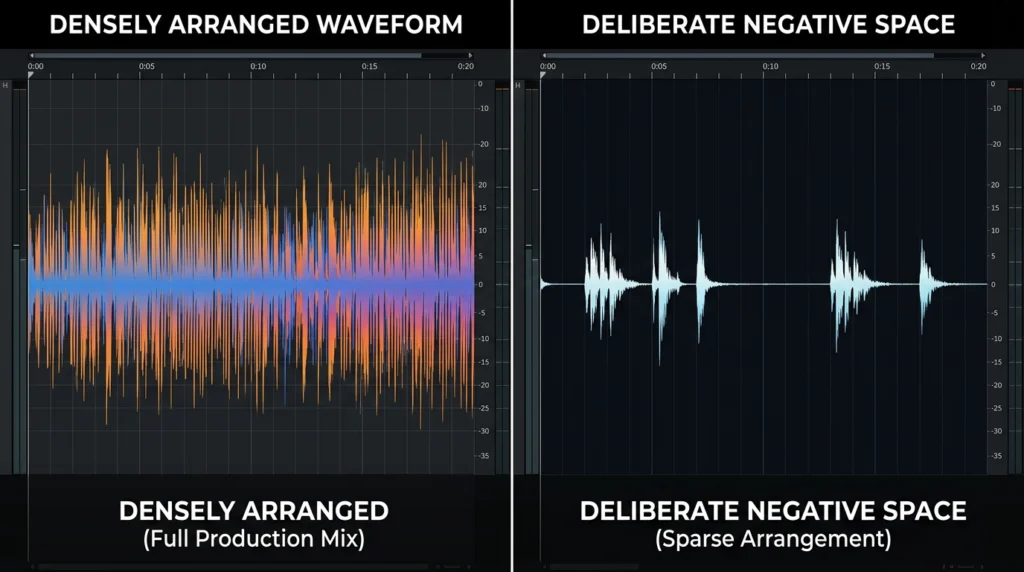
One of the most effective and most underused techniques in modern production is the complete removal of all elements for one bar immediately before the drop. No kick. No bass. No melody. No atmospheric layer. Complete silence for two or four beats.
This silence creates a moment of total suspense. The listener’s nervous system is primed by everything that came before it and is now suspended in anticipation. When the drop arrives, it does not just sound loud. It feels like a physical impact. The perceived volume and energy of the drop increases dramatically simply because of the silence that preceded it.
Frequency Negative Space in Music production Before a Drop
An alternative to complete silence is frequency-specific negative space before a drop. This involves removing low-frequency content while retaining high-frequency content, or the reverse. The most common approach in dance and electronic music is to high-pass filter the entire mix in the final bar before the drop, removing all bass and kick content while allowing the high-frequency elements to continue.
When the drop restores the full frequency spectrum, the perceptual contrast is enormous. The bass and kick feel like they are arriving from nowhere, which is exactly the sensation a great drop is designed to create.
Post-Drop Negative Space in Music production and the Recovery Moment
Negative space after a drop is as important as negative space before it. Many producers ruin the impact of a strong drop by immediately crowding the arrangement with elements that dissipate the energy. A post-drop section that strips back to a single bass line and kick for four bars before rebuilding the arrangement allows the impact of the drop to sustain and gives the listener space to register the emotional event they just experienced.
Secret 3: Negative Space in Rhythm Creates Groove That Tight Patterns Cannot
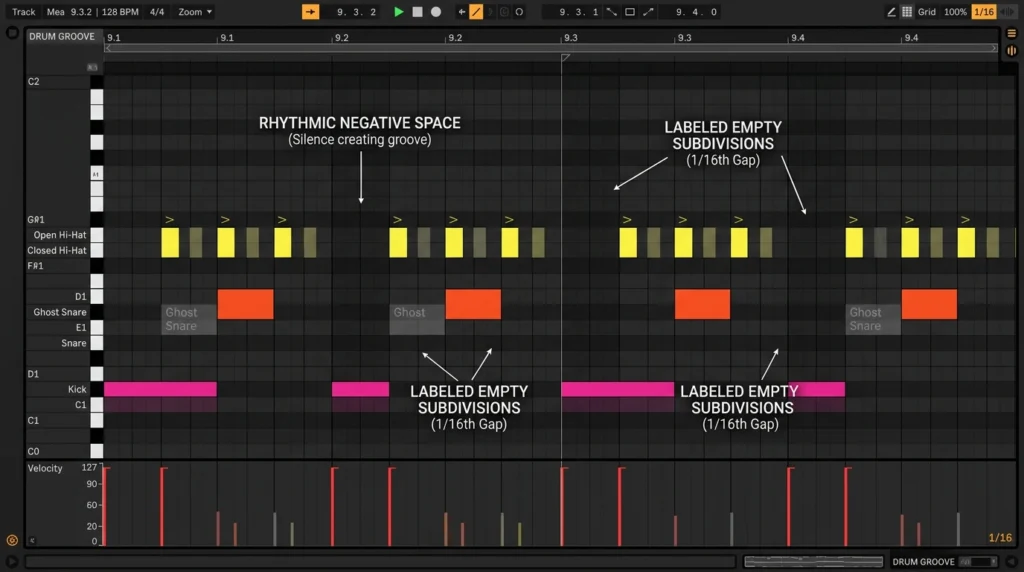
Rhythm is one of the most direct applications of negative space in music production. The rests, silences, and gaps within a rhythmic pattern are as responsible for the groove of that pattern as the notes and hits that fill it.
Why Off-Beat Space Creates More Groove Than On-Beat Density
The most groove-oriented rhythmic patterns in music history share a consistent characteristic: they leave space on the beat. West African drumming traditions, jazz rhythm sections, funk bass lines, and Afrobeat percussion patterns all use on-beat silence to create off-beat emphasis that generates irresistible forward momentum.
When every beat is filled, the rhythm feels mechanical and rigid. When beats are left deliberately empty and the rhythmic emphasis falls on unexpected subdivisions, the pattern creates tension and release that makes the body want to move. This is not accidental. It is the deliberate use of rhythmic negative space.
The Afrobeat drum patterns guide demonstrates exactly how West African rhythmic tradition uses deliberate silence and off-beat emphasis to create the polyrhythmic groove that defines the genre.
Ghost Notes and Implied Space
Ghost notes are low-velocity hits that suggest rhythmic movement rather than asserting it. They are one form of rhythmic negative space because they occupy the space between main hits without claiming equal attention. A pattern with well-placed ghost notes feels busier than it actually is because the ghost notes imply activity without demanding it.
The space around ghost notes, the subdivisions where nothing plays at all, creates the breathing room that makes the main hits land with maximum impact. A snare that plays on beat three after two beats of relative silence hits harder than a snare surrounded by continuous hi-hat density.
Reducing Rhythmic Density in Verses
One of the most consistent differences between amateur and professional productions is what happens in the verse. Amateur productions tend to run the full drum pattern throughout the verse, maintaining constant density from bar one. Professional productions typically reduce rhythmic density in the verse by removing hi-hats, reducing fill frequency, or simplifying the kick and snare relationship.
This reduction creates rhythmic negative space that makes the chorus feel fuller and more energetic even when the same drum pattern plays in both sections. The pattern has not changed. The contrast between the sparse verse and the full chorus has done the work.
Secret 4: Negative Space in Melody Is the Difference Between a Hook and a Statement
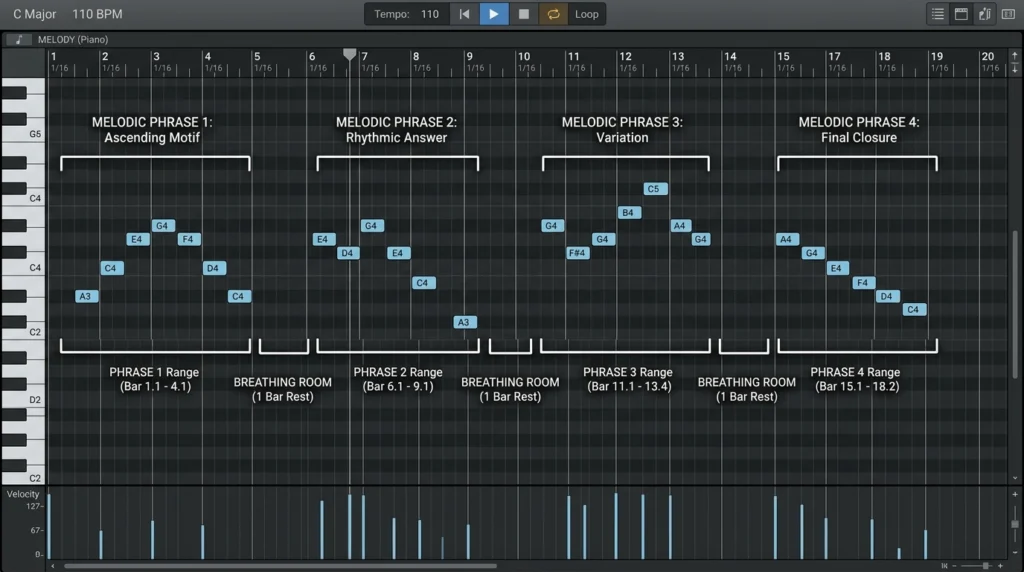
Melodic negative space is the deliberate use of rests and held notes within a melody to give each phrase room to resonate. It is one of the most immediately learnable techniques in this guide and one of the most consistently overlooked.
The Breath Rule for Melodic Phrasing
Experienced songwriters and vocal coaches often teach a concept called the breath rule: if a human singer could not physically deliver a melodic line without pausing for breath, the line is too dense. This rule applies equally to instrumental melodies.
Melodies that follow natural breathing patterns, with phrases followed by rests, feel more human, more memorable, and more emotionally resonant than melodies that run continuously without pause. The rest is not a gap in the melody. It is an exhale that makes the next phrase feel like a fresh breath.
Using Sustained Notes as Melodic Space
A sustained note within a melody functions as a form of negative space. It stops the melodic movement and creates a moment of harmonic stasis that the listener experiences as resolution or suspension, depending on the harmonic context. Many of the most memorable melodic hooks in popular music are built almost entirely from a few short notes followed by a sustained tone.
The sustained note invites the listener to sit with the emotion of the melodic phrase rather than immediately moving on. It is a deliberate pause in the narrative of the melody.
Call and Response as Structural Negative Space in Music production
Call and response is one of the oldest musical structures in human history, and it is fundamentally an application of negative space. The call phrase occupies certain beats. The space that follows is left deliberately open for either the response phrase or, in many traditions, for the audience or another instrument to complete the thought.
In production terms, call and response creates melodic space by design. A lead melody that plays for two bars and then steps back for two bars creates a groove pocket in those empty bars that can be filled by a bass line, a counter-melody, or left open for the listener’s imagination.
Harmonic Negative Space in Music production Gives Your Chords Room to Breathe
Harmonic negative space refers to the gaps between chord changes, the use of sustained single notes instead of full chords, and the deliberate avoidance of harmonic density in sections where rhythm and melody should dominate.
The Power of Suspended Harmony
Suspended chords, which omit the third and replace it with either a second or fourth, create harmonic ambiguity that functions as a form of negative space. The ear cannot fully resolve whether the chord is major or minor, which creates tension and anticipation that a full major or minor chord immediately resolves.
Using suspended harmonies in verse sections and resolving them with full chords in the chorus creates a harmonic arc that parallels and reinforces the arrangement-level contrast between sparse and full. The music theory for producers guide covers suspended harmony and its emotional applications in detail.
Reducing Chord Voicing Density
Full, close-voiced chords in the mid-range occupy a large amount of harmonic space. In sections where negative space is the goal, replacing full chord voicings with sparse open voicings, a root note and a fifth with the third omitted, removes harmonic density without removing the harmonic foundation.
This technique is common in verse sections of R&B, Afrobeat, and trap productions where the bass line and vocal carry the harmonic information and the harmonic layers are deliberately kept sparse to avoid competing.
Silence Between Chord Changes
One of the most immediately impactful applications of harmonic negative space is the insertion of brief silence between chord changes rather than letting chords sustain into each other with smooth voice leading. A gap of even a quarter beat between chords creates a moment of harmonic reset that makes each new chord feel like an arrival rather than a continuation.
This technique is used widely in Afrobeat and Afroswing production where the staccato, punctuated harmonic approach creates rhythmic drive from the chords themselves rather than solely from the percussion.
Dynamic Negative Space in Music production Is the Key to Mixes That Feel Professional
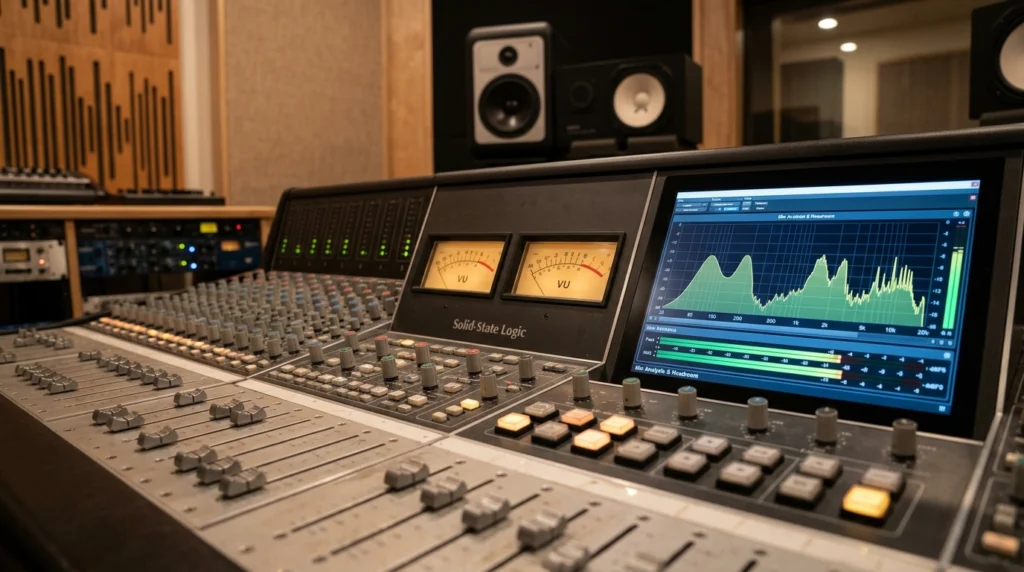
Dynamic negative space refers to the management of loudness, compression, and dynamic range to create contrast between quiet and loud moments. This is the mixing dimension of negative space in music production, and it is where most independent productions fail their own arrangements by compressing away the very contrast they have worked to create.
Over-Compression as the Enemy of Dynamic Space
Over-compression eliminates dynamic negative space by reducing the difference between the quietest and loudest moments in a production. When everything is compressed to a similar level, the arrangement-level contrast you created is preserved in the visual arrangement view but destroyed in the audio output. The stripped verse and the full chorus end up at roughly the same perceived loudness, and the impact of the contrast is lost.
The guide on over-compressing audio and preserving your dynamics addresses exactly this problem, covering how to use compression in a way that supports rather than destroys the dynamic negative space in your arrangement.
Mixing for Headroom and Perceived Loudness
Leaving headroom in a mix is not a technical compromise. It is a creative choice that preserves dynamic negative space. A mix with 3 to 6 dB of headroom has room to contain true dynamic variation. A mix that has been pushed to 0 dB from the beginning has no dynamic ceiling available and every attempt to create contrast through arrangement will be undermined by the mix itself.
Working with lower gain staging throughout a session and reserving the mix bus compression and limiting for the mastering stage preserves the dynamic range that makes negative space audible and impactful.
Automation as a Dynamic Space Tool
Volume automation applied to individual elements can create dynamic negative space within sections that are otherwise fully arranged. Reducing the volume of harmonic layers by 3 to 4 dB in the verse and restoring it in the chorus creates a perceived dynamic shift that the listener registers as increased energy even though no elements have been added or removed.
This technique is subtle but cumulative. Applied across multiple elements simultaneously, it creates a sense that the entire mix is expanding into the chorus, which is exactly the feeling that the most impactful releases consistently produce.
The sidechain compression techniques guide covers how dynamic interaction between elements can be used to create rhythmic negative space through automated volume reduction in addition to static arrangement choices.
Frequency Negative Space in Music production Keeps Your Mix Clean and Powerful
Frequency negative space is the deliberate avoidance of certain frequency zones by certain elements, creating clear separation between sounds and giving each element room to project fully without competing.
The Frequency Map and Its Empty Zones
A professional mix has intentional empty zones in the frequency spectrum. The area below the fundamental frequency of the kick is empty to prevent sub-bass muddiness. The area between the bass and mid-range is often deliberately sparse to maintain kick and bass clarity. The area above the presence range of the lead vocal is kept free of competing elements to preserve vocal intelligibility.
These empty zones are not gaps caused by poor mix decisions. They are deliberate acts of frequency negative space that give each element its own zone of projection. A frequency-mapped mix where every element has its designated zone is the technical foundation of the wide, clear professional sound that most producers are trying to achieve.
High-Pass Filtering as Frequency Space Creation
High-pass filtering is the primary tool for creating frequency negative space. Every element that does not require low-frequency content should be high-pass filtered to remove it. Pads filtered at 200 Hz. Guitars filtered at 100 Hz. Atmospheric layers filtered at 300 Hz or higher. Each filter removes content from the low-frequency zone and leaves that space open for the elements that actually need it.
This is not an aggressive mixing decision. It is the standard practice of every professional mix engineer, applied consistently across every session.
Mono Compatibility and Frequency Negative Space
Checking a mix in mono reveals frequency negative space problems that stereo monitoring conceals. Elements that appear to occupy different frequency zones in stereo often overlap and compete when collapsed to mono. A stereo pad and a melodic lead that sound separated in stereo may fight for the same frequency zone in mono, causing one or both to lose definition.
The mono mixing secrets guide covers how to use mono referencing to identify and correct frequency conflicts that undermine the negative space in your mix, ensuring that the clarity you hear in stereo survives translation to every playback system.
Applying Negative Space in Music Production Across Every Genre
The principles of negative space in music production apply universally. The specific application changes by genre. Understanding how each genre uses space gives you the vocabulary to apply these techniques authentically in your own productions.
Negative Space in Music production: Afrobeat Production
Afrobeat arrangements are built on rhythmic negative space. The polyrhythmic percussion tradition explicitly uses off-beat silence to create the cross-rhythm feel that defines the genre. Melodic elements play in short, punctuated bursts separated by open space. The bass sits back in the groove rather than filling every beat.
Contemporary Afrobeats productions maintain this spatial tradition while adding modern elements. The guide to arranging an Afrobeat track professionally covers how negative space is built into the arrangement structure of the genre from the ground up.
Negative Space in Music production: Trap Production
Trap is a genre defined by the relationship between density and space. The 808 decay creates space by implication, its long tail preventing other elements from entering without creating rhythmic conflict. Hi-hat rolls create rhythmic density that makes the empty spaces between kick hits feel more cavernous by contrast.
The most effective trap productions use negative space in the melodic layer, often reducing the lead melody to a few sparse notes separated by significant rests, while maintaining rhythmic density in the percussion. This contrast between melodic space and rhythmic density is the core tension that defines the genre’s sound.
Negative Space in Music production: Amapiano Production
Amapiano’s distinctive feel comes partly from how the log drum bass creates a continuous mid-bass texture that defines the space rather than filling it. The melody and piano elements play in the space above the log drum rather than competing with it. Vocal chops appear and disappear in deliberate contrast to the continuous rhythmic foundation.
The arrangement philosophy in amapiano is fundamentally about defining the space first and then populating it selectively. The consistent groove foundation creates a container of space that the melodic and harmonic elements inhabit rather than fill.
Start Using Negative Space in Music Production in Your Next Session
Negative space in music production is not about playing less. It is about playing intentionally. Every note you add should earn its place by either filling a role that serves the track or stepping back to let other elements take the space they need.
The seven secrets in this guide work at every level of production: arrangement, drop and release, rhythm, melody, harmony, dynamics, and frequency. Each one addresses a different dimension of the same core principle. What you do not play defines what you do play.
Start your next session by subtracting before you add. Strip your current project to its essential elements before adding anything. Ask what can be removed rather than what can be added. Apply automation to create dynamic variation before reaching for a new sound. Use a frequency map before adding a new layer. Practice deliberate restraint and watch your productions come alive.
Negative space in music production is the discipline that turns good tracks into great ones. Master it and you gain access to a level of impact that no plugin, sample pack, or technique can replicate on its own.
The most powerful moment in any track is the one just before everything comes back. Build that moment deliberately and you build music that people feel.
Frequently Asked Questions About Negative Space in Music Production
What is negative space in music production?
Negative space in music production is the deliberate use of silence, rest, sparse arrangement, and frequency gaps to create emphasis, contrast, and emotional impact. It is the discipline of choosing what not to play so that what you do play carries maximum weight. It operates at every level of production including arrangement, rhythm, melody, harmony, dynamics, and frequency management.
Why do professional tracks sound more spacious than independent releases?
Professional productions are typically more spacious because experienced producers and mix engineers deliberately create and preserve negative space at every level. They use high-pass filtering to clear frequency zones, automation to manage dynamic contrast, arrangement contrast to amplify the impact of full sections, and rhythmic space to make grooves feel human. Independent producers tend to fill every available space out of insecurity about empty moments, which results in dense, fatiguing mixes.
How do I know how much Negative Space in Music production to use in a track?
The right amount of negative space depends on the genre, the emotional intent of the track, and the energy level you want to sustain. A general principle is that every section should have a clearly defined role in a spectrum from sparse to full, and no two consecutive sections should have the same density. If your verse and chorus sound equally full, you have not used enough negative space in the verse. If your track sounds completely empty for too long, you have removed the tension that makes space effective.
Does negative space in music production mean my track will sound empty or unfinished?
No, provided the space is intentional. Accidental space sounds unfinished because it has no relationship to the surrounding elements. Intentional space sounds professional because it creates tension, contrast, and anticipation that listeners experience as a deliberate choice rather than an omission. The difference is always audible. If you are uncertain whether a space feels intentional, add a single sustained note or subtle atmospheric element that bridges the gap without filling it.
How does Negative Space in Music production relate to mixing and mastering?
Negative space at the mixing level involves frequency separation, dynamic range management, and avoiding over-compression. Negative space at the mastering level involves preserving the dynamic range created in the mix rather than compressing it away in pursuit of loudness. A master that destroys dynamic negative space undermines every arrangement and mixing decision that relied on contrast to create impact. The mixing and mastering guide covers how to preserve the spatial decisions from arrangement through to the final master.
Can I apply Negative Space in Music production techniques to genres that are traditionally dense?
Yes. Even in genres with high arrangement density, such as big room electronic music or gospel production, negative space operates at different levels. Rhythmic space exists within dense percussion patterns. Frequency space is preserved through careful filtering even when many elements are playing simultaneously. Dynamic space is created through automation even when the arrangement remains full. The principle scales to every genre. The application changes but the discipline remains essential.
What is the fastest way to start using Negative Space in Music production today?
The fastest entry point is arrangement subtraction. Take your current project and mute half the elements in the verse. Listen to what remains. Identify the two or three elements that carry the most essential information and keep only those in the verse. Restore all elements in the chorus. Listen to the contrast. This one exercise, done in under ten minutes, will demonstrate the impact of arrangement-level negative space more effectively than any theoretical explanation. From there, apply the same principle to rhythm, melody, and frequency using the techniques in this guide.