
An amapiano radio edit is the version of your track that actually gets heard outside the club. Amapiano was built for DJs, with long intros, slow builds and six-minute grooves. That is perfect for a three-hour set, but deadly on a streaming playlist where listeners decide in seconds.
The problem is simple. Most producers either release the long version and lose listeners before the hook, or chop it down randomly and lose the vibe that made the track special.
This guide fixes both. You will get the tempo math behind a 2:45 track, a bar-by-bar blueprint, seven steps to cut your edit cleanly, and the mixing and release details that help the edit perform on streaming platforms.
What Is an Amapiano Radio Edit?
A radio edit is a shortened version of a song made for radio and mainstream listening. An amapiano radio edit takes a long, DJ-focused track and tightens it into a short song that hooks fast while keeping the groove intact.
New to the genre itself? Start with our beginner’s guide to amapiano beats, then come back to learn the edit.
Extended Mix vs Radio Edit
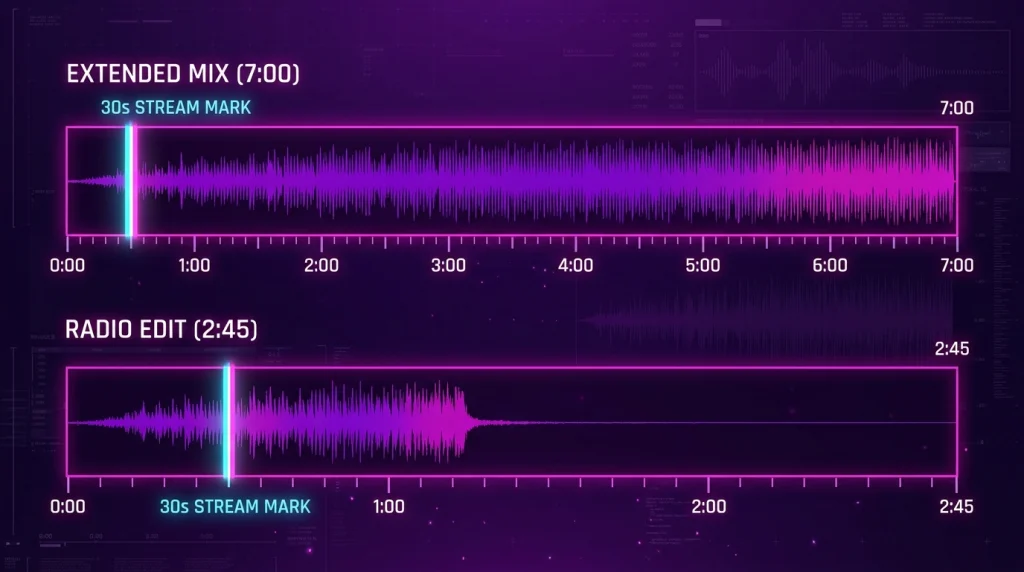
Amapiano tracks are often made in long form so DJs can blend them. The extended mix has long intros and outros, multiple breakdowns and slow builds. The radio edit keeps the best hook, the strongest verse material and one big log drum moment, and removes almost everything else.
You need both. The extended mix serves DJs. The radio edit serves playlists, radio and casual listeners.
Why 2:45 Is the Sweet Spot
At 2:45, a song is long enough to feel complete, with two verses and three hooks, but short enough to replay instantly. Short songs also make it easier for listeners to finish the track, and fewer skips are a good sign for any release.
There is no magic rule that 2:45 beats 3:00. It is a strong target because it forces you to keep only your best ideas.
When to Make the Edit
Plan the edit while you produce, not after the release is booked. Writing a strong eight-bar hook and a clear log drum switch from the start makes the amapiano radio edit easy to cut later. If you finish the extended mix first, set aside a separate session for the edit so you hear the song with fresh ears and can cut without attachment.
The 30-Second Rule
Spotify counts a stream when a listener plays your song for at least 30 seconds. If your amapiano radio edit spends those 30 seconds on a filtered intro, many listeners will skip before the stream even counts.
Key rule: Your hook, or at least your main vocal, should arrive well before the 30-second mark.
The Math Behind a 2:45 Amapiano Track
Building an amapiano radio edit gets much easier when you know exactly how many bars you have to work with.
How Long Is One Bar?
In 4/4 time, one bar is four beats. The formula is:
Bar length in seconds = 240 / BPM
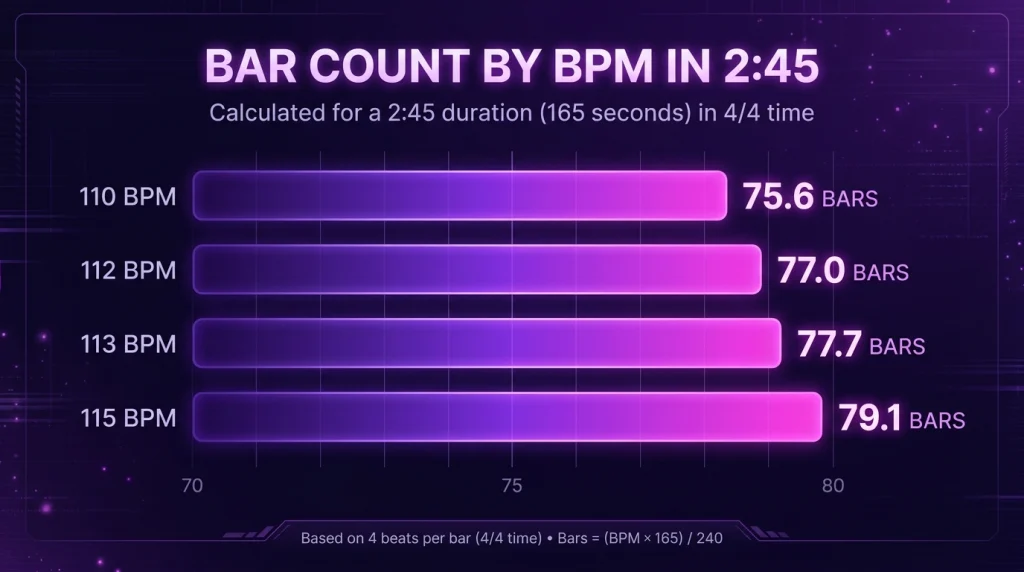
At 112 BPM, one bar lasts 240 / 112 = about 2.14 seconds. That means 2:45 (165 seconds) holds roughly 77 bars.
Bars per Tempo Table
| Tempo | Seconds per Bar | Bars in 2:45 |
|---|---|---|
| 110 BPM | 2.18 | About 75.6 |
| 112 BPM | 2.14 | About 77.0 |
| 113 BPM | 2.12 | About 77.7 |
| 115 BPM | 2.09 | About 79.1 |
Why 76 Bars Works
At 112 BPM, 76 bars last about 2:43. Add a two-second reverb or delay tail at the end and you land right on 2:45. Seventy-six also divides cleanly into 4- and 8-bar sections, which keeps your edit musical.
The 2:45 Amapiano Radio Edit Blueprint
Here is a proven structure at 112 BPM. Adapt the section lengths to your song, but keep the total near 76 bars.
The Bar-by-Bar Map
| Section | Bars | Starts At | What Happens |
|---|---|---|---|
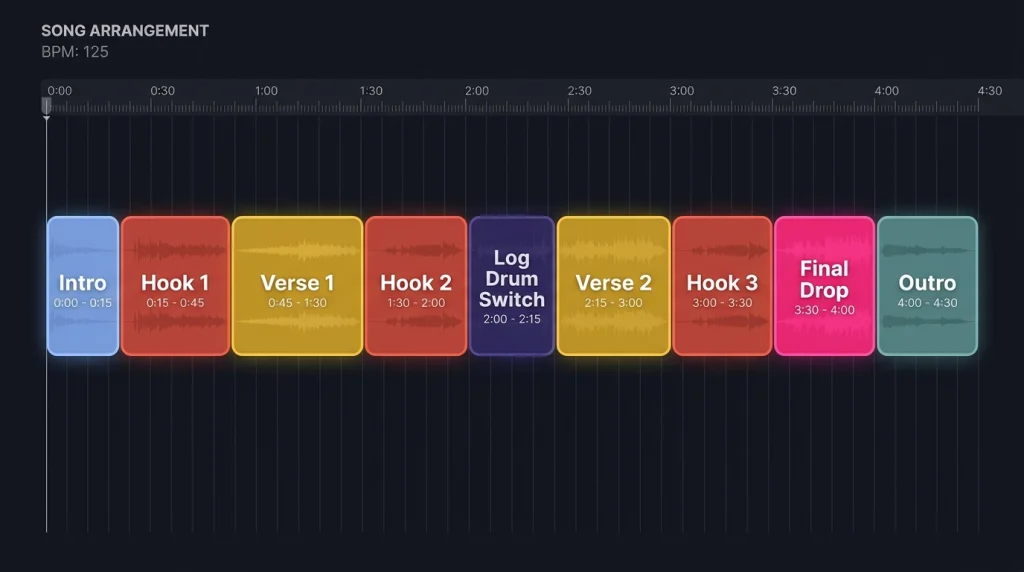
| Intro | 4 | 0:00 | Keys, shakers and a vocal teaser |
| Hook 1 | 8 | 0:08 | Full hook, log drum enters |
| Verse 1 | 16 | 0:25 | Lead vocal, stripped log drum |
| Hook 2 | 8 | 1:00 | Full hook, extra percussion |
| Log drum switch | 8 | 1:17 | Breakdown, then the big log drum pattern |
| Verse 2 | 12 | 1:34 | Second verse or call-and-response section |
| Hook 3 | 8 | 2:00 | Full hook with ad-libs |
| Final drop | 8 | 2:17 | Hook chants over the heaviest groove |
| Outro | 4 | 2:34 | Strip back, end on a clean hit |
| Tail | – | 2:43 | Reverb or delay tail to 2:45 |
Section-by-Section Breakdown
- Intro (4 bars): Just enough to set the key and groove. A short vocal teaser here grabs attention immediately.
- Hook 1 at 0:08: The hook arrives within ten seconds, long before the 30-second mark.
- Verse 1 (16 bars): The longest section. Thin out the log drum so the vocal sits forward.
- Log drum switch at 1:17: The signature amapiano moment, compressed from a long DJ breakdown into eight bars.
- Verse 2 (12 bars): Shorter than verse 1 to keep momentum.
- Final drop and outro: End on energy, not on a long fade.
Alternative Blueprint: Hook-First Open
If your hook is your strongest asset, skip the intro entirely. Open with Hook 1 at 0:00, then run Verse 1, Hook 2, the log drum switch, Verse 2, Hook 3 and a four-bar outro. Add four bars to the final drop or verse 2 to keep the total near 76. This hook-first amapiano radio edit grabs listeners in the first second and works especially well for playlist and social media discovery.
For the general principles behind this layout, see our professional song structure blueprint.
7 Steps to Cut an Amapiano Radio Edit
Follow these steps to turn your extended mix into a tight amapiano radio edit without losing the vibe.
Step 1: Start From the Project, Not the Bounce
Edit inside your original project or from stems whenever possible. You get clean edit points, control over reverb tails and the ability to rebalance parts. Editing a stereo bounce works in a pinch, but it limits your options.
Step 2: Mark Your Best Moments
Listen to the extended mix and mark the strongest hook, the best verse lines and the most powerful log drum moment. Everything else is optional. Be ruthless: if a section does not earn its place, cut it.
Step 3: Cut the Intro to 4 Bars
DJ intros often run 16 or 32 bars. Shrink yours to four bars, or even start straight on the vocal. This is the single biggest change in any amapiano radio edit.
Step 4: Move the Hook Forward
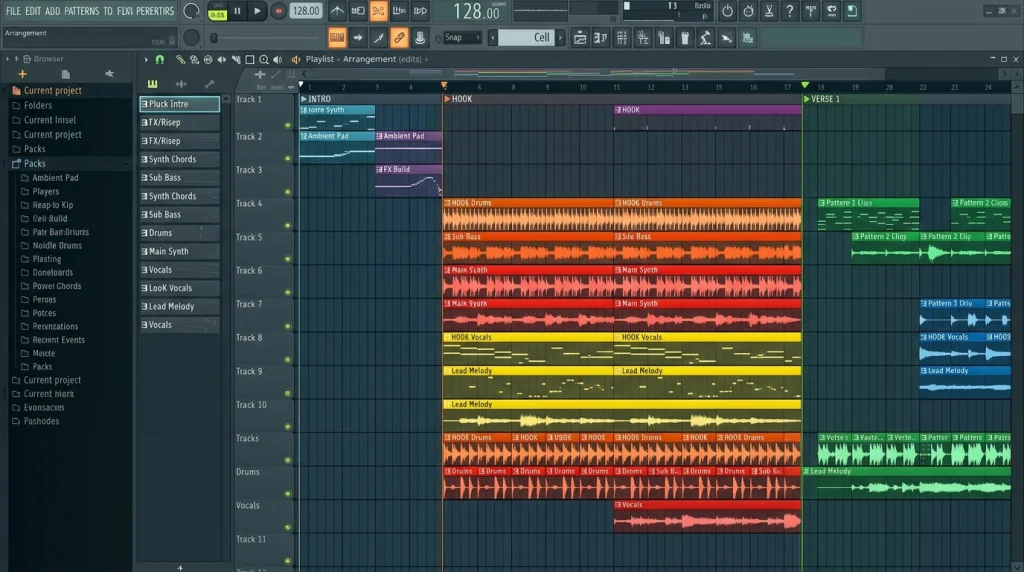
Place the first full hook right after the intro, at around 0:08. If your original song starts with a verse, consider opening the edit with the hook instead.
Step 5: Compress the Breakdowns
Extended mixes often have two or three long breakdowns. Keep one, shorten it to eight bars and make it lead straight into the log drum switch.
Step 6: Edit on Bar Lines With Short Crossfades
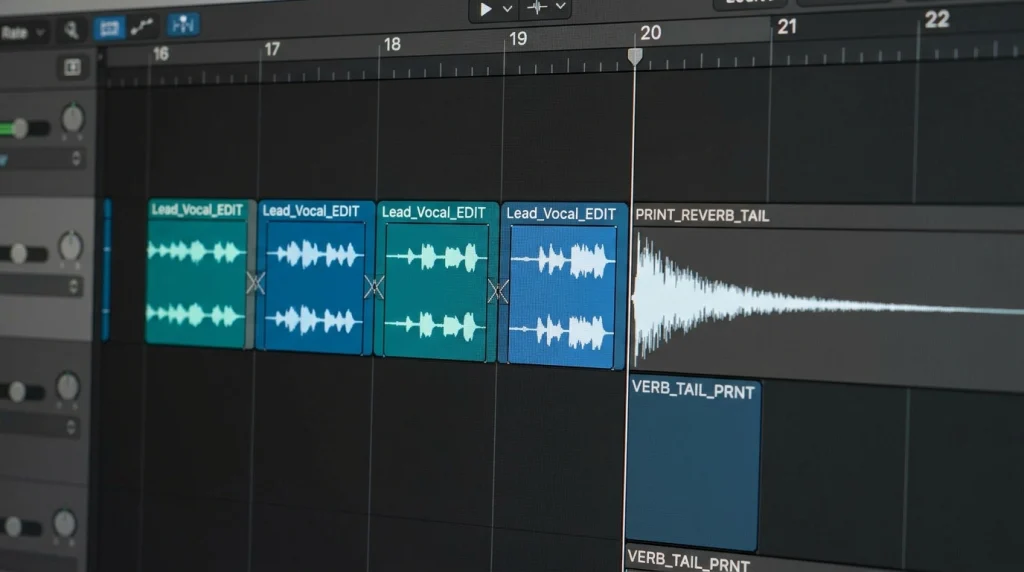
Always cut on bar lines, ideally at the start of a phrase. Use very short crossfades to avoid clicks, and check that reverb and delay tails do not cut off abruptly at edit points. Print effect tails where needed.
Step 7: Time It and Listen Fresh
Bounce the edit and check the length: aim for 2:40 to 2:50. Then take a break and listen from start to finish as a casual listener would. If any moment feels slow, trim another four bars.
Keeping the Amapiano Feel in a Short Song
The biggest risk of any short edit is losing the groove that makes amapiano special. Protect these three elements.
Protect One Log Drum Moment
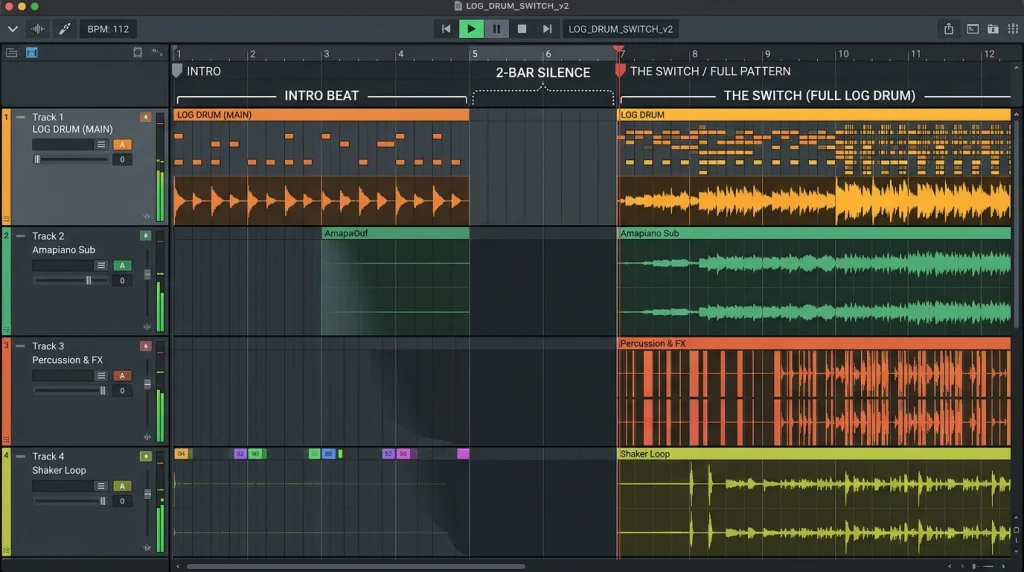
The log drum switch is the moment fans wait for. Even in a 2:45 amapiano radio edit, keep one clear build, a short silence or filter dip, and a full log drum return. Make sure it hits hard with our tips on mixing amapiano log drums.
Keep the Shakers Rolling
Shakers and percussion carry amapiano’s hypnotic feel. Keep them running through edit points so cuts feel seamless and the groove never stops.
Let the Chants Do the Work
Short chant hooks and call-and-response phrases are perfect for a short format. They are easy to repeat in the final drop, and they work well as short clips on social media.
Mixing and Mastering for Streaming
The amapiano radio edit is shorter, but the mix still needs to compete on every platform.
Loudness Targets
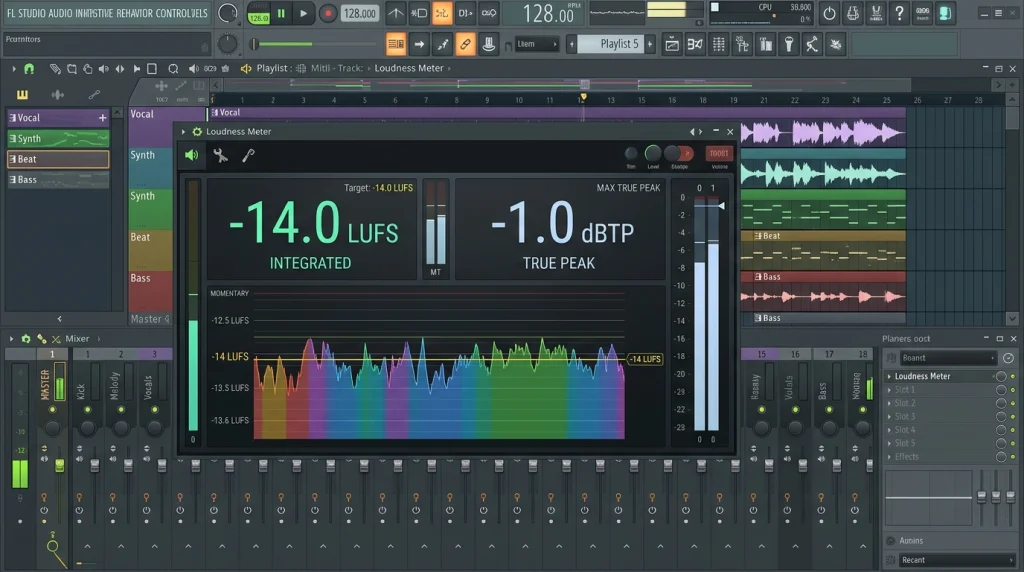
Spotify’s loudness normalization guidelines normalize playback to -14 LUFS integrated and recommend a true peak of no more than -1 dB. If your master is louder than -14 LUFS, Spotify recommends keeping true peak at -2 dB or lower. Mastering much louder will not make your track louder on Spotify with normalization on, but it can cost you dynamics.
Learn the trade-offs in our guide to competitive mastering loudness.
Phone Speaker Check
Many listeners hear your amapiano radio edit on a phone first. Check that the log drum still reads on small speakers by adding gentle saturation to bring out its upper harmonics, and confirm the vocal and hook stay clear in mono.
Clean Edits and Tails
Listen closely around every edit point on headphones. Clicks, cut-off reverbs and sudden level jumps are the telltale signs of a rushed edit.
Compare Against a Reference
Load a recent amapiano single you admire into your session and match its level with your master. Compare how quickly it reaches the hook, how wide the shakers sound and how much low end the log drum carries. A reference keeps your ears honest after hours of editing, and it shows you whether your short version holds its energy from the first bar to the last.
Versions, Metadata and Release Strategy
A great amapiano radio edit needs the right release plan to perform.
The Version Pack
Prepare a full set of versions:
- Radio edit (2:45): for playlists, radio and pitching.
- Extended mix (5 to 7 minutes): for DJs.
- Clean version: if the lyrics need it for radio.
- Instrumental: for DJs, sync and social content.
Naming and ISRCs
Label versions clearly, such as “Song Title (Radio Edit)” and “Song Title (Extended Mix)”, following your distributor’s style guide. Each version is a different recording, so it needs its own ISRC code. Your distributor usually assigns these on upload.
Short Clips for Social Media
Your edit also feeds your social content. Export 15 to 30 second clips of the hook and the log drum switch for short-form video. Because the amapiano radio edit already puts the best moments up front, finding clip-ready sections takes minutes instead of hours.
Which Version to Pitch
Pitch the amapiano radio edit to editorial playlists and radio, and send the extended mix to DJs. Each version usually collects its own streams, so focus your promotion on one main version to concentrate your numbers. For more on how plays are counted, see RouteNote’s explanation of stream counting.
5 Radio Edit Mistakes to Avoid
Avoid these and your amapiano radio edit will sound intentional, not chopped.
- A long intro. If the hook arrives after 0:30, many listeners leave first.
- Cutting the log drum moment. Without it, the edit loses its amapiano identity.
- Edits off the bar line. Off-grid cuts feel wrong even to casual listeners.
- Fading out. A clean ending hit sounds more confident and replays better.
- Reusing the ISRC. Each version needs its own code for accurate reporting.
Conclusion: Make Your Amapiano Radio Edit Work for You
An amapiano radio edit is not a compromise. It is a second version built for a different audience, and it can introduce your music to listeners who will never hear a DJ set.
Here are the key takeaways for a hit amapiano radio edit:
- Aim for about 76 bars at 112 BPM, which lands near 2:45 with a short tail.
- Get the hook in by 0:08, well before Spotify’s 30-second stream mark.
- Keep one log drum switch, rolling shakers and repeatable chants.
- Edit on bar lines with short crossfades and printed tails.
- Master around Spotify’s targets and give every version its own ISRC.
Ready to build your next release? Load our must-have amapiano drum kits, make the extended mix, then cut a 2:45 edit using the blueprint above.
Frequently Asked Questions
How long should an amapiano radio edit be?
Most work well between about 2:30 and 3:15. A 2:45 target gives you two verses, three hooks and one log drum moment without any filler.
How many bars is a 2:45 song at 112 BPM?
About 77 bars. One bar at 112 BPM lasts about 2.14 seconds, so 76 bars plus a short reverb tail lands on 2:45.
When should the hook come in?
As early as possible. Aim for the first hook around 0:08, and definitely before the 30-second mark, when Spotify counts a stream.
Do I need a separate ISRC for the radio edit?
Yes. Each version, including the radio edit, extended mix, clean version and instrumental, is a separate recording with its own ISRC.
Should I release the amapiano radio edit or the extended mix first?
Lead with the radio edit for streaming and playlists, and make the extended mix available for DJs at the same time or shortly after.
What loudness should I master to for streaming?
Spotify normalizes to -14 LUFS and recommends a true peak of no more than -1 dB, or -2 dB if your master is louder than -14 LUFS.
Will a short edit lose the amapiano vibe?
Not if you keep one log drum switch, steady shakers and the chant hooks. Those elements carry the genre’s feel even in under three minutes.