
Afro house is the fastest-growing dance sound on the planet right now, and it is surprisingly easy to start making. Rolling percussion, deep grooves, soulful chords and hypnotic chants have taken it from South African clubs to the biggest festival stages in the world.
But here is the problem. Most producers who try it end up with a flat four-on-the-floor loop that sounds like generic tech house with a bongo on top. The magic of the genre lives in the details: the swing, the layered hand drums, the rolling bass and the long, patient arrangement.
This guide shows you exactly how to make Afro house from a blank session to a finished, DJ-ready track. You will learn the right tempo, drum patterns, percussion layering, bass, chords, vocals, arrangement and mix. Every step works in FL Studio, Ableton Live, Logic Pro or any other DAW.

Why Afro House Is the Sound of 2026
Before you open your DAW, it helps to understand why this sound is exploding. The numbers are hard to ignore.
The Numbers Behind the Boom
According to the Splice and MIDiA Sounds of 2026 report (MIDiA Research), Afro house samples grew by 778 percent on Splice in one year, from about 760,000 downloads to almost 6.7 million. The genre also drove nearly 70 percent of all house music growth on the platform.
- House rose from the fifth to the second most downloaded genre on Splice
- Afro house pulled in around 1.3 million searches on Splice
- It has climbed from the 23rd to the 4th most searched genre on Beatport in two years
Where the Sound Comes From
The genre grew out of South African house culture, mixed with rhythms and chants from across the continent. Pioneers like Black Coffee, Culoe De Song, Da Capo and Shimza built the sound over decades. Today, artists like Keinemusik, &ME, Rampa and Adam Port have pushed it into global clubs and festivals.
Why Producers Should Care
A genre with fast-growing demand and a limited number of skilled producers is a real opportunity. There is demand for tracks, remixes, sample packs and DJ edits. If you already make Afrobeat or Amapiano, you have a head start because you already understand percussion and groove.
Key takeaway: Afro house is not a passing trend. It has decades of culture behind it and fast-rising demand in front of it.
Afro House vs Afrobeat vs Amapiano: Know the Difference
Many producers mix these three genres up. They share roots and energy, but they are built very differently.
The Quick Comparison Table
| Element | Afro House | Afrobeat | Amapiano |
|---|---|---|---|
| Tempo | 118 to 124 BPM | 95 to 110 BPM | 110 to 115 BPM |
| Kick | Four-on-the-floor | Syncopated | Sparse, often off-grid |
| Bass | Rolling sub or bassline | Melodic bass | Log drum |
| Length | 6 to 8 minutes | 2.5 to 4 minutes | 5 to 7 minutes |
| Built for | Clubs and DJs | Radio and streaming | Clubs and streaming |
Why the Kick Changes Everything
The steady kick on every beat is what makes the genre “house”. Afrobeat and Amapiano leave space and move the kick around. In Afro house, the kick is the anchor, and the percussion dances around it.
Moving From Amapiano to Afro House
If you already make Amapiano, you know how to build long, hypnotic grooves. Our beginner’s guide to making Amapiano beats covers those foundations. The main changes are a faster tempo, a straight kick and a rolling bass in place of the log drum.
Step 1: Set the Right Tempo, Key and Session
A good session setup saves you hours later. Get these basics right first.
Choose Your Tempo
Most Afro house sits between 118 and 124 BPM. A tempo of 120 to 122 BPM is a safe starting point. Slower tempos feel deeper and more hypnotic, while faster ones feel more driving and festival-ready.
Pick a Minor Key
The genre leans heavily on minor keys for its emotional, slightly mysterious mood. A minor, F minor, G minor and D minor are all popular choices. Keep the whole track in one key so DJs can mix it easily.
Build a Template
Create buses for kick, percussion, bass, music, vocals and FX before you write anything. Color them clearly. With 15 or more percussion layers, you will be glad you did.
Step 2: Program the Core Afro House Drum Pattern
The drums are the heart of the track. Start simple and add groove on top.
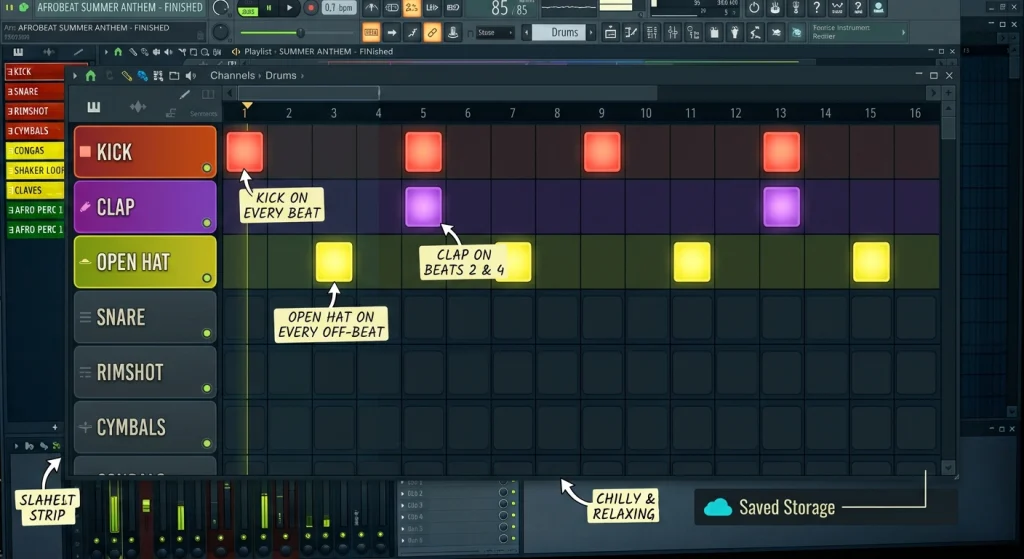
The Basic Pattern
- Kick: Place a kick on every beat (steps 1, 5, 9 and 13 in a 16-step grid).
- Clap or rim: Place it on beats 2 and 4 (steps 5 and 13). Many tracks use a soft rimshot or a clap with a short tail.
- Open hat: Put it on every off-beat (steps 3, 7, 11 and 15).
- Closed hat or shaker: Fill in the 16th notes at a lower volume.
Choosing the Right Kick
Kicks in this style are usually round and warm, not clicky. Look for a kick with a solid low end around 50 to 60 Hz and a soft attack. A short, punchy kick leaves more room for the bass to roll.
Add Swing
Straight, robotic drums kill the vibe. Add a small amount of swing to your hats and shakers, or nudge some hits slightly late by hand. The goal is a relaxed, human feel.
For a deeper look at swing and syncopation, our guide to Afrobeat drum patterns explained shows many of the same ideas in action.
Step 3: Layer the Percussion That Makes It Afro
This is where Afro house gets its identity. The percussion layers create the hypnotic, rolling motion that makes people move.
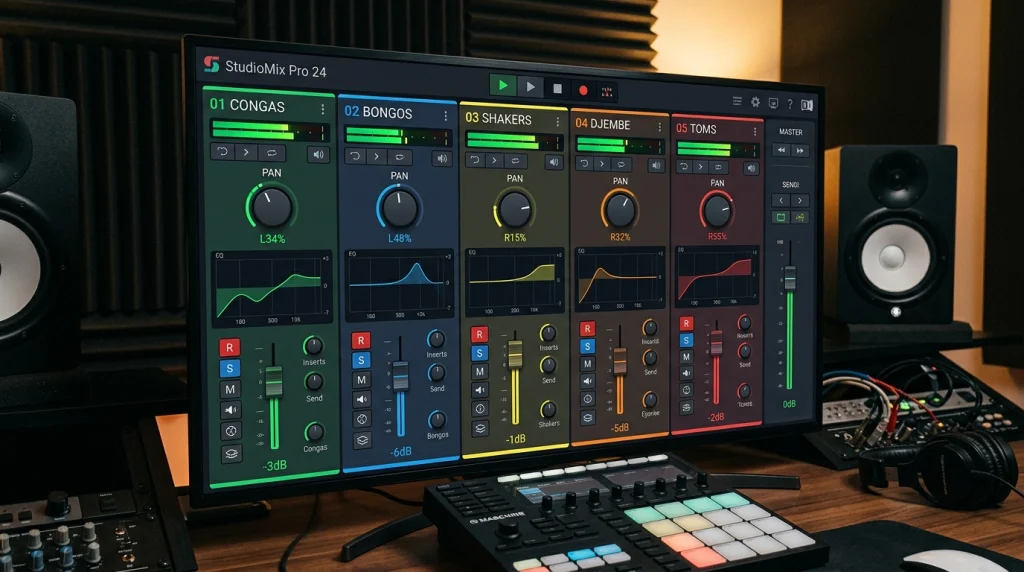
The Essential Percussion Layers
- Congas and bongos: Syncopated patterns that answer the kick
- Shakers: 16th-note movement with swing
- Djembe or hand drums: Deep, earthy accents
- Tribal toms: Fills and rolling patterns every 4 or 8 bars
- Bells and wood blocks: Small accents that add sparkle
Use the 3-3-2 Rhythm
A lot of African and Latin percussion uses a 3-3-2 pattern. In a 16-step bar, place hits on steps 1, 4 and 7, then repeat on 9, 12 and 15. Try it on a conga or a tom and you will hear the groove come alive right away.
Pan and Space Your Layers
Pan each layer to its own spot: congas slightly left, bongos slightly right, shakers wide. Cut low frequencies from every percussion channel with a high-pass filter. This keeps the low end clean for the kick and bass.
Humanize the Velocity
Real drummers never hit every note at the same strength. Vary the velocity of your conga, bongo and shaker hits so some notes are soft and others are accented. A simple rule: accent the first hit of each group and keep the in-between notes 20 to 40 percent quieter. This one change can make programmed percussion sound like a live player.
Where to Find Great Percussion Sounds
Quality samples make a huge difference. Our Afrobeat drum kits guide lists packs full of congas, shakers and hand drums that work perfectly for this style.
Step 4: Write a Rolling Afro House Bassline
The bass here does not just hold the low end. It rolls, pulses and pushes the groove forward.
Pick Your Bass Sound
Start with a warm sine or triangle sub, or a soft analog-style bass with a low-pass filter. Avoid bright, buzzy basses, which fight with the percussion.
Write the Pattern
- Place notes on the off-beats, between the kicks, so the bass and kick never clash
- Use short notes with small gaps for a bouncy feel
- Stick to the root note and one or two others, such as the fifth or the octave
- Add a small pitch slide now and then for movement
Sidechain the Bass to the Kick
Even with off-beat notes, a light sidechain helps the kick punch through. Set a fast attack and a release that matches the tempo. Our sidechain compression guide explains how to get a clean pump without killing the bass.
Keep the Low End in Mono
Everything below about 120 Hz should be mono. Clubs play in mono more often than you think, and a wide bass can disappear on a big system.
Step 5: Build Soulful Chords and Melodies
Chords and melodies bring the emotion. In Afro house, less is often more.
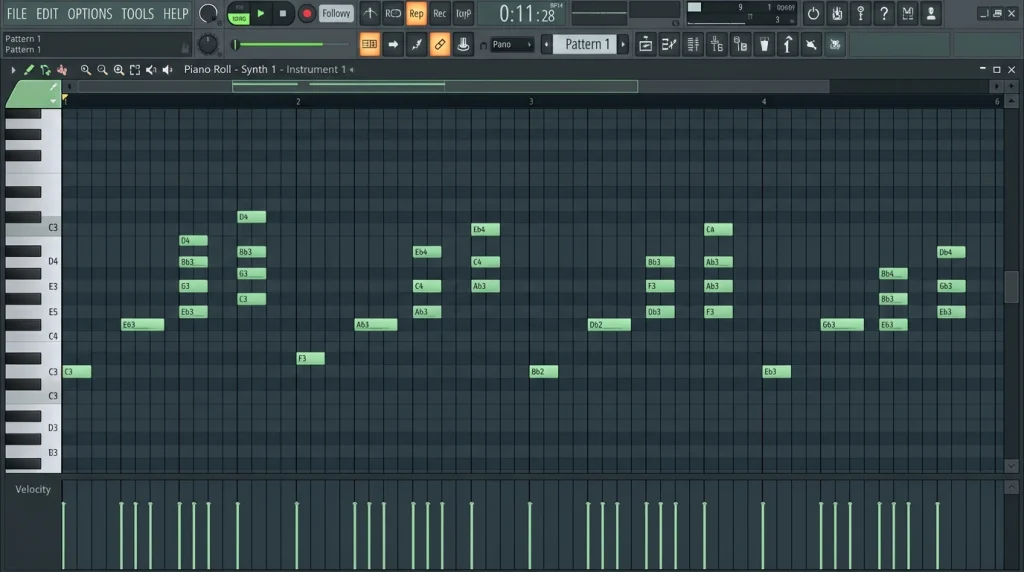
Use Rich Minor Chords
Minor 7th and minor 9th chords give the genre its deep, soulful color. A simple progression like i – VI – III – VII (for example Am7, Fmaj7, Cmaj7, G) works in many tracks. Keep chords short and rhythmic rather than long and static.
Popular Instrument Choices
- Rhodes and electric pianos for warmth
- Marimba and kalimba for an organic, African texture
- Soft plucks for rhythmic motifs
- Wide, evolving pads for atmosphere
- Flute and wooden instruments for a natural, earthy lead
Write a Hypnotic Motif
Instead of a busy melody, create a short 2 or 4 bar motif and repeat it. Change it slowly over time with filter sweeps, volume automation or small note changes. This repetition is what puts dancers in a trance.
Step 6: Add Vocals and Chants the Right Way
Vocals give the track its human, spiritual feel. They are often short chants, call-and-response phrases or one repeated hook.
Types of Vocals That Work
- Short chants and call-and-response phrases
- Spoken word or whispered lines
- A soulful sung hook repeated through the track
- Vocal chops used as a rhythmic instrument
Respect the Culture
Many classic Afro house vocals use African languages such as Zulu, Xhosa, Yoruba or Swahili. If you use them, work with vocalists who speak the language or use properly licensed sample packs. Never take vocals from other songs without permission.
Processing Tips
Add a plate or hall reverb on a send and a quarter or dotted delay for space. High-pass the reverb so it does not muddy the low end. Automate the reverb to grow in the breakdown for a big emotional lift.
Step 7: Arrange Your Afro House Track for DJs
This is club music first. That means long, DJ-friendly arrangements with clear 8, 16 and 32 bar sections.
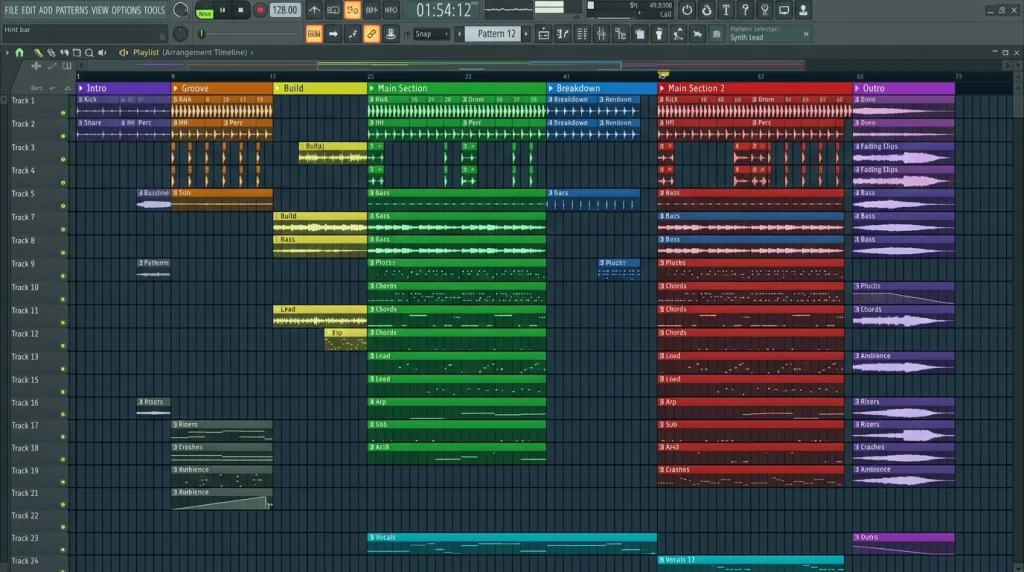
A Proven Arrangement Template
| Section | Length | What Happens |
|---|---|---|
| Intro | 16 to 32 bars | Kick and percussion only |
| Groove | 16 bars | Bass enters |
| Build | 16 bars | Chords and first vocal hints |
| Main section | 32 bars | Full groove and motif |
| Breakdown | 16 to 32 bars | Drums drop, pads and vocals shine |
| Main section 2 | 32 bars | Everything returns with a new layer |
| Outro | 16 to 32 bars | Strip back to drums for mixing |
Why DJs Need Long Intros and Outros
DJs blend tracks for 16 to 32 bars. A drums-only intro and outro make your track easy to mix, which means more DJs will play it. Most releases are 6 to 8 minutes long.
Keep the Energy Moving
Add or remove one element every 8 or 16 bars. Use filter sweeps, percussion fills and risers to signal changes. For more ideas on structure, see our song structure blueprint.
Step 8: Mix Afro House for Big Club Systems
A great mix in this style feels warm, wide and clear, with a powerful low end and crisp percussion.
Balance the Kick and Bass
Start your mix with only the kick and bass. Make sure they sit in different frequency spots, for example the kick around 50 to 60 Hz and the bass slightly above or around it with sidechain. Everything else is built around this pair.
Carve Space for Percussion
- High-pass every percussion channel
- Cut harsh frequencies around 2 to 5 kHz on bright shakers
- Use a bus compressor lightly on the percussion group to glue it together
- Keep the groove loud enough to feel, but never louder than the kick
Add Depth With Reverb and Delay
Use sends rather than inserts so all your elements share the same space. Short reverbs keep percussion tight, while longer ones on pads and vocals create depth.
Common Mix Mistakes to Avoid
- Too much percussion at once: If every layer plays all the time, the groove turns into noise. Mute a few layers in each section and bring them back later.
- A boomy low end: Two sounds fighting below 100 Hz is the most common problem. Pick one to own the sub and cut the other.
- Harsh shakers: Bright shakers get tiring fast on a loud system. Turn them down and tame the top end.
- Mixing too loud: Mix at a low, comfortable volume. You will make better balance decisions and your ears will last longer.
- Skipping reference tracks: Compare your mix to a released track at the same volume every 20 to 30 minutes.
Step 9: Master for Clubs and Streaming
Your master needs to work in two places: loud club systems and streaming apps.
Club Masters vs Streaming Masters
Club tracks are often mastered louder than streaming tracks. Streaming apps turn loud tracks down to match their loudness target (Spotify uses about -14 LUFS by default), so extreme loudness brings no benefit there.
Simple Mastering Chain
- Gentle EQ to balance the low end and air
- Light glue compression
- Soft saturation for warmth
- A limiter to control peaks, with the ceiling around -1 dB true peak
Test on Real Systems
Check your master in a car, on earbuds and, if possible, on a club or PA system. The low end should feel strong but never boom.
Step 10: Explore Afro House Subgenres and Find Your Sound
Once you know the basics, explore the different styles inside the genre and find the one that fits you.
Organic and Deep Afro House
Warm, earthy and spiritual, with live-sounding percussion, flutes and soulful vocals. Think Black Coffee and Culoe De Song.
Afro Tech
A harder, more electronic style that mixes Afro percussion with techno and tech house energy. Keinemusik and &ME are key references.
3-Step
A South African style that breaks the straight kick into a swinging three-step pattern. It feels more broken and hypnotic than classic four-on-the-floor.
Melodic Afro House
Big emotional synths and pads on top of Afro percussion, built for festival main stages.
Study the Charts
Listen closely to the current Beatport Afro House Top 100 (Beatport). Pick three tracks you love, load them into your DAW and compare their drums, bass and arrangement to yours.
Conclusion: Start Your First Afro House Track Today
Learning how to make Afro house is about groove, patience and respect for the culture. The kick keeps things steady, the percussion brings life, and long, DJ-friendly arrangements get your music played.
Here is your quick recap:
- Set your tempo between 118 and 124 BPM in a minor key
- Build a solid four-on-the-floor base, then add swing
- Layer and pan congas, shakers and hand drums
- Write a rolling off-beat bass and sidechain it lightly
- Use rich minor chords and a hypnotic motif
- Arrange in 16 and 32 bar sections with long intros and outros
- Mix for the club, then test everywhere
Now open your DAW and build your first 32-bar groove today. When it is done, share it in the comments and tell us which step helped you the most.
FAQ
What BPM is Afro house?
Most tracks sit between 118 and 124 BPM, with 120 to 122 BPM being the most common range.
What is the best DAW for making this style?
Any modern DAW works. FL Studio is great for fast drum programming, Ableton Live is popular with DJs and live performers, and Logic Pro offers strong built-in instruments.
What is the difference between Afro house and Amapiano?
Afro house uses a steady four-on-the-floor kick at around 120 BPM with a rolling bass. Amapiano is slower, has a sparser drum pattern and uses the log drum as its signature bass sound.
How long should a track in this genre be?
Most club releases run 6 to 8 minutes, with long intros and outros so DJs can blend them. Radio edits are often around 3 to 4 minutes.
Do I need live percussion to make it sound authentic?
No. High-quality percussion samples work well. What matters most is how you layer, swing and pan them.
Can I use African vocals in my tracks?
Yes, as long as you have permission. Work with vocalists directly or use licensed sample packs, and treat the languages and culture with respect.