
Somewhere in your catalog there is probably a track that earned you nothing last year. Not a small amount. Nothing. The Spotify 1000 stream rule means any track that fails to reach 1,000 streams in a 12-month period no longer generates recorded royalties, and for independent producers with deep catalogs, that can quietly switch off dozens of songs at once.
Here is the good news. Once you understand how the Spotify 1000 stream rule works, you can audit your releases, rescue the tracks worth saving, and plan future drops so they clear the bar with room to spare. This guide walks you through every part of it, with real numbers and a clear action plan.
What Is the Spotify 1000 Stream Rule?
The Spotify 1000 stream rule is a minimum activity threshold that a track must hit before it earns recorded music royalties. It was announced in late 2023 as part of a wider royalty overhaul and has applied to payouts since early 2024.
The Rule in One Sentence
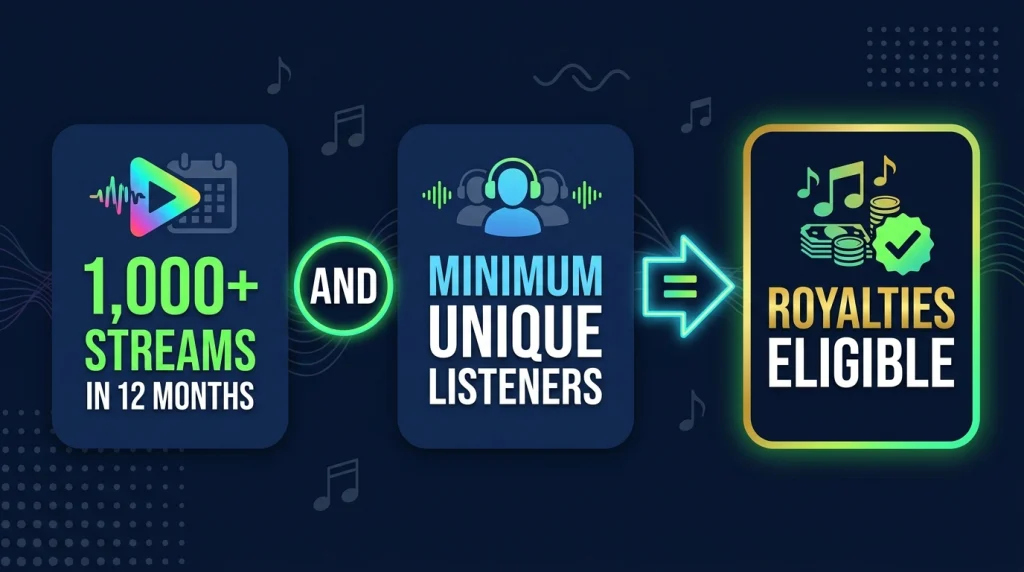
A track must reach at least 1,000 streams in the previous 12 months to be eligible for recorded royalties from Spotify. If it falls short, its streams still count for listeners and for your profile, but they do not generate a payout for the master owner.
When the Royalty Threshold Took Effect
Spotify outlined the change in its official royalty system announcement (Spotify for Artists), and the new model kicked in during the first quarter of 2024. Every payout cycle since then has applied the Spotify 1000 stream rule.
The Unique Listener Requirement
Raw stream count is not the only test. Spotify also requires a minimum number of unique listeners on each track. This part of the Spotify 1000 stream rule stops someone from playing their own song on repeat 1,000 times to unlock royalties. Spotify has not published the exact listener number, which is intentional, since a public figure would be easy to game.
Key takeaway: Think of the Spotify 1000 stream rule as two gates, not one. You need enough plays and enough real people pressing play.
Why Spotify Introduced a Minimum Stream Threshold
Why would a platform choose to stop paying for some streams? The reasoning comes down to three problems Spotify wanted to fix at the same time.
The Problem With Micro-Payments
According to Spotify, tracks below 1,000 annual streams were earning an average of about $0.03 per month. Many distributors require a minimum balance before you can withdraw, and some charge fees, so a large share of those cents never reached artists at all. Spotify estimated the payments added up to tens of millions of dollars a year that were effectively stuck in the system. The Spotify 1000 stream rule was designed to stop that leakage.
Fighting Artificial Streaming and Noise Tracks
Small, low-activity tracks were also a favorite target for fraud. Bad actors would upload huge volumes of short tracks and use bots to collect tiny payments spread across thousands of uploads. Alongside the Spotify 1000 stream rule, Spotify introduced:
- Per-track charges to labels and distributors when flagrant artificial streaming is detected
- A minimum length of two minutes for functional “noise” recordings (white noise, nature sounds) to earn royalties
- Stricter enforcement of Spotify’s artificial streaming guidelines (Spotify for Artists)
Where the Redirected Money Goes
This is the part many artists miss. Spotify does not keep the money from tracks under the line. The royalty pool stays the same size, and the share that would have gone to sub-1,000 tracks gets redistributed to eligible tracks. Spotify estimated this would move around $40 million a year toward artists whose songs clear the threshold.
In plain terms, the Spotify 1000 stream rule takes from the bottom of the catalog and adds to the middle and top. Which side of the line your music sits on decides whether you gain or lose.
How the Spotify 1000 Stream Rule Calculates Eligibility
Understanding the mechanics matters more than the headline number. Here is how the check actually works.
The Rolling 12-Month Window
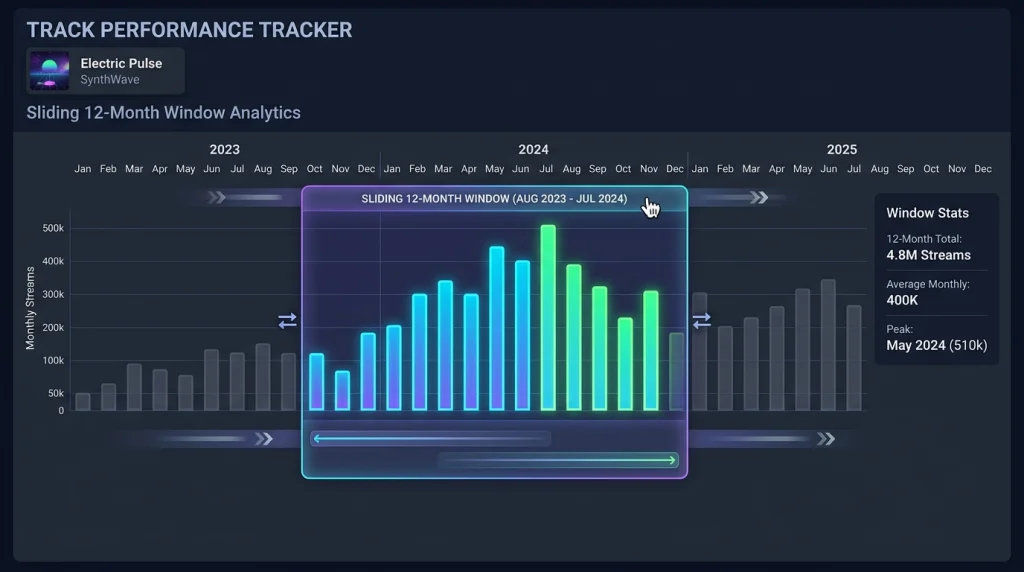
Eligibility is not judged once per calendar year. It is checked against the trailing 12 months each time royalties are calculated. A song that was released in March gets assessed on its last 12 months of activity, and so does a song from 2016.
This means a track can fall out of eligibility, then earn its way back in. If an old single gets picked up by a playlist and its rolling total climbs past 1,000, it starts generating royalties again.
Per Track, Not Per Artist
The Spotify 1000 stream rule applies to each individual recording, not to your artist profile as a whole. You could have 500,000 monthly listeners and still have deep cuts that fail the test. Each track is judged on its own numbers.
How Distributors Report It
Your distributor (DistroKid, TuneCore, CD Baby, UnitedMasters and others) receives royalties only for eligible tracks. Most do not clearly flag tracks that fail the Spotify 1000 stream rule in their dashboards, so the effect shows up as a track simply reporting streams with no matching earnings. That is why your own audit, covered below, is so important.
Which Royalties Are Affected and Which Are Not
A lot of panic around the Spotify 1000 stream rule comes from a misunderstanding about which money is on the line.
Master Recording Royalties
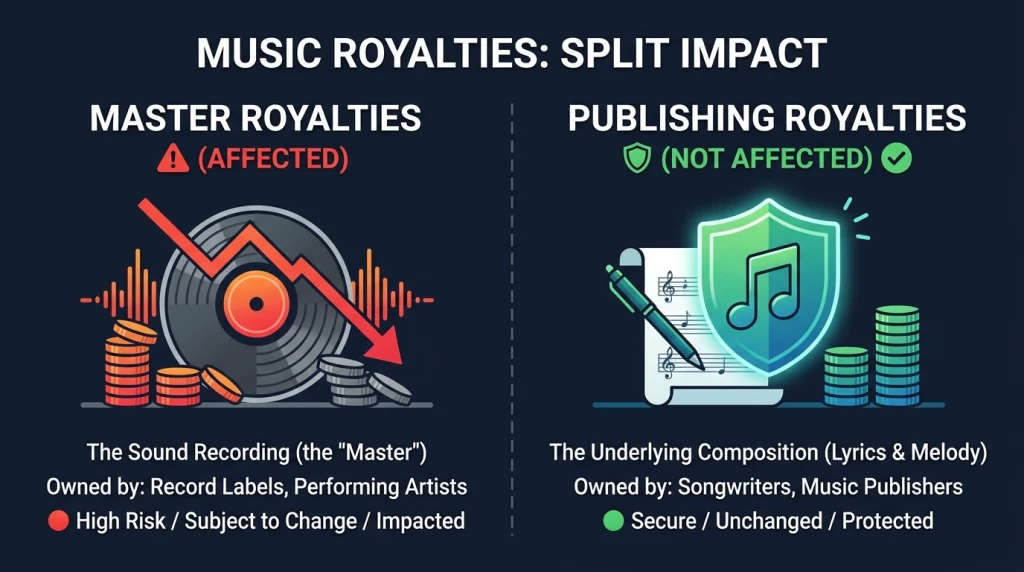
The rule applies to recorded music royalties, the money paid to whoever owns the master recording. For most independent artists that is you, collected through your distributor. This is the income stream the Spotify 1000 stream rule switches off for tracks under the threshold.
Publishing and Songwriter Royalties
Publishing royalties are a separate flow. Mechanical and performance royalties paid to songwriters and publishers are handled under different agreements and were not part of this change. In the US, mechanical royalties from streaming are collected by The Mechanical Licensing Collective (The MLC), while performance royalties go through organizations like ASCAP, BMI and SESAC.
If you write your own songs and have not registered with a PRO and The MLC, you may be missing money that the rule never touched. If you are unsure how these pieces fit together, start with this breakdown of how music licensing and publishing rights work.
| Royalty Type | Who Gets Paid | Affected by the Threshold? |
|---|---|---|
| Recorded (master) royalties | Master owner via distributor or label | Yes |
| Mechanical royalties | Songwriter and publisher | No |
| Performance royalties | Songwriter and publisher via PRO | No |
| Sync and licensing fees | Rights holders, negotiated directly | No |
Sync, Licensing and Other Platforms
The Spotify 1000 stream rule is a Spotify policy only. Apple Music, Amazon Music, YouTube and other services run their own royalty systems. Sync placements and direct licensing deals are also completely separate. A track that earns nothing on Spotify can still earn elsewhere.
The Real Math Behind Small Streaming Royalties
Let us put actual numbers on the table so you can judge the impact on your own catalog.
What 999 Streams Was Actually Worth
Spotify does not pay a fixed rate per stream. It pays a share of a revenue pool based on each rights holder’s portion of total streams in a given market. Still, independent artists commonly see an effective rate somewhere around $0.003 to $0.005 per stream, depending on listener location and subscription type.
At that range, a track with 999 streams in a year would have earned roughly $3 to $5. Across one song, losing that to the Spotify 1000 stream rule is barely noticeable.
When Small Numbers Add Up
Now picture a producer with 150 instrumentals uploaded over five years, 100 of which sit below the line at an average of 400 streams each:
- 100 tracks x 400 streams = 40,000 streams
- 40,000 x $0.004 = about $160 a year
That is not life-changing money, but it is not zero either. For a producer with a large beat catalog or a lo-fi artist releasing weekly singles, the Spotify 1000 stream rule can remove a meaningful slice of passive income. You can see how payouts are distributed across the whole platform in Spotify’s Loud and Clear report (Spotify), which shows Spotify paid out roughly $10 billion to the music industry in 2024 alone.
Reality check: The rule rarely hurts one great song. It hurts wide, shallow catalogs where many tracks each get a little attention.
How to Audit Your Catalog for the Spotify 1000 Stream Rule
You cannot fix what you have not measured. This three-step audit takes about an hour and gives you a clear picture of where every release stands.
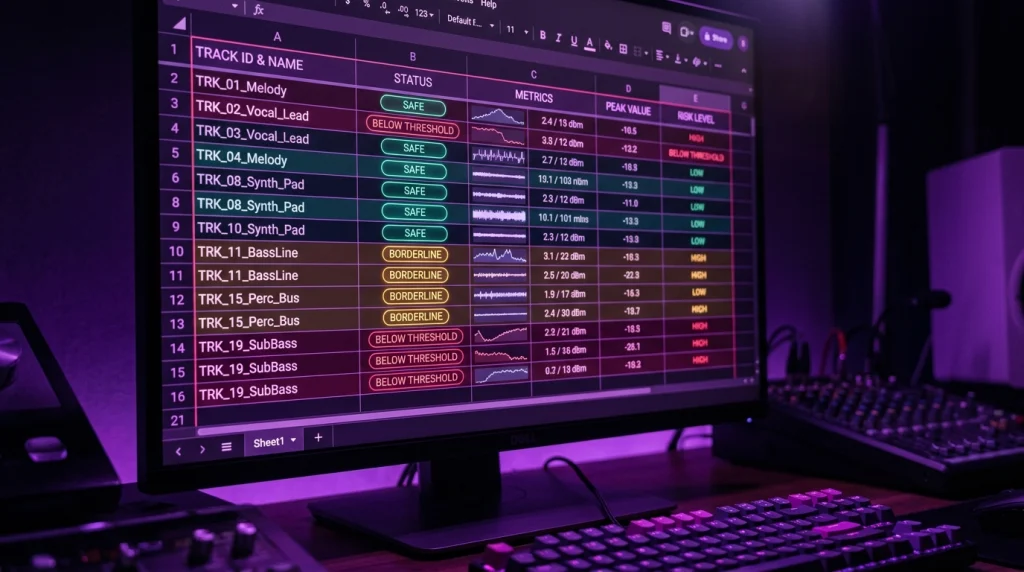
Step 1: Export Your Stream Data
Open Spotify for Artists, go to the Music tab, and set the date range to the last 12 months. Note the stream count for every song. If you manage many tracks, copy the numbers into a spreadsheet. Your distributor’s sales report can confirm which tracks generated earnings and which did not.
Step 2: Sort Tracks Into Three Tiers
Group every track into one of three buckets:
- Safe (2,000+ streams): Comfortably above the threshold. Keep doing what works.
- Borderline (700 to 1,999 streams): At risk of slipping under, or close to crossing over. This is where your effort pays off most.
- Below threshold (under 700 streams): Currently earning nothing from Spotify master royalties.
Step 3: Decide Keep, Push or Retire
For each borderline or below-threshold track, make a deliberate choice:
- Push it if the song is strong and has a clear audience. Use the tactics in the next section.
- Keep it if it serves your artistic story, even without royalties. Not every song needs to earn.
- Retire or repackage it if it is a weak early release. Consider folding it into a compilation or a remastered version later.
Run this audit every quarter. Because of the rolling window under the Spotify 1000 stream rule, a track’s status can change from one quarter to the next.
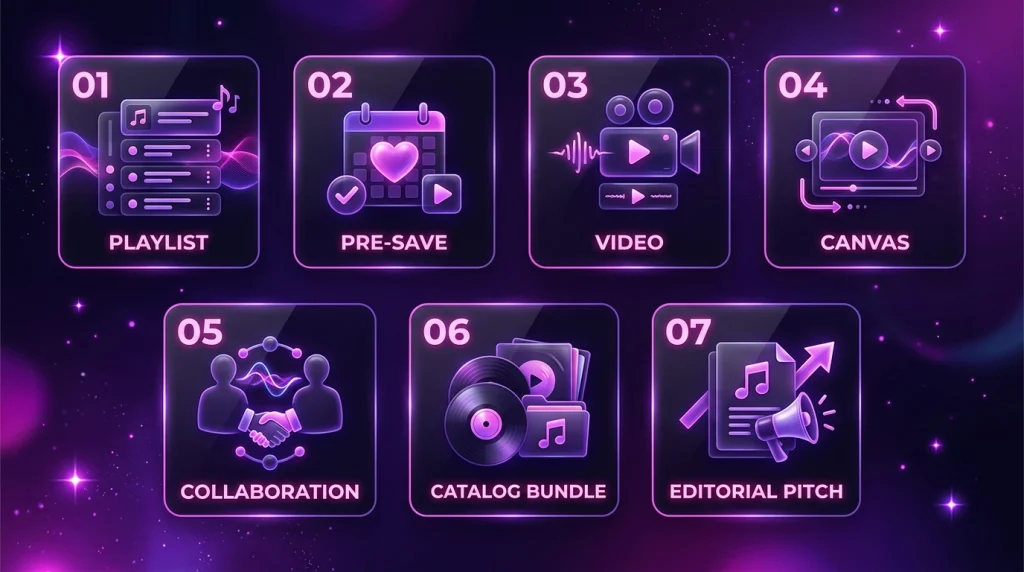
7 Proven Secrets to Push Tracks Past 1,000 Streams
Beating the Spotify 1000 stream rule works out to fewer than 3 streams a day. That is very achievable with consistent effort. Here are seven tactics that work without breaking any platform rules.
Secret 1: Build and Promote Your Own Playlists
Create two or three themed playlists on your artist profile, such as “Late Night Afrobeat Instrumentals.” Mix your tracks with well-known songs in the same lane. Share the playlist, not just your single. Listeners stay longer, and your borderline tracks get steady passive plays.
Secret 2: Use Pre-Saves on Every New Release
Pre-save campaigns turn launch-day attention into automatic library adds. Tracks saved to libraries keep getting replayed long after release week, which helps the rolling 12-month total.
Secret 3: Pitch Through Spotify for Artists
Submit every unreleased track to Spotify editorial at least seven days before release. Even if you do not land an editorial playlist, a successful pitch puts the song into your followers’ Release Radar, which is often enough to cross 1,000 streams by itself.
Secret 4: Drive Traffic With Short-Form Video
Clips on TikTok, Reels and Shorts remain the strongest discovery engine for independent music. Post the hook of a borderline track, a beat-making breakdown, or a before-and-after mix clip. For a full playbook, read our guide on growing your audience on Instagram as a producer.
Secret 5: Add Canvas and Update Your Artist Profile
Spotify Canvas, the short looping video behind a track, keeps listeners engaged and makes them more likely to share. Fresh artist pick selections and an updated bio also give old songs a second spotlight.
Secret 6: Collaborate and Feature
A feature puts your track in front of a second artist’s audience and appears on both profiles. Even a remix with a peer at the same level can double the reach of a song that is sitting at 600 streams.
Secret 7: Revive Older Tracks With Catalog Moments
Tie older songs to new moments: an anniversary post, a live version, a sped-up or slowed version linked back to the original, or a “first beat I ever released” story. Revival works because the rolling window rewards any 12 months of activity, not just the release year.
Costly Mistakes That Put Your Back Catalog at Risk
Some reactions to the Spotify 1000 stream rule do more damage than the rule itself. Avoid these.
Buying Streams
Paying for streams or using bot services is the fastest way to lose everything. Spotify can remove tracks, withhold royalties and now charges distributors for flagrant artificial streaming, and distributors often pass that cost or a ban straight to you. The unique listener requirement built into the Spotify 1000 stream rule also makes fake streams far less effective.
Splitting Momentum Across Too Many Releases
Releasing a new beat every few days spreads your audience thin. Ten tracks with 300 streams each earn nothing under the Spotify 1000 stream rule. Two tracks with 1,500 streams each both get paid.
Ignoring Old Releases
Many artists only promote what is new. Your back catalog is an asset that can be revived at almost no cost. A single playlist placement or viral clip can bring a forgotten track back over the line.
Building a Release Strategy Around the Spotify 1000 Stream Rule
The smartest long-term response is not a rescue mission. It is a release plan designed so most songs clear the bar naturally.
Release Fewer, Stronger Tracks
Quality now has a direct financial edge. Put more time into each song, from arrangement through final master. If your finishing process needs work, follow a professional mixing and mastering workflow before your next drop.
Bundle Ideas Into EPs and Albums
Instead of uploading eight loose singles, group them into an EP with a strong lead single. Listeners who find the lead often play the full project, which lifts every track together.
Plan a 12-Month Life for Every Song
Map out promotion for a full year, not one week. A simple plan might look like this:
| Timeframe | Action |
|---|---|
| Weeks 1 to 2 | Pre-save campaign, editorial pitch, launch content |
| Months 1 to 3 | Short-form clips, playlist outreach, Canvas |
| Months 4 to 8 | Remix, live version or collaboration |
| Months 9 to 12 | Anniversary content, add to new playlists, bundle into a project |
Treat every song under the Spotify 1000 stream rule as a year-long campaign, and far more of your catalog will stay above the line.
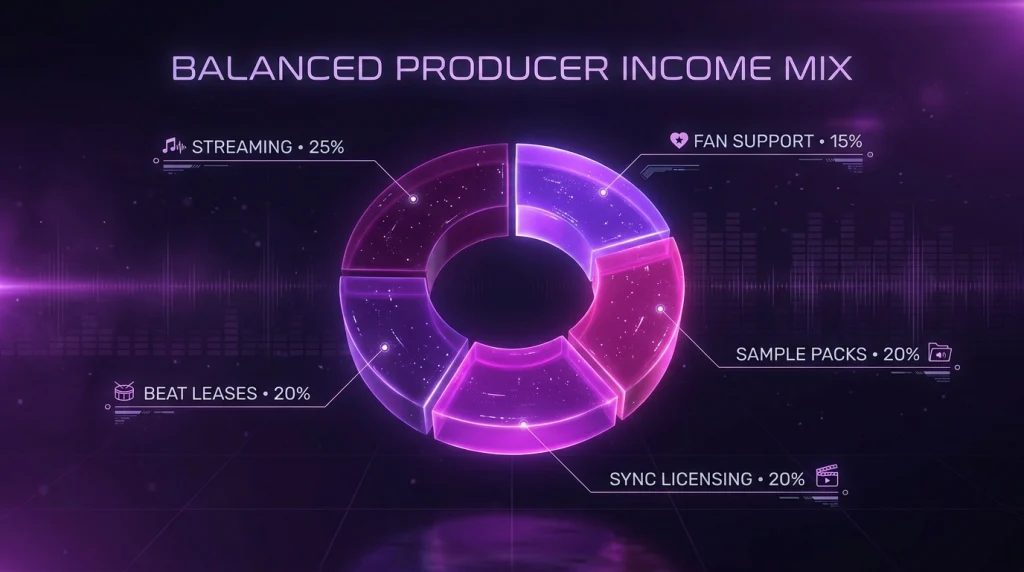
Diversifying Income Beyond Streaming Royalties
Streaming is only one revenue source, and this rule is a reminder not to depend on it. According to IFPI’s Global Music Report (IFPI), streaming makes up the majority of recorded music revenue worldwide, but independent producers have access to many income streams that labels do not rely on.
Beat Leasing and Licensing
For producers, leasing instrumentals usually earns far more per track than streaming does. A single $30 lease beats a year of streaming royalties on most small tracks. If you have not started yet, learn the basics of selling type beats online.
Sample Packs and Digital Products
Drum kits, MIDI packs and loop libraries turn your sound design into products that sell repeatedly. They also build your name with other producers, which feeds back into your streaming audience.
Direct Fan Support
Bandcamp, Patreon, merch and live shows all pay you directly with no threshold. A small group of loyal fans is worth more than thousands of passive streams. Explore more proven ways producers make money to build a mix that suits you.
Conclusion: Make the Threshold Work for You
The Spotify 1000 stream rule is not a reason to panic, but it is a reason to change how you manage your music. The threshold rewards artists who release with intention, promote consistently and treat their catalog as a long-term asset.
Your key takeaways:
- Tracks need 1,000+ streams and a minimum number of unique listeners in the last 12 months to earn master royalties.
- Publishing, mechanical and performance royalties are not affected.
- The money from ineligible tracks is redistributed to eligible ones, not kept by Spotify.
- A quarterly catalog audit tells you exactly which tracks to push, keep or retire.
- Fewer, stronger releases with a 12-month promotion plan beat a flood of singles.
Start today. Open Spotify for Artists, pull your last 12 months of data, and sort your catalog into the three tiers. Pick your top five borderline tracks and apply two of the seven secrets to each this month. Small, consistent steps are exactly what this rule rewards.
FAQ
What is the Spotify 1000 stream rule?
It is a policy that requires a track to earn at least 1,000 streams, from a minimum number of unique listeners, over the previous 12 months before it generates recorded royalties on Spotify.
Does the Spotify 1000 stream rule affect songwriter royalties?
No. The rule applies to recorded master royalties only. Mechanical and performance royalties for songwriters and publishers are handled separately and were not part of this change.
Do streams under 1,000 still count on my profile?
Yes. Every stream still appears in Spotify for Artists, counts toward your monthly listeners, and helps algorithmic recommendations. It simply does not produce a master royalty payout until the track becomes eligible.
Is the 1,000 streams counted per year or all time?
It is a rolling 12-month count. Each payout cycle looks back over the previous 12 months, so a track can lose eligibility and regain it later.
Where does the money from ineligible tracks go?
It stays in the royalty pool and is redistributed to eligible tracks. Spotify estimated this moves about $40 million a year toward tracks that clear the threshold.
Should I delete tracks that fail the Spotify 1000 stream rule?
Usually not. Deleting removes the chance of a future revival and breaks playlist links. Repackaging weak tracks into a compilation or simply leaving them live is normally a better choice.
Can I buy streams to reach the threshold?
You should not. Artificial streaming violates Spotify’s terms, can get tracks removed, and can lead to distributor penalties. The unique listener requirement also makes bought streams largely ineffective.