
I still remember staring at my DAW for the first time, completely overwhelmed. Empty playlist. Cursor blinking. Zero clue where to start. Thousands of dollars in gear, hundreds of YouTube tutorials watched, and I still couldn’t finish a track that didn’t sound like garbage.
Sound familiar?
The problem isn’t you. It’s that most music production tips floating around the internet are either too advanced for beginners or too basic to matter. They skip the messy middle where real growth happens.
After 10,000+ hours in the studio, countless failed tracks, and finally figuring out what actually works, I compiled everything I wish someone had told me on day one. These 25 music production tips represent years of frustration compressed into one guide. No fluff. No theory without application. Just the essential secrets that transformed my workflow and sound.
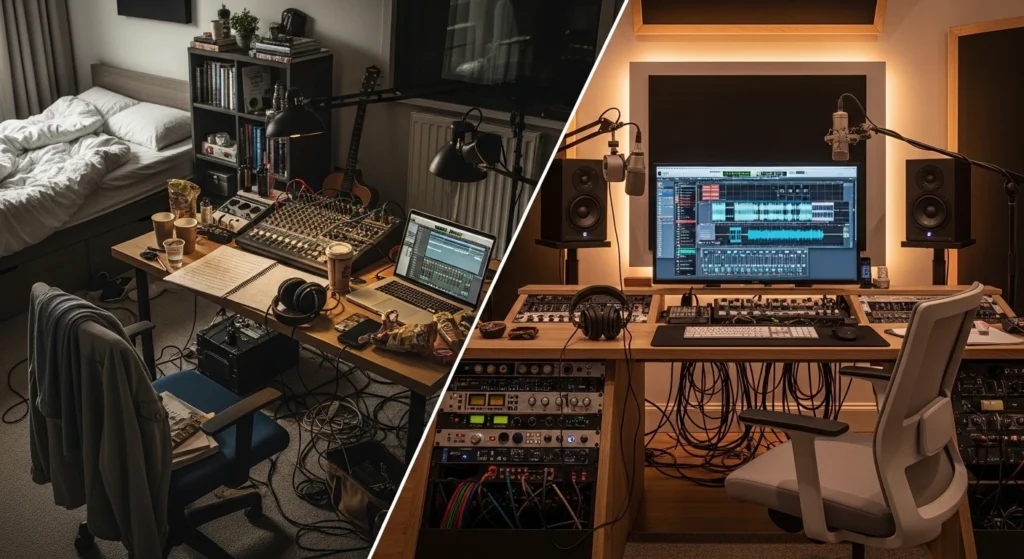
Music Production Tips That Save You Years of Frustration
Why Most Beginners Quit (And How You Won’t)
The dropout rate for music producers is brutal. Over 90% of people who start producing never release a single track they’re proud of. They quit not because they lack talent, but because they lack the right music production tips at the right time.
The first year is a gauntlet. Your ears develop faster than your technical skills. You can hear that something sounds wrong, but you don’t know how to fix it. This gap between taste and ability is where most dreams die.
The secret? Accept that everything you make for the first six months will sound terrible. Seriously. Lower your expectations, focus on finishing, and let your skills catch up to your ears gradually.
The Mindset Shift That Changes Everything
Here’s the truth nobody tells you: music production is 20% technical skill and 80% psychology. Your mindset determines your ceiling more than your gear or training ever will.
The producers who succeed aren’t the most talented. They’re the ones who keep showing up when it gets hard. They treat production like a practice, not a performance. Every unfinished track is data, not failure. Every bad mix is a lesson, not a verdict on their potential.
Adopt this mindset early, and you’ll be producing long after the hobbyists have quit.
What I Learned From 10,000 Hours in the Studio
Ten thousand hours sounds like forever until you realize it’s just three hours a day for nine years. Along the way, patterns emerge. The same mistakes repeat. The same breakthroughs happen.
The biggest lesson? There are no shortcuts, but there are faster paths. The right music production tips don’t eliminate the work, they make the work count. This guide is those faster paths distilled into 25 essential truths.
Essential Music Production Tips for Your Studio Setup
Buy Once, Cry Once: Smart Gear Investments
The gear trap is real. You convince yourself that better equipment will make your tracks better. So you buy another synthesizer, another microphone, another interface. And your music still sounds exactly the same.
Here’s what I wish I knew: gear doesn’t fix skill gaps. A better microphone won’t fix bad recording technique. Expensive monitors won’t fix a poorly treated room. The best music production tips about gear are actually about restraint.
Start with the absolute minimum: a computer, a DAW, decent headphones, and one MIDI controller. Make ten tracks with just that. Then, and only then, ask yourself what’s actually limiting you. Usually, it’s not the gear.
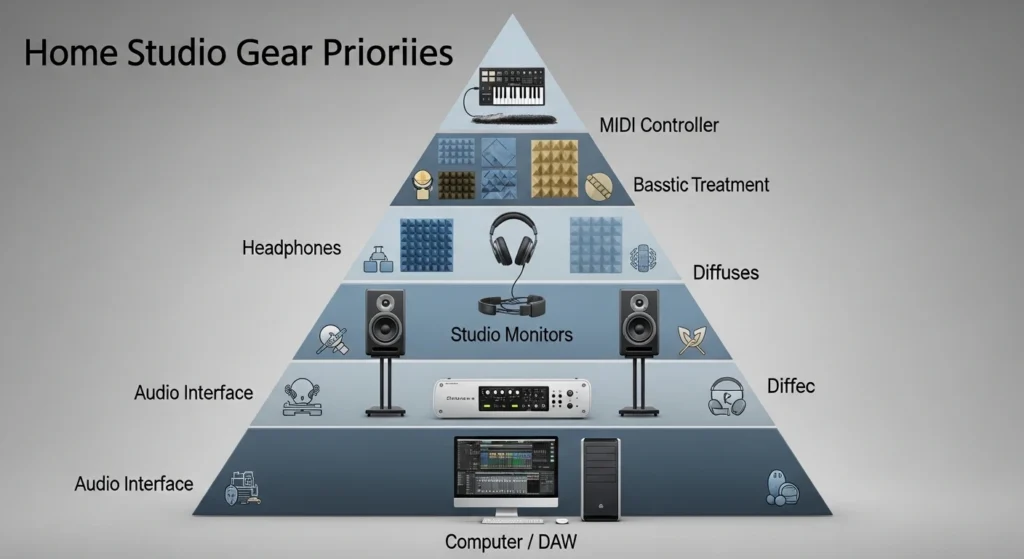
The 80/20 Rule of Studio Equipment
Pareto’s Principle applies everywhere in music production. Twenty percent of your gear delivers eighty percent of your results. That twenty percent is: a reliable computer, quality headphones, and one versatile MIDI controller.
Everything else sits in the remaining eighty percent. Outboard gear, multiple synthesizers, collectible microphones, fancy preamps. Nice to have? Absolutely. Essential? Not even close.
When I started, I spent thousands on gear I didn’t need. Now I work faster and sound better with a fraction of the equipment. The constraint became creative freedom.
Acoustic Treatment Beats Expensive Monitors
This single music production tip would have saved me two years of bad mixes. I bought thousand-dollar studio monitors before treating my room. The result? My mixes sounded great in my untreated bedroom and terrible everywhere else.
Here’s the hard truth: in an untreated room, expensive monitors are just expensive speakers playing inaccurate sound. The room itself colors everything you hear. Reflections, standing waves, bass buildup, comb filtering. Your monitors can’t fix physics.
Spend your first studio upgrade money on acoustic treatment. Bass traps in corners, absorption panels at first reflection points, and a thick rug if you have hard floors. Your mixes will translate better than they would with monitors twice the price.
Your Computer Setup Matters More Than You Think
We obsess over plugins and ignore the machine running them. Then wonder why our sessions crash during creative flow.
The best computer for music production isn’t the newest model with the most cores. It’s the one that’s optimized for audio work. This means adequate RAM (16GB minimum, 32GB ideal), fast storage (SSD for system and samples), and proper power management settings that prevent CPU throttling.
Take an afternoon to optimize your system. Disable Wi-Fi during sessions. Close background apps. Learn your DAW’s performance monitoring tools. These boring music production tips will save you more frustration than any plugin ever could.
Workflow Music Production Tips to Finish More Tracks
Template Creation Saves Hours Every Week
Starting every track from an empty session is like building a new kitchen every time you want to cook. You could. But why would you?
A well-built template eliminates decision fatigue and gets you creating faster. My template includes: pre-routed tracks for drums, bass, chords, and leads; my favorite starter plugins on each channel; basic bus routing with effects sends; and color coding that makes navigation instant.
The initial investment of building your template pays back in productivity. Every session starts with creativity, not setup.
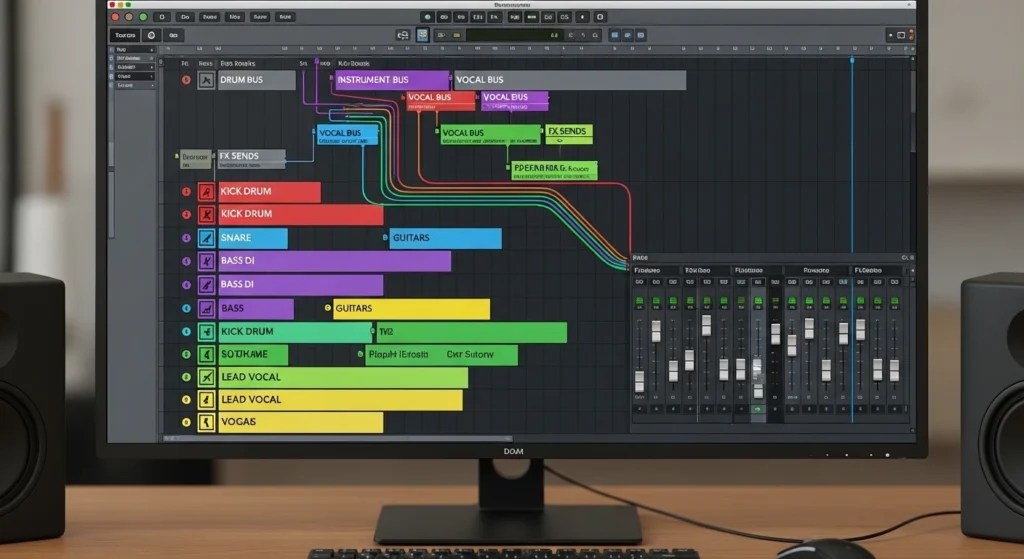
Music Production Tips: The 10-Minute
Perfectionism kills more tracks than any technical limitation. You start with a spark, then immediately start tweaking the kick drum. Two hours later, the spark is dead and you have one perfectly EQ’d kick and no song.
The 10-minute rule changed everything for me. When inspiration hits, set a timer for ten minutes. In that time, you cannot tweak. You cannot perfect. You can only add. Drums, chords, bass, melody, arrangement. Just get the skeleton down.
After ten minutes, you have something to work with. You can refine, but you can’t delete the original idea. This simple constraint preserves the energy that made you want to create in the first place.

Music Production Tips: Sound Design VS Songwriting
These are two different skills requiring two different mindsets. Mixing them guarantees mediocre results at both.
Sound design is technical, analytical, and detail-oriented. Songwriting is emotional, intuitive, and big-picture. When you try to design sounds while writing songs, you kill the creative flow with technical decisions. And when you try to write songs while designing sounds, you make boring patches that don’t serve any musical purpose.
Dedicate separate sessions to each. One day, just make sounds. Save them as presets, samples, or audio clips. The next day, write using only those pre-made sounds. Both activities improve, and your tracks benefit.
Music Production Tips: Reference Tracks
Somewhere along the way, producers decided that using reference tracks was somehow dishonest. This is nonsense. Every visual artist studies the masters. Every writer reads great books. But musicians think they should work in a vacuum.
Reference tracks are your compass. They tell you where you’re going and whether you’ve arrived. Load a commercial track in your genre onto a separate track in your session. A/B constantly. Compare your levels, your frequency balance, your width, your depth.
You’re not trying to copy. You’re trying to understand. What does professional sound like in this genre? How loud is the kick? How wide are the pads? How present are the vocals? These are questions reference tracks answer instantly.
Sound Design Music Production Tips That Elevate Your Beats
Music Production Tips: Layering
Professional tracks sound full because their sounds are built, not just picked. Every kick, snare, and synth is actually multiple sounds blended into one.
The principle is simple: use each layer for what it does best. For kicks, layer a sub-heavy kick for low end with a clicky kick for attack. For snares, blend a crack layer with a body layer. For synths, combine a sub layer with a mid-range texture and a high-frequency sparkle.
The magic is in the blend. EQ each layer to focus on its contribution. High-pass the click kick so it doesn’t muddy the sub. Low-pass the body snare so it doesn’t compete with the crack. When done right, the layers disappear into one sound that feels massive.
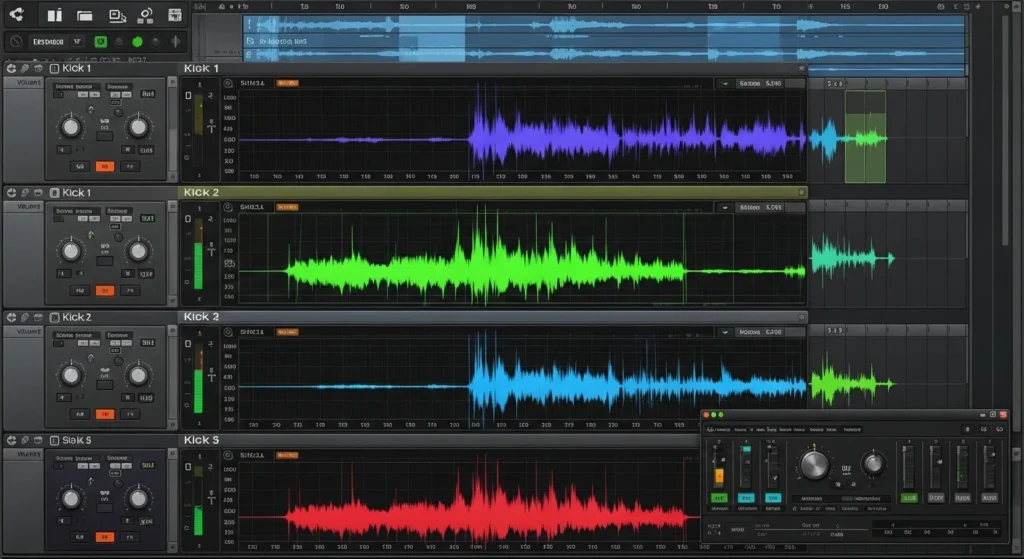
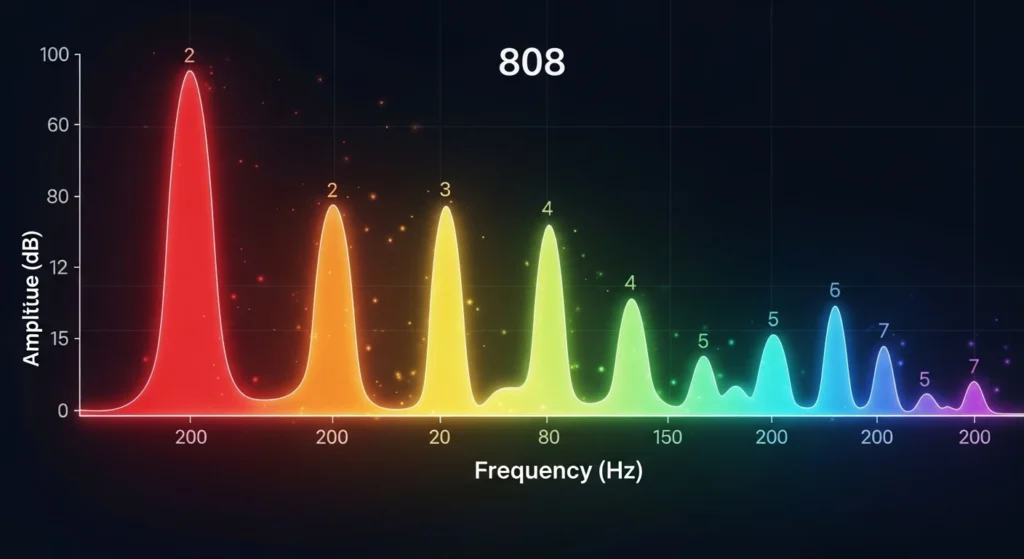
Why Your 808s Sound Weak ?
Weak 808s plague bedroom producer mixes. The pattern is always the same: you boost the low end, but it just gets muddy. You turn it up, but it just gets flabby. Nothing hits.
The problem is almost always frequency conflict. Your 808 is competing with your kick, your bass, even your pads. They’re all fighting for the same low-end space, and the result is a muddy mess where nothing hits cleanly.
Fix it with sidechain compression. Route your kick to trigger compression on your 808. Every time the kick hits, the 808 ducks slightly. This creates space for the kick transient while preserving the 808’s body. The pumping effect becomes a feature, not a bug.
Also, check your 808’s harmonic content. The fundamental frequency gives you weight, but the harmonics give you presence on smaller speakers. A little saturation adds upper harmonics that make your 808 audible on phone speakers and laptops.
Music Production Tips: Synthesis Basics
You don’t need to be a synthesis expert, but you need the fundamentals. Every synth, no matter how complex, rests on the same building blocks: oscillators, filters, envelopes, and LFOs.
Oscillators generate the raw sound. Filters shape the tone by removing frequencies. Envelopes control how sounds change over time. LFOs create movement and modulation.
Master these four concepts, and you can approach any synth with confidence. You’ll stop scrolling through presets hoping to find something that works and start tweaking sounds until they work for your track.
Music Production Tips: Sampling Techniques
Sampling gets a bad reputation from producers who just loop and call it a day. But creative sampling is an art form that produces some of the most original music ever made.
The trick is to make samples unrecognizable. Pitch them up or down dramatically. Chop them into tiny pieces and rearrange. Reverse them. Layer multiple unrelated samples. Run them through heavy processing.
When you transform a sample beyond recognition, you’re not borrowing, you’re creating. The original becomes raw material, not the final product. This approach lets you sample anything without worrying about sounding like everyone else using the same packs.
Mixing Music Production Tips for Cleaner Tracks
Gain Staging: The Most Overlooked Foundation
Gain staging sounds boring. It’s not glamorous like compression or exciting like saturation. But get it wrong, and nothing else matters.
Gain staging simply means managing levels throughout your signal chain so each stage operates in its sweet spot. Too hot, and you get unwanted distortion and reduced headroom. Too low, and you raise the noise floor when you boost later.
The rule is simple: keep your levels conservative. In the digital world, aim for peaks around -18dBFS on individual tracks. This leaves plenty of headroom for mixing and prevents the cumulative level buildup that crushes your mix bus.
Advanced mixing techniques for cleaner tracks: https://wtmhstudio.com/trap-mixing-advanced-techniques/

Mix in Mono First, Stereo Later
This music production tip sounds counterintuitive. Why mix in mono when everyone listens in stereo? Because mono reveals problems stereo hides.
Phase cancellation, frequency masking, and balance issues all become obvious in mono. If your mix falls apart when you sum to mono, it will fall apart for anyone listening on a phone, a Bluetooth speaker, or in any environment with less-than-perfect stereo reproduction.
Start your mix in mono. Get everything sitting right. Balance your levels. EQ out conflicts. Then switch to stereo and add width as the final polish. Your mixes will translate better across every playback system.
Your Ears Lie: Use Visual Tools Wisely
Our ears adapt. After thirty minutes of mixing, your perception of frequency balance shifts. What sounded bright now sounds dull. What sounded punchy now sounds weak. You compensate by making changes that seem right but push your mix further from neutral.
Visual tools keep you honest. A spectrum analyzer shows you your actual frequency balance, independent of ear fatigue. Correlation meters show you phase issues your ears might miss. Level meters show you dynamics objectively.
Don’t mix with your eyes. But use visual tools as guardrails that keep your ears from wandering too far.
The Car Test Never Fails
Your studio setup, no matter how good, is just one listening environment. Your monitors, your room, your positioning, all create a unique sound that doesn’t match the real world.
The car test is the great equalizer. Cars have small speakers, reflective surfaces, and significant road noise. If your mix sounds good in the car, it sounds good everywhere. If it falls apart, you have work to do.
Listen to your mix in the car. Note what’s missing. Note what’s overpowering. Note what sounds harsh. Then return to the studio with clear targets for improvement. Repeat until the car test passes.
Music Production Tips for Beating Creative Blocks
Constraints Create Creativity
Unlimited options paralyze. When you can do anything, you do nothing. The blank session is terrifying because it could become anything, so it becomes nothing.
The solution is intentional constraints. Limit yourself to three sounds. Force yourself to use only stock plugins. Give yourself thirty minutes to complete a track. Sample only from one source.
Paradoxically, limits free you. When you can’t do everything, you actually do something. The constraint becomes a container that holds your creativity instead of letting it spill everywhere.
When to Walk Away From a Project
Ear fatigue is real. After a few hours, your perception degrades. Frequencies sound different. Dynamics feel wrong. You start making changes that fix problems that don’t exist and create problems you’ll fix tomorrow.
Learn to recognize the signs. When you’re second-guessing every decision. When you’ve made the same EQ adjustment three times. When you can’t tell if the mix is better or just different. These are signals to stop.
Walk away. Sleep on it. Work on something else. Come back tomorrow with fresh ears. You’ll hear clearly what actually needs attention and what was fine all along.
Collaboration Breaks Mental Walls
Producing alone too long creates echo chambers. Your habits reinforce themselves. Your blind spots stay blind. Your techniques plateau because you never see alternatives.
Collaboration shatters these walls. Working with another producer forces you to explain your decisions, hear different approaches, and adapt to unfamiliar workflows. Even one session with someone else can unlock breakthroughs that months of solo work couldn’t achieve.
Find producers slightly better than you and ask to work together. The discomfort is the point. Growth lives there.
Consume Different Music Than You Produce
If you only listen to the genre you produce, you’ll make music that sounds like everyone else making that genre. Your influences become identical to your competitors, and originality suffocates.
Actively listen outside your lane. If you produce trap, study classical arrangements. If you make house, analyze jazz harmony. If you create pop, deconstruct film scores.
The ideas you import from other genres become your unique fingerprint. That classical chord progression under a trap beat. That jazz harmony in an electronic track. That film score texture in a pop song. These cross-pollinations create the sound only you can make.
Business Music Production Tips for Making Money
Your Catalog Is Your Asset
Producers think their income comes from the next sale. They chase placements, push individual tracks, and treat each beat as a separate transaction. This mindset keeps you broke.
Your catalog is your actual asset. Every track you’ve ever made is an income stream waiting to be activated. A beat you made three years ago could get placed tomorrow. A loop you forgot about could become a sample pack bestseller. A track you almost deleted could be your biggest earner.
Build your catalog with intention. Tag everything. Back up everything. Treat every finished track as inventory, not art. The producer who wins isn’t the one with the biggest hit, but the one with the deepest catalog working for them over time.
Networking Beats Cold Outreach
Sending beats to strangers almost never works. Artists get hundreds of unsolicited emails daily. Yours gets deleted before anyone listens.
Real placements come from relationships. When an artist knows you, trusts you, and values your opinion, they actually want to hear your beats. The cold email becomes a warm text.
Network without asking for anything. Go to shows. Support artists online. Offer value before requesting anything. Comment genuinely. Share their music. Become part of their community. When you finally send a beat, it arrives with context and trust already established.
Pricing Psychology for Beat Sales
Pricing beats is more psychology than math. Too cheap, and buyers assume low quality. Too expensive, and you price out your market. The sweet spot balances perceived value with accessibility.
The key is tiered pricing. Offer leases at different price points for different usage levels. Basic lease for small artists. Premium lease for growing acts. Exclusive rights for serious investments. This captures value across your entire market instead of forcing everyone into one price.
Also, never compete on price. If someone chooses another producer because they’re cheaper, let them. Those clients are always more trouble than they’re worth. Compete on quality, service, and relationship.
Protect Your Work Legally Early
Nothing hurts like hearing your beat in a commercial and realizing you never signed a contract. You have no rights, no royalties, and no recourse.
Register your copyrights. Use beat licenses for every sale. Understand the difference between leased and exclusive rights. Learn basic contract terms so you recognize when an agreement is unfair.
The time to learn this stuff is before you need it. A few hours of education now prevents thousands in lost revenue later.
Final Music Production Tips for Long-Term Growth
Comparison Is the Thief of Joy
Social media shows you highlights, not reality. You see the producer with millions of streams, but not the years of struggle before. You see the beat that went viral, but not the fifty that flopped. You see the studio setup, but not the debt used to buy it.
Comparison is always unfair because you’re comparing your behind-the-scenes to someone else’s highlight reel. The only meaningful comparison is between you yesterday and you today. Are you better than last month? Last year? Five years ago? That’s the only metric that matters.
Teach What You Learn
The best way to master something is to teach it. Explaining concepts forces you to understand them deeply. Answering questions reveals your own gaps. Organizing knowledge for others organizes it for yourself.
You don’t need to be an expert to teach. You just need to be one step ahead of someone else. Share what you’re learning as you learn it. Your struggles are as valuable as your successes because they show others what the path actually looks like.
The Plateau Is Part of the Process
Progress isn’t linear. You improve quickly at first, then plateau for months. During these plateaus, it feels like you’re stuck. Nothing sounds better. Nothing feels easier. You question whether you’re actually learning anything.
The plateau is where real growth happens. Your conscious mind has learned everything it can, and now your unconscious is integrating. Skills are moving from effortful to automatic. The plateau isn’t stagnation, it’s consolidation.
Trust the process. Keep showing up. The next breakthrough is always preceded by the longest plateau.
Consistency Compounds
This is the most important music production tip in this entire guide. Consistency beats intensity every time. One hour every day produces better results than seven hours every Sunday. Daily practice builds neural pathways that weekly binges never develop.
Show up when you don’t feel like it. Make something when everything sounds terrible. Finish tracks when you’d rather start new ones. The compound interest of consistency is the secret sauce behind every successful producer you admire.
They didn’t get there because they were more talented. They got there because they kept showing up long after the talented people quit.
Conclusion “Music Production Tips”
These 25 music production tips represent years of trial and error compressed into one guide. Some will resonate immediately. Others might take years to fully appreciate. That’s okay. The journey is the point.
Start with the music production tips that address your biggest current struggle. Implement one change this week. See how it affects your workflow. Then add another. Small improvements compound into transformation faster than dramatic overhauls ever could.
Remember why you started. Not for the money, not for the fame, but because something inside you needs to create. Honor that impulse by giving it the best conditions to flourish. These music production tips are just tools. You’re the artist who wields them.
Now close this article and open your DAW. The only thing that actually matters is what you make next.
FAQ
What are the most important music production tips for beginners?
The most important music production tips for beginners focus on mindset and fundamentals. Finish tracks even when they’re bad. Learn gain staging before fancy plugins. Use reference tracks. Treat your room before buying expensive monitors. And most importantly, be consistent. Daily practice matters more than occasional intensity.
How long does it take to learn music production tips?
Most producers need 2-3 years of consistent practice to reach a professional level. The first year is survival. The second year is competency. The third year is when things start clicking. This timeline varies based on practice quality, mentorship, and prior musical experience.
What equipment do I need to start producing music?
You need surprisingly little: a decent computer, a DAW (Digital Audio Workstation), quality headphones, and one MIDI controller. Everything else is optional. Start here and only upgrade when you can articulate exactly what’s limiting your current setup.
How do I make my beats sound professional?
Professional-sounding beats come from arrangement, sound selection, and mix balance, not expensive plugins. Focus on frequency balance, dynamic range, and stereo width. Use reference tracks religiously. Test your mixes on multiple systems. And finish tracks consistently, because you can’t mix what you never complete.
Why do my mixes sound amateur?
Amateur mixes typically suffer from frequency masking, poor gain staging, and lack of reference. Multiple elements compete for the same frequencies. Levels are too hot with no headroom. And you’re mixing in isolation without comparing to professional tracks. Address these three issues, and your mixes will improve dramatically.
How do I find my sound as a producer?
Your sound emerges naturally from your influences, limitations, and preferences. Consume music outside your genre. Imitate producers you admire until you understand their techniques. Combine influences in unexpected ways. And most importantly, make enough music that patterns emerge. Your sound finds you faster than you find it.
Can I learn music production tips without a mentor?
Yes, thousands of successful producers are self-taught. The internet provides endless resources. But self-teaching requires discipline and strategic learning. You need to identify your gaps actively, seek targeted education, and avoid practicing mistakes into habits. Structured courses and feedback communities accelerate this process significantly.
What music production tips actually help with creativity?
Creative music production tips include: the 10-minute rule for capturing ideas, separating sound design from songwriting, using intentional constraints, and collaborating with other producers. Also, consume different music than you produce. The ideas you import from other genres become your creative signature.