
Afrobeat vs Amapiano is one of the most common debates in modern production, and Afro house makes it even more confusing. All three come from Africa, all three fill dancefloors worldwide, and all three get mislabeled every day on streaming playlists and beat stores.
For producers, the confusion is expensive. Tag an amapiano beat as Afrobeat and the right artists never find it. Build an Afro house track at Afrobeat tempo and DJs cannot mix it. Most guides talk about vibes, but vibes do not help you program a drum pattern.
This guide gives you the three secrets that actually separate these genres: tempo, drums and bass. You get exact ranges, pattern breakdowns, a master comparison table and recipes to convert a beat from one genre to another.
Afrobeat vs Amapiano vs Afro House: The Quick Answer
Short on time? Here is the whole Afrobeat vs Amapiano vs Afro House breakdown in one place.
The Master Comparison Table
| Element | Afrobeat (Afrobeats) | Afro House | Amapiano |
|---|---|---|---|
| Origin | Nigeria, Ghana, UK | South Africa | South Africa (Gauteng) |
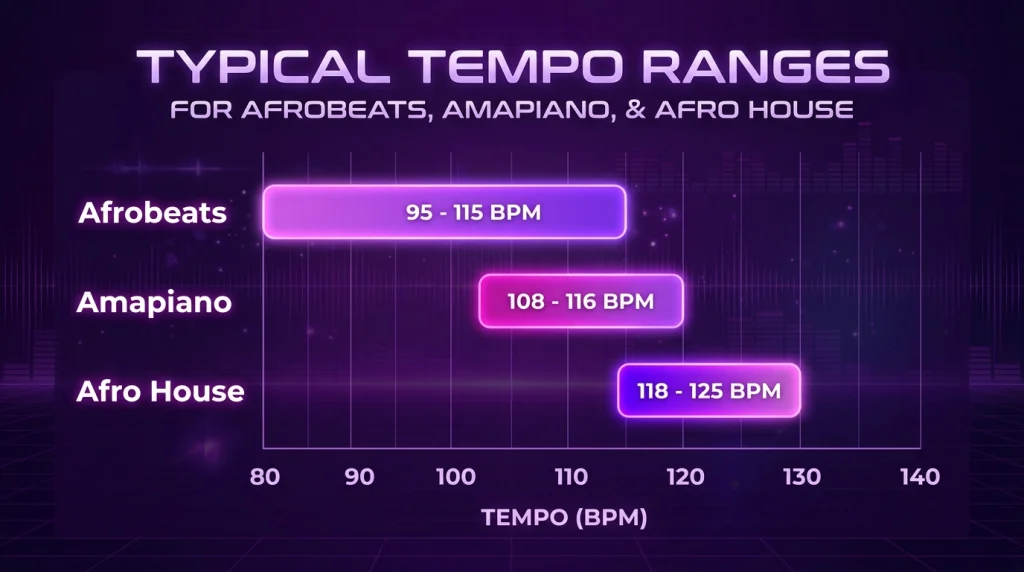
| Typical tempo | About 95 to 115 BPM | About 118 to 125 BPM | About 108 to 116 BPM |
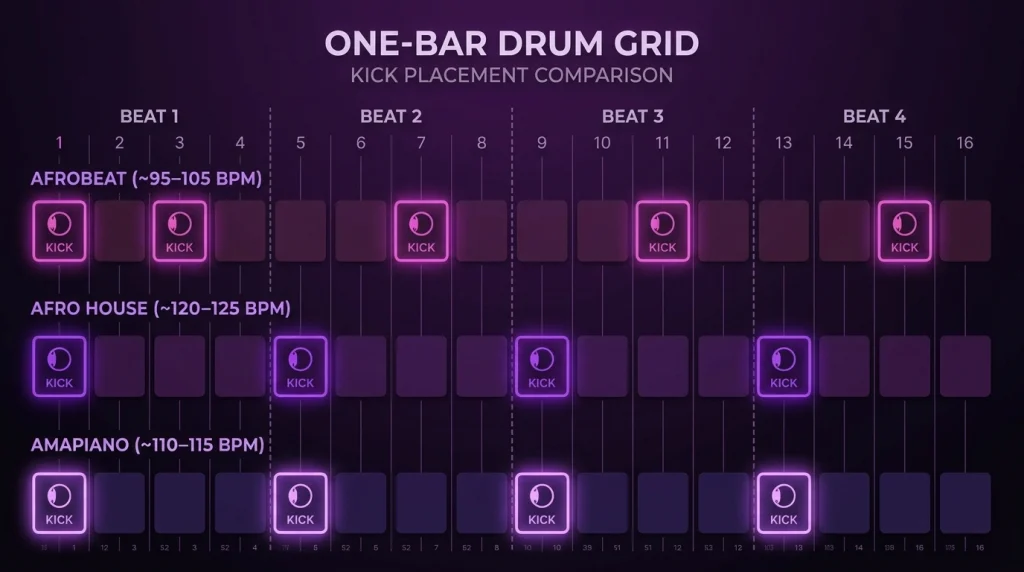
| Kick pattern | Syncopated, not four-on-the-floor | Steady four-on-the-floor | Steady but soft, often four-on-the-floor |
| Rhythm signature | 3-2 or 2-3 clave feel | Driving, hypnotic pulse | Swung shakers and log drum syncopation |
| Snare/clap | Often on beat 3 or the backbeat | Claps on 2 and 4 | Light rims and claps |
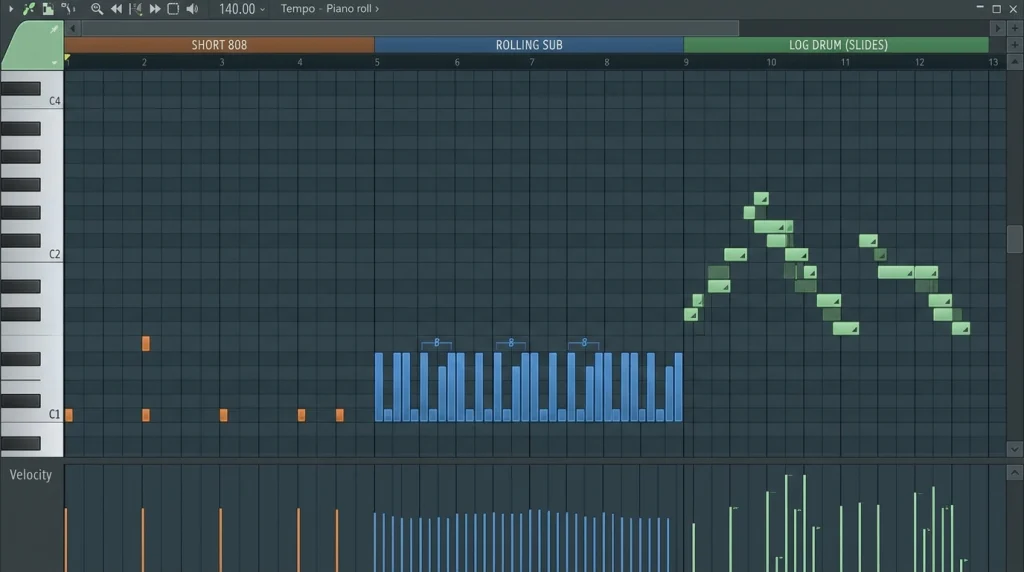
| Bass | Short 808 or sub notes, melodic | Deep, rolling sub or synth bass | The log drum, plus sub |
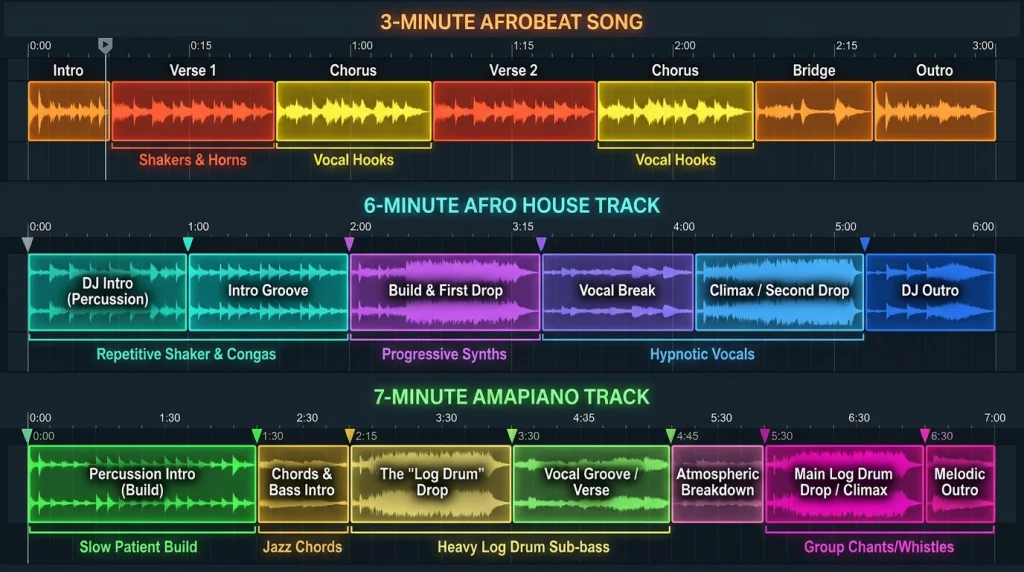
| Song length | 2.5 to 3.5 minutes | 6 to 8 minutes | 5 to 7 minutes |
The Three Secrets in One Sentence Each
- Tempo: Afrobeat sits slowest, amapiano in the middle, Afro house fastest.
- Drums: Afrobeat is syncopated, Afro house is four-on-the-floor, amapiano is laid back with busy shakers.
- Bass: Afrobeat uses short 808s, Afro house uses deep rolling subs, amapiano uses the log drum.
Remember those three lines and you will never mix the genres up again.
Meet the Three Genres
Before the technical Afrobeat vs Amapiano breakdown, a quick introduction to each sound and where it comes from.
Afrobeat and Afrobeats: A Naming Note
Strictly speaking, Afrobeat is the 1960s and 1970s sound of Fela Kuti and Tony Allen: big bands, long jams, jazz and funk. Afrobeats, with an “s”, is the modern West African pop sound of artists like Wizkid, Burna Boy, Davido and Rema. As the history of Afrobeats explains, the “s” was added in the UK to market the newer sound.
In everyday producer talk, people use “Afrobeat” for both. In this guide, Afrobeat means the modern Afrobeats production style, because that is what most producers are making. For the original story, read our revolutionary history of Afrobeat.
Afro House: South Africa’s Club Sound
Afro house developed mainly in South Africa from the late 1980s and 1990s, drawing on kwaito, deep house, tribal house and soulful house. Artists like Black Coffee, Culoe De Song, Da Capo and Shimza, along with global names like Keinemusik, made it a festival staple.
Amapiano: The Log Drum Generation
Amapiano emerged in Gauteng’s townships in the mid-2010s. According to amapiano’s background, its signature is the log drum, an electronic take on a percussive bass sound. Kabza De Small, DJ Maphorisa and Kelvin Momo helped take it worldwide.
Secret 1: Tempo
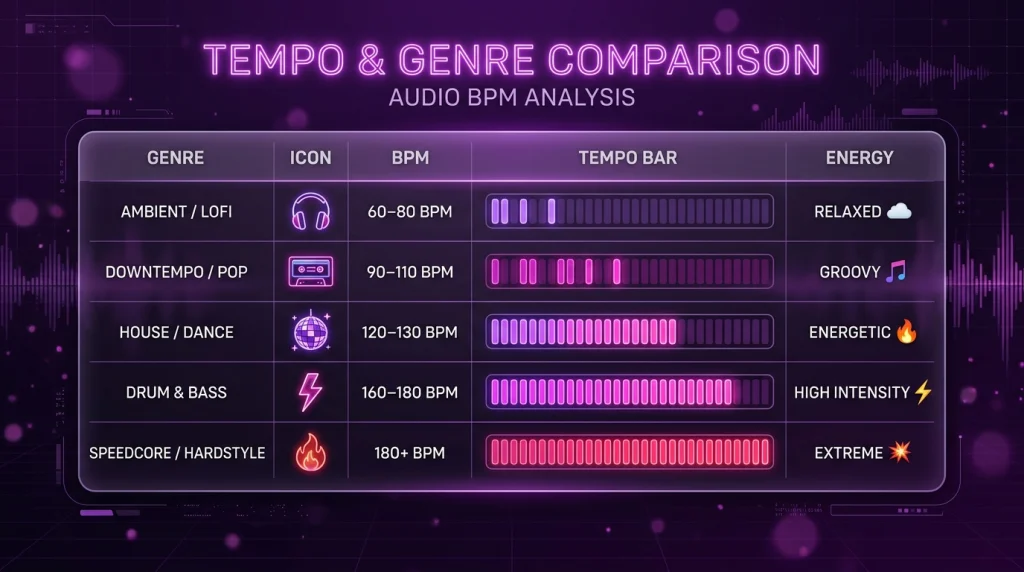
Tempo is the fastest way to identify each genre, and the first decision you make in a session. In the Afrobeat vs Amapiano debate, tempo alone often settles the question.
Afrobeat Tempo
Most modern Afrobeat songs sit between roughly 95 and 115 BPM, with many hits around 100 to 110 BPM. The groove feels relaxed and bouncy because the syncopation fills the space between beats.
Afro House Tempo
Afro house is the fastest of the three. Most club-focused tracks land around 118 to 125 BPM, with 120 to 123 BPM especially common, according to production guides and Mixgraph’s Afro house tempo data. That tempo puts it in line with other house music, which makes it easy for DJs to blend.
Amapiano Tempo
Amapiano usually sits between about 108 and 116 BPM, with many tracks around 112 to 113 BPM. It is faster than most Afrobeat but slower than Afro house, and the laid-back drums make it feel even slower than the number suggests.
Why a Few BPM Change Everything
The gap between 110 and 122 BPM looks small, but it changes the body’s response completely. Below 110, dancers bounce and sway. Around 120, they step and drive. If your Afrobeat vs Amapiano beat sounds confused, check the tempo before anything else.
Swing Settings Matter Too
Tempo is only half the timing story. Afrobeat usually uses a medium swing, Afro house stays fairly straight, and amapiano uses the heaviest swing of the three, especially on shakers. Two beats at the same BPM can land on opposite sides of the Afrobeat vs Amapiano line purely because of swing. Start around 55 to 60 percent swing for amapiano shakers and adjust by ear.
Quick rule: Under 110 BPM, think Afrobeat. Around 112, think amapiano. 120 and up, think Afro house.
Secret 2: Drum Patterns in Afrobeat vs Amapiano and Afro House
If tempo is the first clue in Afrobeat vs Amapiano, the kick pattern is the proof. Each genre places its kick in a completely different way.
Afrobeat Drums: Syncopation and Clave
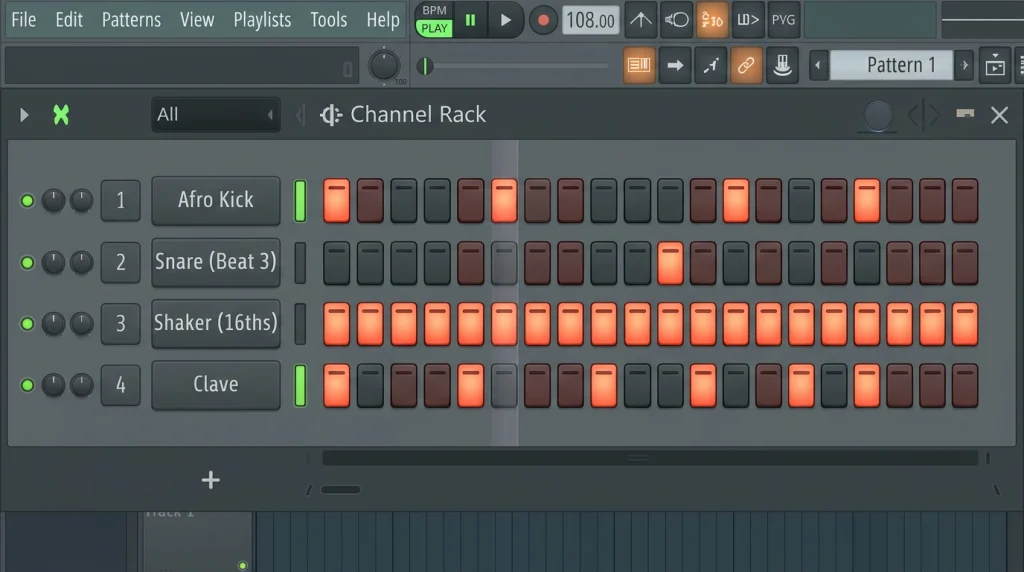
Afrobeat drums are built on syncopation. The groove usually follows a 3-2 or 2-3 clave feel, and the kick avoids landing on every beat. Producers often place the snare or main clap on beat 3 rather than the hip hop backbeat, a detail that defines the bounce.
Around that core, you will hear shakers in 16th notes, congas, rimshots and talking drum fills. For full patterns you can copy, see Afrobeat drum patterns explained.
Afro House Drums: The Four-on-the-Floor Engine
Afro house runs on a steady four-on-the-floor kick: one kick on every beat of the bar. On top sit claps on beats 2 and 4, off-beat open hats and, most importantly, layered organic percussion such as congas, bongos and djembe. As Native Instruments’ Afro house production guide shows, the percussion carries much of the groove’s character.
One exception is South African 3-step, which removes one of the four kicks to create a rolling, unbalanced feel.
Amapiano Drums: Laid-Back Kick, Busy Shakers
Amapiano usually keeps a steady kick, often on every beat, but it sits softer and further back in the mix than in Afro house. The energy comes from swung shakers, light rimshots, wood blocks and the syncopated log drum, which acts as both bass and percussion.
The result feels relaxed and hypnotic rather than driving.
Percussion Layers Compared
| Layer | Afrobeat | Afro House | Amapiano |
|---|---|---|---|
| Kick | Syncopated | Every beat, punchy | Every beat, soft |
| Snare/clap | Beat 3 or backbeat | Beats 2 and 4 | Light, sparse |
| Shakers | 16ths, accented | Steady, often off-beat | Busy, heavily swung |
| Hand percussion | Congas, talking drum | Congas, bongos, djembe | Wood blocks, rims |
| Swing | Medium | Light | Heavy |
Secret 3: Bass in Afrobeat vs Amapiano and Afro House
The low end is the final Afrobeat vs Amapiano secret, and the one most producers get wrong. Use the wrong bass type and no amount of drum programming will save the track.
Afrobeat Bass: Short, Punchy and Melodic
Afrobeat bass is usually a sub or 808 playing short, punchy notes that lock with the kick, often with a melodic shape that follows the chords. Some productions use a live bass guitar for a warmer, groovier feel. For sound design tips, check our guide to designing crushing 808 bass.
Afro House Bass: Deep and Hypnotic
Afro house bass is deep and rolling. It often plays on the off-beats or in long, repetitive phrases that weave around the four-on-the-floor kick. Sidechain compression keeps it from clashing with the kick, and the pattern repeats for long stretches to build trance-like momentum.
Amapiano Bass: The Log Drum Does Double Duty
Amapiano’s bass identity is the log drum: a pitched, percussive sound with a punchy attack and a booming tail. It plays syncopated patterns with slides, acting as bass, rhythm and hook at the same time. Many producers add a clean sub underneath to control the lowest frequencies. Learn how to balance it with our guide on how to mix amapiano log drums.
Melody, Vocals and Arrangement Differences
Tempo, drums and bass settle the Afrobeat vs Amapiano question, but melody, vocals and structure finish the picture.
Chords and Melody
Afrobeat leans on catchy, simple progressions with guitar riffs, keys and synth hooks. Afro house favors moody, minor-key pads and hypnotic melodic loops. Amapiano mixes jazzy piano chords with sparse synth stabs, especially in its soulful lanes.
Vocal Approach
Afrobeat is song-first: verses, a big hook and melodic ad-libs. Afro house often uses chants, spoken phrases or soulful vocal loops. Amapiano sits in between, with chant-like hooks, short phrases and plenty of instrumental space.
Arrangement Length
Afrobeat songs are built for radio and streaming, usually 2.5 to 3.5 minutes. Afro house and amapiano tracks are built for DJs, often 5 to 8 minutes with long intros and outros for mixing.
How to Convert a Beat From One Genre to Another
Understanding Afrobeat vs Amapiano differences lets you remix your own beats into new markets. Here are three quick recipes.
Afrobeat to Amapiano
- Raise the tempo from about 105 to around 112 BPM.
- Replace the syncopated kick with a soft kick on every beat.
- Swap the 808 for a log drum and write a syncopated pattern with slides.
- Add heavily swung shakers and light rims.
- Extend the arrangement with longer intros and breakdowns.
Amapiano to Afro House
- Raise the tempo to around 120 to 122 BPM.
- Make the kick punchier and louder.
- Replace the log drum with a deep, rolling sub bass.
- Add claps on 2 and 4 and layer congas and bongos.
- Darken the chords with minor pads.
Keep the Vocal, Change the Groove
If you already have a vocal, these recipes become remix tools. Keep the vocal and chords, then rebuild the tempo, kick and bass around them. Time-stretch the vocal carefully, since big jumps (such as 100 to 122 BPM) can create artifacts. In Afrobeat vs Amapiano remixes, the vocal usually survives the move well because both genres leave space for chant-style hooks.
Afro House to Afrobeat
- Drop the tempo to around 100 to 108 BPM.
- Rewrite the kick as a syncopated, clave-based pattern.
- Move the main snare or clap to beat 3.
- Replace the rolling bass with short 808 or sub notes.
- Shorten the arrangement around a strong vocal hook.
Which Genre Should You Produce?
The Afrobeat vs Amapiano vs Afro House choice depends on your goals:
- Want placements with singers and rappers? Afrobeat is the most song-focused and placement-friendly.
- Want DJ support and club plays? Afro house fits festival and club sets best.
- Want viral dance moments and a growing global scene? Amapiano is built for dance challenges and long, hypnotic sets.
In the Afrobeat vs Amapiano decision, there is no wrong answer: many successful producers work in all three. Master one first, then use the conversion recipes above to expand.
5 Mistakes Producers Make When Mixing These Genres
Avoid these Afrobeat vs Amapiano mix-ups and your beats will land in the right lane every time.
- Using the wrong tempo. A 122 BPM “Afrobeat” beat will confuse artists and DJs alike.
- Four-on-the-floor in Afrobeat. A straight kick kills the syncopated bounce.
- An 808 in amapiano. Without a log drum, it is not really amapiano.
- Burying Afro house percussion. The percussion is the groove, so keep it present.
- Mislabeling your uploads. Accurate tags help the right artists and DJs find your work.
Conclusion: Afrobeat vs Amapiano vs Afro House Made Simple
The Afrobeat vs Amapiano vs Afro House debate gets much simpler once you know where to listen. Three secrets separate them every time.
Here are the key takeaways:
- Tempo: Afrobeat about 95 to 115 BPM, amapiano about 108 to 116 BPM, Afro house about 118 to 125 BPM.
- Drums: syncopated clave for Afrobeat, four-on-the-floor for Afro house, soft kick and swung shakers for amapiano.
- Bass: short 808s for Afrobeat, deep rolling subs for Afro house, the log drum for amapiano.
- Structure: Afrobeat is song-length, while Afro house and amapiano are built for DJs.
Now put it into practice Afrobeat vs Amapiano. Grab our mix-and-match sample kits for genre production, set your tempo and build one beat in each style this week.
Frequently Asked Questions
What is the main difference in Afrobeat vs Amapiano?
Afrobeat uses a syncopated, clave-based drum pattern with short 808 or sub bass at about 95 to 115 BPM. Amapiano uses a soft steady kick, swung shakers and the log drum as bass at about 108 to 116 BPM.
Is Afro house the same as amapiano?
No. Both come from South Africa, but Afro house is faster (about 118 to 125 BPM), with a punchy four-on-the-floor kick and deep rolling bass. Amapiano is slower and built around the log drum.
Is Afrobeat the same as Afrobeats?
Not strictly. Afrobeat is Fela Kuti’s 1970s sound, while Afrobeats is modern West African pop. Many producers use “Afrobeat” for both.
Which is faster, Afrobeat vs Amapiano?
Amapiano is usually faster, at about 108 to 116 BPM, compared with about 95 to 115 BPM for most Afrobeat. Afro house is the fastest of the three.
What is a log drum?
The log drum is amapiano’s signature sound: a pitched, percussive bass with a sharp attack and booming tail, used for both rhythm and bass lines.
Can I mix Afrobeat vs amapiano in one track?
Yes. Many hits blend Afrobeat vocals and melodies with amapiano log drums and shakers. Choose one genre’s tempo and kick pattern as the foundation so the groove stays clear.
What BPM should I use for Afrobeat vs Amapiano?
Start around 120 to 123 BPM. Most club Afro house sits between about 118 and 125 BPM.