
Frequency masking is the reason your mix sounds perfect in your headphones and disappears on a phone speaker. It is the reason your kick and bass fight each other no matter how hard you try to separate them. It is the reason your vocals get swallowed by the midrange, your hi-hats vanish behind the synths, and your snare sounds like it is playing from another room.
Every producer encounters frequency masking. Most never identify it correctly. Instead they add more of what they cannot hear, which makes the problem worse, or they reach for aggressive EQ cuts that fix the clash but kill the character of the sounds they spent hours designing.
This guide changes both of those habits. These 7 proven secrets give you the tools to identify frequency masking precisely, address it surgically, and clean your mix without losing the warmth, weight, or energy that makes your productions compelling. By the end, frequency masking will not be a problem you stumble across by accident. It will be a problem you solve on purpose.
A great mix is not about what you add. It is about what you allow each sound to occupy without competition.
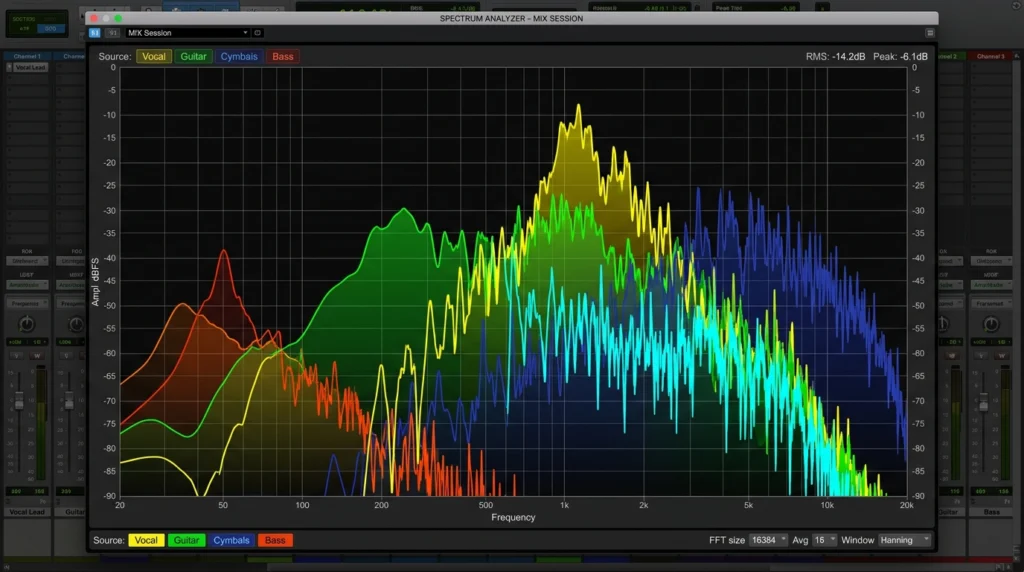
What Is Frequency Masking and Why It Ruins Otherwise Good Mixes
Frequency masking is a psychoacoustic phenomenon in which one sound obscures another because they share the same or adjacent frequency content. When two sounds compete for the same frequency zone at similar levels, the louder or more energetically dominant sound makes the other one inaudible or significantly reduced in perceived volume.
This is not a mixing opinion. It is a documented property of the human auditory system. The cochlea, the part of the inner ear responsible for frequency analysis, has limited resolution in certain frequency bands. When two sounds activate the same region of the cochlea simultaneously, the brain receives a single combined signal rather than two distinct ones.
Understanding that frequency masking is a perceptual phenomenon rather than purely a technical one is the foundation of addressing it correctly. You are not just solving an EQ problem. You are solving a listening problem.
Simultaneous Masking Versus Temporal Masking
Frequency masking occurs in two forms. Simultaneous masking happens when two sounds play at the same time in the same frequency range. This is the most common form in music production: a pad and a vocal competing in the 1 kHz to 3 kHz range, or a bass line and a kick drum competing in the 60 Hz to 120 Hz zone.
Temporal masking is less discussed but equally important. It occurs when a loud sound masks a quieter sound that either precedes or follows it by a short time interval, typically within 200 milliseconds. A loud snare transient can mask the attack of a guitar chord that follows immediately after it. A heavy kick can mask the beginning of a bass note that starts on the same beat.
Both forms of masking require different solutions, and recognizing which type you are dealing with is the first step to addressing it correctly.
The Three Conditions That Create Frequency Masking Problems
Not every frequency overlap creates a masking problem. Masking becomes a problem when three conditions are met simultaneously.
- The overlapping sounds are close in frequency, within one to two octaves of each other
- The overlapping sounds are close in level, within approximately 10 dB of each other
- The overlapping sounds play at the same time or within a short temporal window
When all three conditions are met, masking is almost guaranteed. When only one or two conditions are met, the overlap may be acceptable or even musically beneficial by creating harmonic density. Understanding these conditions helps you prioritize which clashes to address and which to leave alone.
Why Aggressive EQ Cuts Make Masking Worse Over Time
The most common response to frequency masking is to make broad, aggressive cuts to the problem sound. This approach removes the masking conflict but often removes the character of the sound along with it. A 6 dB broad cut at 2 kHz to stop a pad from masking a vocal also removes the presence and air that made the pad feel alive and three-dimensional.
The better approach is narrower, more targeted intervention that addresses the specific conflicting frequencies while preserving the surrounding character. This is the surgical EQ approach, and it is what separates mixes that are clear and still sound great from mixes that are clear but sterile.
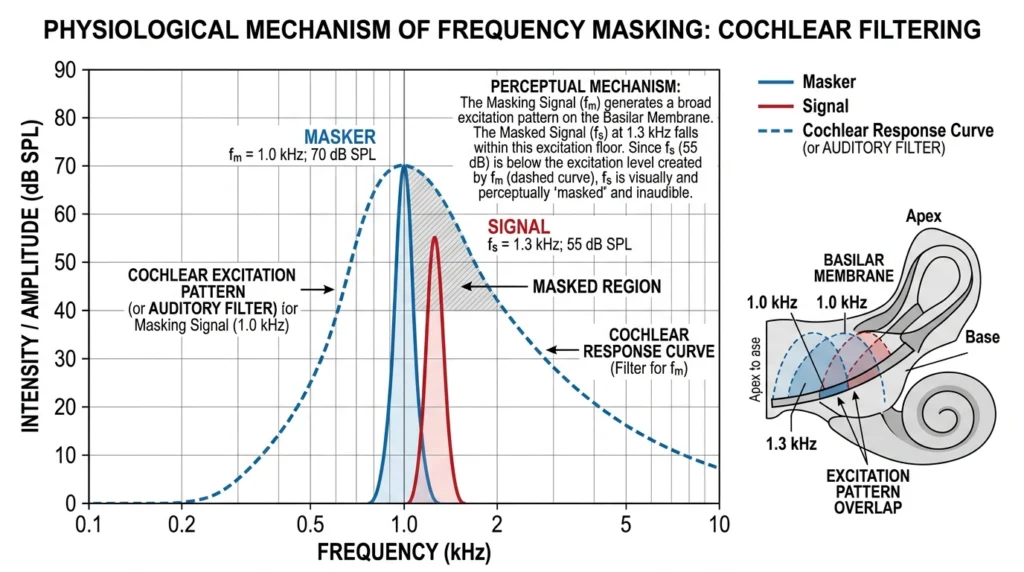
Secret 1: Learn to Identify Frequency Masking Before You Touch the EQ
The most powerful change you can make to your approach to frequency masking is to develop the skill of identifying it accurately before you attempt to fix it. Most producers skip this step entirely, diving straight into EQ moves based on guesses about what is conflicting. This produces inconsistent results and often creates new masking problems while solving the original one.
The Solo and Reference Method
The most direct method for identifying frequency masking is the solo and reference approach. Solo each element you suspect is involved in a masking conflict and use a spectrum analyzer to map exactly where its energy is concentrated. Then un-solo and listen to how the element changes when the full mix is playing.
If an element that sounds full and present in solo becomes thin, quiet, or undefined in the full mix, frequency masking is almost certainly responsible. The difference between what you hear in solo and what you hear in the mix is the masking effect. Your job is to identify exactly which frequencies are being suppressed and by which competing element.
Using a Spectrum Analyzer to Map Conflicts
A real-time spectrum analyzer is the essential tool for visual identification of frequency masking. Insert one on every track in your session and use it to compare frequency content between elements that you suspect are competing. When two tracks show significant energy in the same frequency zone at similar levels, you have found a masking conflict.
Spectrum analyzers with a freeze function allow you to capture a snapshot of a dense section of the mix and examine the overlap at your own pace. This is particularly useful for identifying masking in complex arrangements where multiple conflicts may exist simultaneously.
The mixing beats with precise frequency control guide covers how to use spectrum analysis as a primary mixing reference tool throughout a session, not just when problems arise.
Listening Tests for Temporal Masking
Temporal masking is harder to identify visually because it occurs across time rather than simultaneously. The most effective listening test is to loop the section where you suspect temporal masking and listen specifically to the attack of the quieter element. If the beginning of a note or hit consistently disappears while the body and tail are audible, temporal masking from a preceding loud transient is likely the cause.
Increasing the attack time or reducing the peak level of the masking element are typically more effective solutions than EQ for temporal masking conflicts, because the problem is dynamic rather than spectral.
Secret 2: Surgical EQ Cuts That Solve Frequency Masking Without Losing Character
Surgical EQ is the practice of making narrow, precise cuts to remove the specific conflicting frequency content from one element to allow the other to be heard clearly. It is the primary technical solution for simultaneous frequency masking, and the difference between doing it well and doing it poorly is almost entirely in the width and placement of the cut.
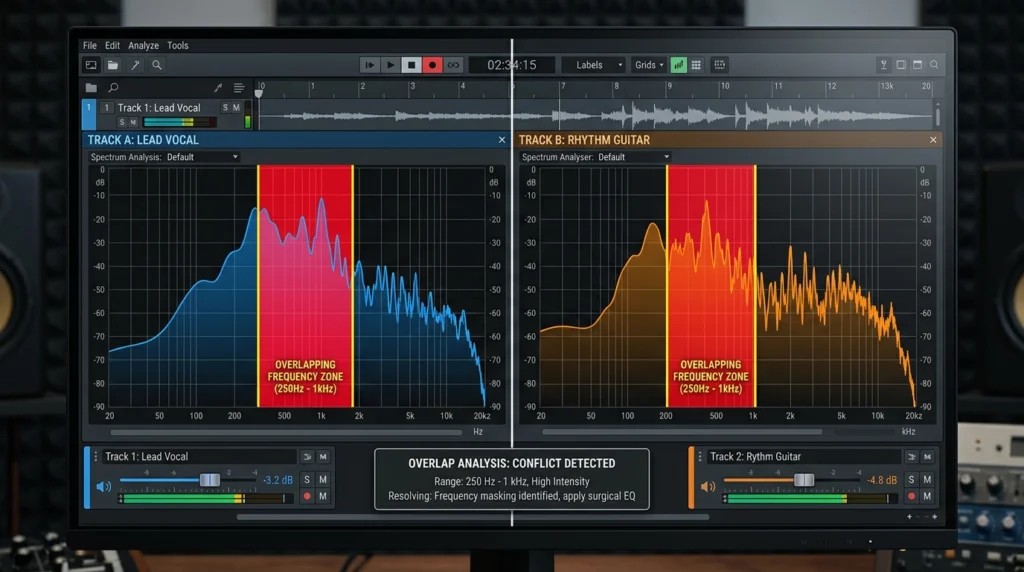
The Narrow Cut Principle
The narrowest cut that solves the masking problem is always the correct cut. A Q value of 3 to 6 on a parametric EQ targets a frequency range narrow enough to address a specific conflict without affecting the surrounding character of the sound. A Q value of 0.5 to 1 affects such a wide range of frequencies that it changes the tonal character of the element fundamentally.
Start with a narrow cut at the center of the conflicting frequency zone and widen only as far as necessary to achieve clarity. In most cases, a well-placed narrow cut of 2 to 4 dB resolves a masking conflict more effectively and with less character damage than a broad cut of 6 dB or more.
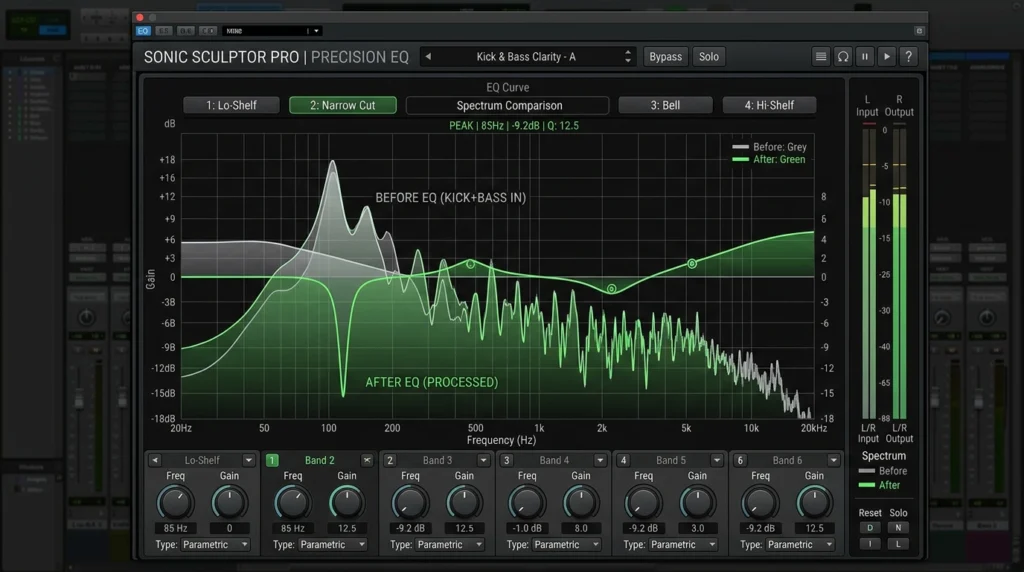
The Sweep and Find Technique
The most reliable method for locating the exact frequency of a masking conflict is the sweep and find technique. On the element causing the masking, boost a narrow band by 6 to 10 dB and slowly sweep it through the suspected frequency range while listening for the moment the conflict dramatically worsens. This peak identifies the center of the masking frequency. Then reduce that boost to a cut of 2 to 4 dB at the same center frequency. The masking conflict is resolved with a single precise cut.
This technique works because boosting the conflicting frequency while searching makes the problem more obvious to the ear than listening at normal levels, allowing precise identification that passive listening cannot achieve.
Cutting the Right Element
A common mistake in frequency masking correction is cutting the wrong element. The instinct is to cut the element you want to be audible, reducing its frequency content to remove the overlap. The correct approach in most cases is to cut the masking element, the one with greater energy in the conflicting zone, rather than the masked element.
This preserves the character of the element you want to hear while reducing the competition it faces. If the bass is masking the kick at 80 Hz, the correct move is usually a cut in the bass at 80 Hz rather than a boost in the kick. If the pad is masking the vocal at 2 kHz, the correct move is usually a narrow cut in the pad at 2 kHz rather than boosting the vocal.
Secret 3: Complementary EQ Creates Space Without Cuts Alone
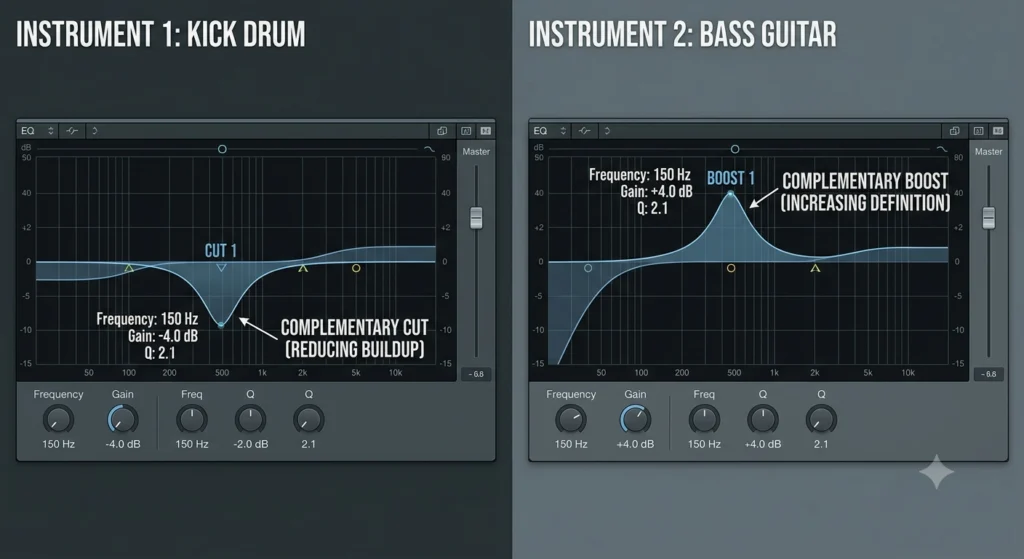
Complementary EQ is one of the most effective and least discussed techniques for solving frequency masking. Instead of making cuts only on the problem element, you create a reciprocal relationship between two competing sounds by cutting from one and boosting the corresponding frequency in the other simultaneously.
How Complementary EQ Works in Practice
If a snare and a lead melody are competing at 3 kHz, complementary EQ involves cutting the snare by 2 dB at 3 kHz while simultaneously boosting the lead melody by 2 dB at 3 kHz. The net result is that the same frequency zone now belongs clearly to the melody. The snare retains its overall character because the cut is small, but yields the contested zone to the element that needs it more.
This technique is particularly powerful because it creates contrast between the two sounds rather than simply quieting one. The boosted element becomes more prominent in the zone where it matters, and the cut element moves out of the way without losing its overall presence in the mix.
Frequency Zoning Across the Full Mix
Complementary EQ applied systematically across an entire mix creates what engineers call frequency zoning: the deliberate assignment of specific frequency ranges to specific elements. No two elements should own the same frequency zone. When each element has its own designated range, frequency masking is eliminated by design rather than corrected after the fact.
A practical frequency zone map for a typical beat-based production might assign the sub-bass zone exclusively to the 808 or bass, the low-mid zone to the kick body, the mid zone to pads and harmonic layers, the upper-mid zone to lead melodies and vocals, and the presence and air zones to hi-hats and atmospheric elements. Applying complementary EQ decisions that enforce this map prevents masking at the source.
Preserving Character While Creating Space
The character of a sound lives in its harmonic overtones, which are distributed across multiple frequency zones. A narrow cut at a specific masking frequency removes that one point of conflict while leaving the surrounding harmonic content intact. A broad cut removes multiple harmonics and changes how the sound is perceived tonally.
The advanced Afrobeat mixing techniques guide demonstrates how complementary EQ is applied in the context of genre-specific instrument relationships, particularly between bass guitar, drums, and melodic instruments where frequency masking is a persistent challenge.
Secret 4: Dynamic EQ and Multiband Compression for Context-Sensitive Masking
Static EQ cuts and boosts address frequency masking that exists consistently throughout a track. Many masking conflicts are context-dependent: they appear during dense sections of an arrangement and disappear during sparse sections. Applying a static EQ cut that is appropriate for the dense section leaves the sound thin and over-processed in the sparse sections where masking is not occurring.
Dynamic EQ and multiband compression solve this problem by applying frequency correction only when the masking threshold is exceeded.
How Dynamic EQ Addresses Intermittent Masking
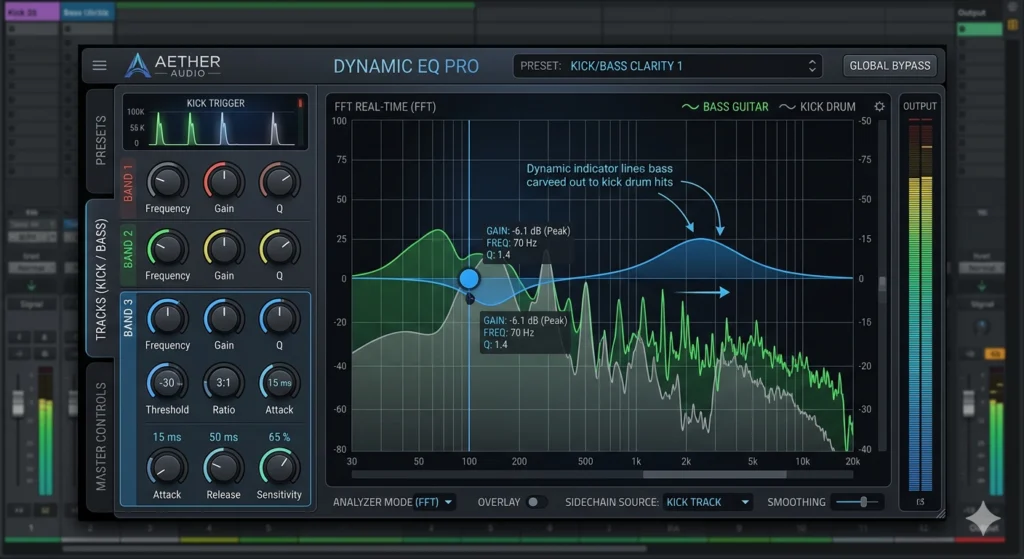
A dynamic EQ applies a cut or boost at a specific frequency only when the signal at that frequency exceeds a defined threshold. If a vocal and a pad compete at 2 kHz only during the chorus when the pad layer becomes more present, a dynamic EQ cut on the pad at 2 kHz will only engage during those moments. In the verse, where masking is not occurring, the pad retains its full character.
This context-sensitive approach is the most transparent way to address frequency masking because it preserves the natural character of elements when they are not competing and applies correction only when competition actually occurs.
Multiband Sidechain Compression for Kick and Bass Masking
The kick and bass frequency masking conflict at 60 Hz to 120 Hz is the most common and most structurally important masking problem in modern beat-based music. When the kick and bass compete in this zone, neither lands with full impact. The standard static EQ approach cuts the bass in this range permanently, which can make the bass feel thin when the kick is not playing.
A multiband sidechain compressor on the bass, triggered by the kick drum signal and targeting only the 60 Hz to 120 Hz band, reduces the bass level in that specific zone only when the kick hits. The bass retains its full low-end weight between kicks and yields the frequency zone to the kick at the moment of impact. This is the most musically natural solution to kick-bass masking because it mirrors how an experienced live bass player would physically create space for a live drummer.
The complete sidechain compression guide covers multiband sidechain approaches in detail, including how to set thresholds and release times for kick-bass masking correction that feels musical rather than mechanical.
Setting Thresholds for Dynamic Masking Correction
The threshold on a dynamic EQ or multiband compressor for masking correction should be set just below the level at which masking becomes audible. If the conflict is only noticeable when the masking element exceeds a certain energy level, set the threshold so that the correction engages at that level and not before.
A slow attack time of 10 to 30 milliseconds allows the transient of the masking element to pass before the correction engages, which preserves the punch and attack of both elements while still reducing sustained masking. A release time of 50 to 150 milliseconds allows the correction to lift naturally before the next transient arrives, preventing pumping that creates its own rhythmic artifacts.
Secret 5: Mid-Side EQ for Stereo Frequency Masking
Mid-side EQ is one of the most powerful and underused tools for addressing frequency masking in the stereo field. Standard EQ affects both the center and the sides of a stereo signal equally. Mid-side EQ allows independent processing of what is panned center and what is spread to the sides, creating options for masking correction that are impossible with standard EQ.
Why Stereo Masking Is Different From Mono Masking
When two elements compete in the center of the stereo field, mono masking occurs and standard EQ addresses it directly. When one element is panned wide in the stereo field and another occupies the center, the masking is primarily in the mono center signal. A standard EQ cut on the wide element reduces its level across the full stereo image, which changes its width and character unnecessarily.
A mid-side cut on only the mid channel of the wide element reduces its center presence without affecting its stereo width. The masking conflict is resolved while the stereo character of the element is fully preserved.
Low-Frequency Masking and the Mid Channel
Low frequencies below 200 Hz should always be mono in a professional mix, because sub-bass content in the stereo sides creates phase cancellation when the mix is folded to mono. This means all low-frequency masking conflicts exist in the mid channel only.
Using mid-side EQ to address low-frequency masking allows cuts to be applied specifically to the center channel, where the conflict exists, without affecting any stereo content that may be present on the sides. This is a more precise approach than standard EQ for low-frequency masking correction in elements that have both mono and stereo content.
The mono mixing secrets guide covers how mono referencing reveals frequency masking problems that stereo monitoring conceals, making it an essential companion tool for mid-side EQ correction.
Mid-Side EQ for Vocal Presence in Dense Arrangements
The most common application of mid-side EQ for masking correction is in vocal mixing. When a lead vocal is masked by harmonic elements in the 1 kHz to 4 kHz presence range, a standard EQ cut on the pad or synth layer reduces its presence equally across the full stereo field. A mid-side cut targeting only the mid channel of the masking element removes the conflict in the center where the vocal sits while leaving the stereo spread of the pad fully intact.
This approach consistently produces cleaner vocal presence than any amount of vocal boosting, because it removes the competition rather than trying to overcome it.
Secret 6: Arrangement and Panning as Frequency Masking Prevention
The most efficient way to handle frequency masking is to prevent it through arrangement and panning decisions before the mixing stage begins. Every frequency masking problem you solve in the mix is a problem that could have been avoided in the arrangement. Building masking prevention into your production workflow reduces mixing time and produces more natural-sounding clarity than corrective EQ alone.
Panning as a Masking Prevention Tool
Two sounds that occupy the same frequency zone create less masking when they are panned to different positions in the stereo field. A lead melody panned slightly left and a counter-melody panned slightly right will mask each other less than if both are panned center, even if their frequency content is identical.
This is because the stereo image provides a second dimension of separation that allows the ear to distinguish elements beyond their frequency content alone. Panning does not eliminate frequency masking, but it significantly reduces its perceptual severity, particularly for elements in the mid-range where the ear is most sensitive to spectral competition.
Arrangement Choices That Eliminate Masking Before It Starts
The simplest masking prevention tool in arrangement is the rule of one: only one element should occupy any given frequency zone as the primary occupant at any given time. When a bass-heavy instrument is playing, melodic elements in the low end should either be absent or significantly reduced. When a dense pad is present, mid-range melodic activity should be simplified.
These arrangement choices create natural frequency zoning without any EQ intervention. The mix clarity that results from this approach does not require surgical correction because the problem was never created in the first place.
Velocity and Density Reduction as Masking Control
Reducing the velocity or density of elements that are contributing to masking is often more musically effective than EQ correction. A pad that is playing every chord on every beat creates sustained mid-range energy that masks vocals and lead melodies continuously. The same pad playing on beats two and four, or with reduced velocity on off-beats, creates rhythmic space that reduces masking naturally while adding groove to the arrangement.
This approach is explored directly in the how to mix beats step-by-step guide, which covers how arrangement decisions made before mixing determines how much corrective EQ the mix will require.
Secret 7: Reference Tracks and Frequency Masking Calibration
One of the most reliable tools for identifying and correcting frequency masking is a well-chosen reference track. Comparing your mix to a professionally mixed track in the same genre instantly reveals which frequency zones have masking problems in your mix by showing you what a clean, separated spectral balance looks and sounds like.
How to Use a Reference Track for Masking Analysis
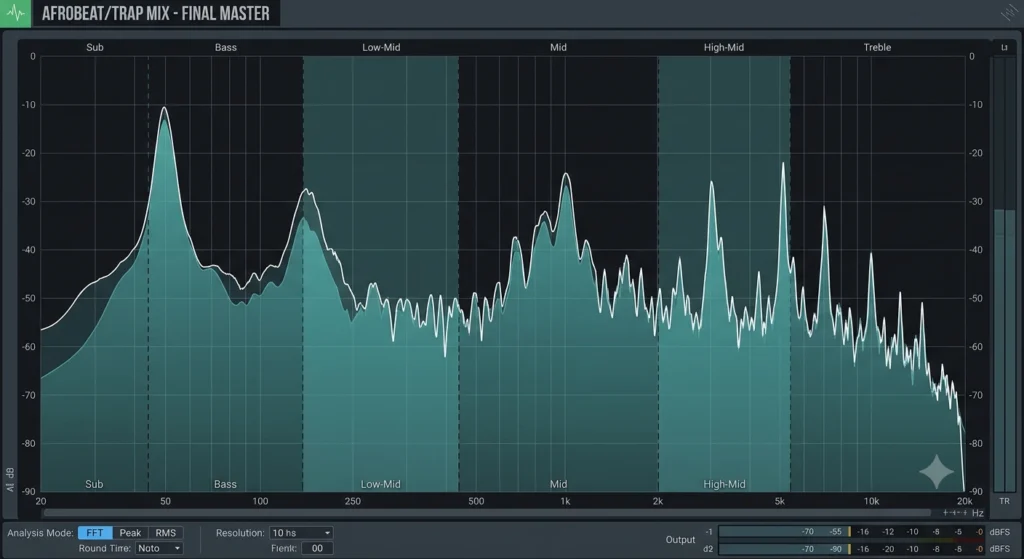
Import a professionally mixed reference track into your session and use a spectrum analyzer to compare its frequency balance to your mix. Zone by zone, from sub-bass to air, note where your mix has significantly more or less energy than the reference. Areas where your mix exceeds the reference by more than 3 to 4 dB often indicate masking buildup where multiple elements are contributing unmanaged energy.
This calibration approach is more reliable than solo monitoring for identifying masking because it gives you a perceptual anchor for what a well-separated mix sounds like in the specific frequency zones that matter for your genre.
Genre-Specific Masking Challenges and Their Solutions
Different genres have distinct frequency masking challenges based on their characteristic instrumentation and arrangement density.
In trap and hip-hop, the primary masking conflict is between the 808 sub-bass and the kick drum at 50 Hz to 100 Hz. The solution is multiband sidechain compression or careful complementary EQ that assigns the fundamental to the 808 and the click and body to the kick.
In Afrobeat and Afrobeats, masking typically occurs between the bass guitar, the rhythm guitar or piano, and the lead vocal in the 200 Hz to 1 kHz zone. Complementary EQ that carves the rhythm instrument below 400 Hz and above 2 kHz while leaving the 400 Hz to 2 kHz zone primarily for the lead vocal and bass resolves most conflicts in this genre.
In amapiano, the log drum bass sits in a unique zone between sub-bass and mid-bass that can mask both the kick and the piano simultaneously. The 808 bass design and low end clarity guide applies directly to managing these conflicts in productions where the bass instrument is a hybrid of percussion and melody.
Building a Personal Frequency Masking Reference Library
Over time, building a library of 10 to 20 professionally mixed reference tracks in your primary genres, organized by their spectral characteristics, gives you a reliable calibration tool for every session. These references serve not just for masking identification but for the full range of mix decisions from tonal balance to dynamic range.
The mixing and mastering proven secrets guide covers how to integrate reference track comparison into a systematic mix workflow that catches frequency masking and other problems before they accumulate into a mix that requires total reconstruction.
Applying Frequency Masking Solutions Across Your Productions
Frequency masking is not a problem you solve once and never encounter again. It is a recurring challenge that appears in every new session in different forms, with different elements, at different frequencies, for different reasons. The goal of this guide is not to give you a checklist of fixes but to build a way of hearing that identifies masking as it forms and addresses it with the minimum intervention necessary.
The Masking Correction Workflow
A systematic approach to frequency masking correction in every session prevents problems from compounding. Apply this workflow in order before reaching for any EQ moves.
- Identify which elements are competing using spectrum analysis and solo comparison
- Determine whether the masking is simultaneous or temporal
- Determine whether the masking is consistent or context-dependent
- Apply static surgical EQ for consistent masking, dynamic EQ for context-dependent masking
- Use complementary EQ to create reciprocal space rather than unilateral cuts where possible
- Check the correction in mono to confirm it holds across playback systems
- Reference against a professional mix in the same genre to calibrate the result
The Character Preservation Test
After any EQ correction for frequency masking, apply the character preservation test. Solo the element you EQed and listen to it in isolation. If it sounds noticeably different from how it sounded before the correction, your cut was too broad or too deep. Back off until the element sounds essentially the same in solo but gains clarity in the full mix. That is the point where frequency masking has been solved without character being sacrificed.
The guide to preserving dynamics when mixing applies the same principle to compression decisions, covering how corrective processing of any kind should be transparent in isolation and only reveal its benefit in the context of the full mix.
Start Solving Frequency Masking in Your Next Session
Frequency masking is the hidden architect of the gap between how your tracks sound and how professional releases sound. It is not a talent gap. It is a diagnostic gap. Once you develop the ability to hear it, map it, and address it systematically, the clarity and power you have been chasing in your mixes becomes achievable without replacing your sounds or starting from scratch.
The 7 proven secrets in this guide work together as a complete system: identify masking accurately, apply surgical narrow cuts, use complementary EQ to create reciprocal space, deploy dynamic EQ for context-dependent conflicts, use mid-side EQ for stereo masking, prevent masking through arrangement decisions, and calibrate with reference tracks.
Frequency masking mastery is not about making a perfect mix in isolation. It is about building the perceptual skills to hear competition between sounds and the technical skills to resolve it with precision. Apply one secret per session until all seven become automatic. At that point, your mixes will not just be clear. They will be powerful, character-rich, and competitive with any professional release in your genre.
Every sound in your mix deserves its own space. Give it that space and it will reward you with presence that no amount of boosting or layering can manufacture.
Frequently Asked Questions About Frequency Masking
What is frequency masking in music production?
Frequency masking is a psychoacoustic phenomenon in which one sound makes another sound inaudible or significantly reduced in perceived volume because they share the same or adjacent frequency content. It occurs because the human auditory system has limited resolution in certain frequency bands and cannot fully distinguish two sounds that activate the same region of the cochlea simultaneously. It is one of the most common causes of muddy, unclear, and unprofessional-sounding mixes.
How do I know if my mix has a frequency masking problem?
The clearest sign of frequency masking is an element that sounds full and present when soloed but thin, quiet, or undefined in the full mix. Other signs include a vocal that disappears behind the arrangement, a kick and bass that feel mushed together rather than punching separately, and a mix that sounds clear on professional speakers but collapses on headphones or phone speakers. Using a spectrum analyzer to compare energy levels between elements in the same frequency zone will confirm a masking conflict visually.
What is the best EQ technique for fixing frequency masking?
The most effective technique is the sweep and find method combined with a narrow parametric cut. Boost a narrow band on the masking element and sweep it through the suspected frequency range until you find the point where the conflict dramatically worsens. Then convert that boost to a cut of 2 to 4 dB. For context-dependent masking that only occurs in dense sections of the arrangement, a dynamic EQ that engages only when the masking threshold is exceeded produces more transparent results than a static cut.
Should I cut the masking element or boost the masked element?
In most cases, cut the masking element rather than boosting the masked one. Boosting the masked element adds gain, which typically creates new masking problems with other elements in the vicinity of the boosted frequency. Cutting the masking element removes the competition directly and preserves the natural level balance of the mix. The exception is when the masked element genuinely lacks energy in the conflicting zone and needs a small boost combined with a cut in the masking element.
How does frequency masking differ from a muddy mix?
A muddy mix is typically a symptom that frequency masking is causing, not a separate problem. Muddiness in the low-mid range, typically 200 Hz to 500 Hz, is almost always caused by multiple elements with unmanaged energy in that zone masking each other and creating a combined buildup that sounds undefined and heavy. Addressing the frequency masking conflicts in that zone through surgical EQ and complementary cuts resolves the muddiness without any separate processing targeted at the mud itself.
Does frequency masking only happen in the low end?
No. Frequency masking occurs across the entire frequency spectrum. Low-end masking between kick and bass is the most discussed because it is the most physically obvious. But mid-range masking between vocals and pads, upper-mid masking between lead melodies and guitars or keys, and high-frequency masking between cymbals and atmospheric elements are all equally common and equally damaging to mix clarity. Each frequency zone requires the same systematic identification and corrective approach.
Can arrangement changes solve frequency masking without EQ?
Yes, and in many cases arrangement changes are more effective and more musical than EQ corrections. Reducing the density or velocity of a masking element, changing its rhythmic pattern to create gaps that coincide with the entry of the masked element, or panning competing elements to different stereo positions all reduce masking perceptually without any spectral processing. The most professional mixes are typically the ones where arrangement decisions have minimized masking before the mix stage, leaving EQ to address the remaining conflicts with minimal intervention.