
Can you Sell AI Beats in 2026? Yes, you can, but the money only stays in your pocket if you understand who owns what. Thousands of producers now start ideas in Suno, Udio, or AI-powered plugins, then upload the results to beat stores within minutes. Many of them have no idea that a beat with no human authorship may have no copyright at all, which means the “exclusive” rights they just sold might be worthless.
This guide cuts through the noise. You will learn what copyright offices and courts have actually said, how AI tool terms decide ownership, which platforms welcome AI-assisted work, and the seven legal rules that let you sell AI beats with confidence.
Quick note: this article is educational, not legal advice. Laws differ by country and change fast. For a big deal or a dispute, talk to a music lawyer.
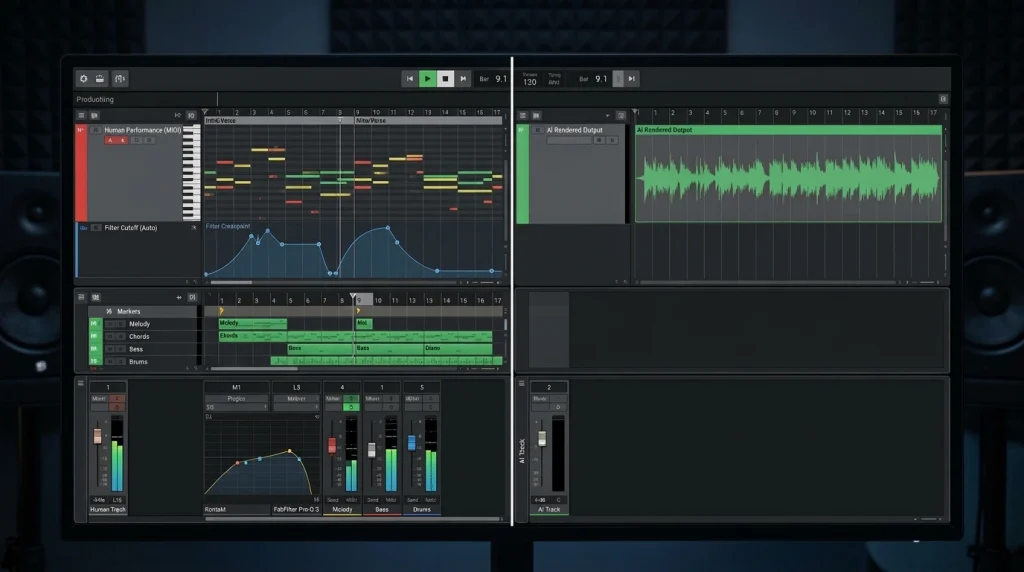
Can You Sell AI Beats? The Short Answer for 2026
Here is the honest answer: nothing in US, UK, or EU law stops you from selling a beat just because AI touched it. Selling is legal. The real question is what you are actually selling, and whether you own enough of it to license.
Think of it in three layers:
- The right to use the audio. This comes from the AI tool’s terms of service. If the terms say you own the output or may use it commercially, you can generally sell AI beats made with it.
- The copyright in the audio. This comes from the law, not from the tool. In the US, copyright needs human authorship, so a fully machine-made beat may be unprotected.
- The right to stop others copying it. Without copyright, you cannot stop someone from ripping your beat and reselling it.
So when producers ask whether they can sell AI beats, the answer is yes, with a catch. You can sell access and a license, but your ability to promise exclusivity depends on how much of the beat is truly yours.
Why This Matters More in 2026
The AI music market exploded. Deezer reported that by late 2025 more than a third of all new daily uploads to its service were fully AI-generated. Beat buyers, labels, and distributors have noticed, and they are asking harder questions before they pay.
Who This Guide Is For
This guide is for beat makers who sell leases and exclusives online, type beat producers on YouTube, and anyone experimenting with AI who wants to sell AI beats without legal surprises. If you already run a store, pair this with our guide on how to sell type beats online with proven strategies.
How Copyright Law Treats AI-Generated Music in 2026
Before you sell AI beats, you need to know how the three biggest legal systems for independent producers treat machine-made work. The short version: the US demands a human, the UK has an old and unusual rule, and the EU is focused on transparency.
The US Copyright Office Position
In January 2025 the US Copyright Office published Part 2 of its report on copyright and artificial intelligence (Source: copyright.gov). Its conclusions are clear:
- Purely AI-generated material is not protected by copyright.
- Prompts alone, even detailed ones, usually do not give you enough control to count as authorship.
- Human contributions are protected: your own melodies, edits, arrangements, and the creative selection and arrangement of AI parts.
For anyone planning to sell AI beats, that last point is the key: your human choices are what the law protects.
The Office also requires you to disclose AI-generated material when you register a work. Its 2023 registration guidance (Source: Federal Register) tells applicants to claim only the human-authored parts and to exclude AI content that is more than minimal.
Thaler v. Perlmutter: The Courts Agree
In March 2025 the US Court of Appeals for the D.C. Circuit ruled in Thaler v. Perlmutter (Source: D.C. Circuit) that the Copyright Act requires a human author. The case involved an image, but the rule applies to music too. A beat generated end to end by software has no human author to own it. If you sell AI beats that no human shaped, you are selling audio that anyone could legally copy.
The UK Computer-Generated Works Rule
The UK is different. Section 9(3) of the Copyright, Designs and Patents Act 1988 (Source: legislation.gov.uk) says that for a computer-generated work, the author is the person who made the arrangements necessary to create it. Protection lasts 50 years instead of the usual life plus 70.
That sounds friendly to anyone who wants to sell AI beats, but be careful. The rule has barely been tested in court, and the UK government has openly questioned whether it should survive. Do not build a business on it alone.
The EU AI Act and Transparency
The EU AI Act does not decide who owns AI music. Instead, Article 50 of the EU AI Act (Source: artificialintelligenceact.eu) sets transparency duties that apply from 2 August 2026. Providers of generative AI must mark outputs as machine-generated in a detectable way, and deepfake audio must be disclosed. If you sell AI beats to European artists, expect more buyers to ask for disclosure.
| Region | Who owns AI output? | Key rule for producers |
|---|---|---|
| United States | No one, unless a human contributed expression | Disclose AI parts when registering |
| United Kingdom | Person who made the arrangements (s. 9(3)) | 50-year term, untested in music |
| European Union | Decided by national law, generally needs a human | Label AI content from August 2026 |
Who Owns Your Beat? Reading AI Tool Terms Before You Sell AI Beats
Copyright law is only half of the picture. The other half is the contract you clicked “agree” on. Every AI music tool has terms of service, and those terms decide whether you are even allowed to sell AI beats made with it.
Free Tiers vs Paid Plans
Most AI music generators split rights by plan. Historically, Suno has told free users that the company keeps ownership and use is non-commercial, while paid subscribers get ownership of their outputs and commercial rights. Other tools follow a similar model.
The rule of thumb is simple:
- Free plan: assume you cannot sell AI beats made on it.
- Paid plan: you may get commercial rights, but only for songs made while your subscription was active.
- Cancelled plan: check whether rights survive. Upgrading later usually does not cover old free-tier songs.
Label Settlements Changed the Rules
In June 2024 the major labels sued Suno and Udio for training on copyrighted recordings. Since then the landscape has shifted. Universal and Warner announced settlements with Udio in late 2025, Warner settled with Suno, and reports in 2026 indicate claims by other labels against Suno continued. Part of these deals involves moving to licensed models and tighter controls on downloads.
What does this mean for you? Terms can change, features can disappear, and older outputs may be treated differently from new ones. Save a dated PDF of the terms every time you create beats you plan to sell.
Stem, Loop, and Plugin Generators
Not every AI tool writes full songs. Many producers use AI drum generators, melody assistants, stem splitters, or AI mastering. These usually carry fewer risks because you still write and arrange the beat. Still, read the license. Some sample libraries now forbid using their sounds to train AI, and some stem separation tools restrict commercial use of extracted parts.
If you want a bigger overview of these tools, see our breakdown of essential AI music tools and how producers use them.
Five Clauses to Check in Any AI Tool
- Ownership: who owns the output, you or the company?
- Commercial use: are sales, streaming, and sync allowed?
- License back: does the company keep a license to use your outputs?
- Warranty: does the company promise the output is non-infringing? Usually not.
- Changes: can they change terms and apply them to past outputs?
7 Legal Rules to Sell AI Beats Without Getting Burned
This is the core of the guide. Follow these seven rules and you can sell AI beats while protecting both yourself and your buyers.
Rule 1: Only Use Tools That Grant Commercial Rights
Never sell AI beats made on a free, non-commercial tier. Before any sale, confirm your plan, the date you generated the audio, and what the terms said on that date. Screenshots and exported account histories are your best friends.
Rule 2: Add Real Human Authorship
The more you create, the more you own. Replace AI drums with your own programmed patterns, re-play melodies on a MIDI keyboard, rewrite chord progressions, arrange the sections, and mix it yourself. Copyright protects those human choices, and they make your beat unique.
Rule 3: Document Your Creative Process
Keep project files, MIDI, session versions, and a short note on what came from AI and what you made. If anyone ever challenges your ownership, this paper trail is the evidence. It also makes it much easier to register your work.
Rule 4: Never Clone a Real Artist’s Voice
This is the fastest way to lose everything. Using an AI voice that sounds like Drake, Rihanna, or any real singer without permission can break right-of-publicity laws, platform rules, and trademark law. We cover this in detail below.
Rule 5: Disclose AI Use to Your Buyers
Transparency protects you. A simple line in your listing and license, such as “Melody sketch generated with AI, fully rearranged, re-recorded, and mixed by the producer,” builds trust and reduces the risk of misrepresentation claims.
Rule 6: Be Careful With Exclusive Rights
If most of the beat is raw AI output, you may not hold a copyright to transfer. Selling “exclusive rights” to something you cannot protect is risky. Either add enough human authorship to justify it or sell non-exclusive leases instead. Many producers who sell AI beats successfully use leases for lighter AI work and save exclusives for fully rebuilt tracks.
Rule 7: Keep Your Licenses and Terms Updated
AI law in 2026 moves quickly. Review your beat license, your store terms, and your tool subscriptions at least twice a year. When a platform or law changes, update your contracts before your next sale.
Key takeaway: you do not need to avoid AI. You need to add human creativity, keep records, stay honest with buyers, and never borrow a real artist’s identity.
Platform Policies: Where You Can Sell AI Beats in 2026
Even when the law allows a sale, every platform can set its own rules. Here is how the main channels treat producers who sell AI beats or release AI-assisted music.
Beat Marketplaces and Your Own Store
Most beat marketplaces focus on two things: you must own or control the rights to what you upload, and you must not infringe anyone else. Read the upload agreement on any marketplace you use, since many ask you to promise that your beats are original and cleared. That promise is hard to keep with unedited AI output.
Running your own store gives you more control over disclosures and license wording. For store tactics, read our guide on how to market your beat store.
Streaming Services
In September 2025 Spotify announced a stricter impersonation policy, a new music spam filter, and support for AI disclosures in song credits. It also said it had removed more than 75 million spammy tracks in the previous 12 months, as reported by Variety (Source: Variety). Deezer now tags fully AI-generated albums and removes them from editorial recommendations.
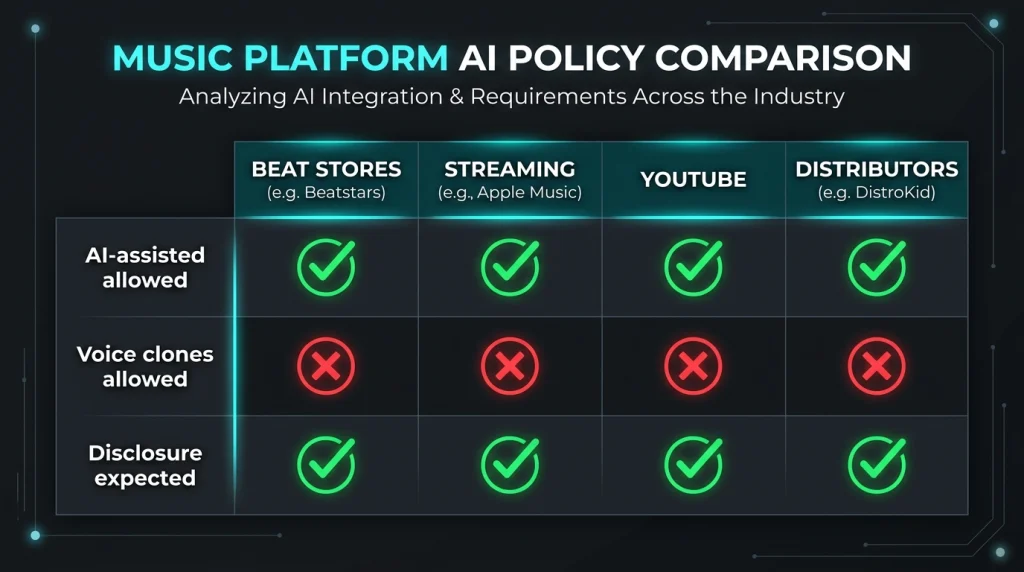
For producers who sell AI beats, this means AI-assisted tracks can still be released, but mass-produced, low-effort tracks and voice clones are being filtered out.
YouTube and Content ID
Type beat producers live on YouTube. Two risks matter here. First, YouTube requires creators to disclose realistic altered or synthetic content. Second, AI tools can output audio that closely matches existing recordings, which can trigger Content ID claims against you or your buyers. Always run a beat through a test upload set to private before you sell it widely.
Distributors
Distributors such as DistroKid, TuneCore, and CD Baby generally accept AI-assisted music but reject impersonation, spam, and content you do not have the rights to. Some now ask whether AI was used during upload. Answer honestly, because a false answer can cost you your account and your royalties. If you sell AI beats to artists who distribute them, tell buyers exactly what to disclose.
Voice Cloning and Type Beats: The Biggest Legal Trap
Type beats are legal. Naming a beat “Drake type beat” describes a style, and producers have done it for years. Using an AI clone of Drake’s actual voice is a completely different thing.
The 2023 Wake-Up Call
In 2023 an anonymous creator released “Heart on My Sleeve,” a song with AI vocals imitating Drake and The Weeknd. It went viral and was pulled from streaming services within days. That moment pushed labels and lawmakers into action.
New Voice and Likeness Laws
Tennessee passed the ELVIS Act in 2024, which expressly protects a person’s voice from unauthorized AI imitation. In Congress, the proposed NO FAKES Act would create a federal right over digital replicas of voice and likeness. Many other states already protect name and likeness through right-of-publicity laws.
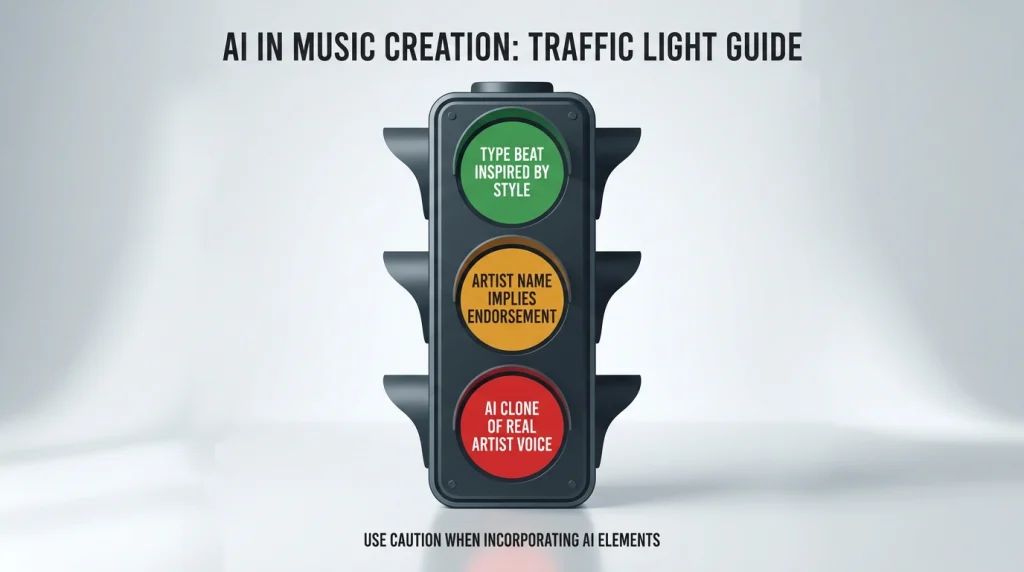
Where the Line Sits
- Safe: a beat inspired by an artist’s sound, tagged as a type beat.
- Risky: using the artist’s name in a way that suggests they endorse or appear on the track.
- Unsafe: AI vocals, tags, or ad-libs that imitate a real artist’s voice without permission.
If you produce in the style of your favorite artists, study their sound the traditional way. Our tutorial on how to make trap beats like Drake shows how to capture a vibe without cloning anyone.
How to License AI-Assisted Beats Honestly
Your license is where the law meets your business. A smart license lets you sell AI beats without overpromising. If licensing is new to you, start with our guide to music licensing explained.
Leases vs Exclusives
Non-exclusive leases are the safest way to sell AI beats. You are granting permission to use the beat, and you are not promising that nobody else can ever use it. Exclusive licenses and full buyouts are different: the buyer pays for control, so you must actually have something to hand over.
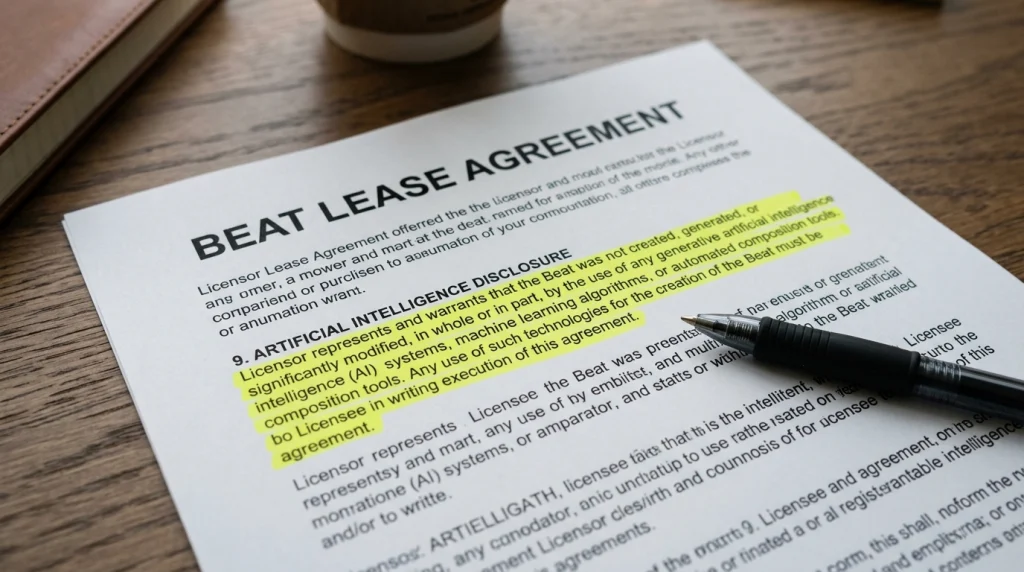
A Sample Disclosure Clause
Add a short clause like this to your license:
“Producer confirms that artificial intelligence tools were used during the creation of this Beat for [melody ideas / drum generation / mastering]. All AI-generated elements were created under a plan granting commercial rights, and the final Beat was arranged, edited, and mixed by Producer. Producer does not warrant that AI-generated elements are eligible for copyright protection.”
Have a lawyer review the final wording for your country.
Warranties and Indemnity
Most beat licenses include a promise that the beat is original and does not infringe anyone. With AI, you cannot always be sure what the model learned from. Keep your warranty narrow: promise what you control, such as your own contributions and your tool licenses, rather than guaranteeing the whole beat is free of any claim.
Pricing AI-Assisted Beats
Should AI-assisted beats cost less? Not necessarily. Buyers pay for quality, vibe, and trust. Heavily human-crafted beats can keep full pricing. If you sell AI beats that are closer to rough sketches, place them in lower-priced lease tiers. Our article on beat pricing psychology explains how to structure tiers.
A Human-First Workflow to Sell AI Beats You Actually Own
The best legal strategy is also the best creative strategy: use AI as a collaborator, not a ghost producer. Here is a workflow that keeps you in charge.
Step 1: Use AI for Sketches, Not Finals
Generate chord ideas, drum grooves, or textures with AI, then treat them like a rough demo. Pick the parts that inspire you and throw away the rest.
Step 2: Rebuild the Core Elements
Re-program drums, re-play melodies via MIDI, design your own 808s, and write a counter melody. Each change adds human authorship and makes your beat stand out from thousands of similar AI tracks.
Step 3: Arrange, Mix, and Master Yourself
Arrangement and mixing are creative choices. Decide the structure, the drops, the transitions, and the space. This also improves quality, which matters more than ever in a crowded market.
Step 4: Register Your Work When It Matters
For your strongest beats, consider registering with the US Copyright Office or your local equivalent. Disclose the AI parts and claim your human contributions. Registration makes it much easier to enforce your rights later.
For a wider look at building AI into your process, see our AI music production workflow guide.
Risks and Red Flags When You Sell AI Beats
Nothing about this area is settled. Here are the risks worth watching as you sell AI beats through 2026 and beyond.
Training Data Lawsuits
Courts are still deciding whether training AI on copyrighted recordings and lyrics is legal. In November 2025 a Munich court ruled against OpenAI in a case brought by the German collecting society GEMA over song lyrics. GEMA has also sued Suno. If a tool loses a major case, its outputs could face new restrictions.
Sound-Alike Outputs
AI models sometimes produce melodies or sounds very close to existing songs. If your beat copies a protected melody, you are liable, not the AI. Listen critically before you sell AI beats, and change anything that sounds familiar.
Buyer Disputes
An artist who pays for an exclusive and later finds the same AI melody on another track will be angry, and may have a claim against you. Honest disclosure and strong human edits prevent most of these disputes.
Checklist Before Every Sale
- Paid plan with commercial rights confirmed
- Meaningful human edits made and saved
- No real artist voice or name misused
- Private test upload passed Content ID
- AI disclosure added to listing and license
Conclusion: Sell AI Beats the Smart Way
So, can you sell AI beats in 2026? Yes. Selling is legal, and millions of listeners never ask how a beat was made. What buyers, platforms, and courts care about is ownership, honesty, and identity.
Remember the essentials:
- Pure AI output usually has no US copyright, so add real human creativity.
- Tool terms decide whether you may sell at all, so use paid plans and save the terms.
- Never clone a real artist’s voice.
- Disclose AI use and keep exclusive promises realistic.
Follow the seven rules above and you can sell AI beats with confidence, protect your buyers, and build a catalog that is truly yours. Ready to level up the human side of your production? Explore our guides, grab a drum kit, and start creating beats nobody else can copy.
Frequently Asked Questions
Can I legally sell AI beats on BeatStars or my own website?
Generally yes, as long as your AI tool’s terms grant commercial rights, you do not infringe existing songs, and you follow the marketplace’s upload agreement. Check each platform’s current rules before listing.
Do I own the copyright to beats made with Suno or Udio?
In the US, you only own copyright in the parts you personally created. A paid plan may give you contractual ownership of the output, but raw AI audio is usually not protected by copyright.
Can I sell exclusive rights to an AI-generated beat?
You can, but it is risky if the beat is mostly raw AI output, because you may have no copyright to transfer. Add significant human authorship or stick to non-exclusive leases.
Do I have to tell buyers my beat was made with AI?
No universal law requires it everywhere yet, but transparency rules are growing, especially in the EU, and platforms increasingly ask. Disclosing AI use protects you from misrepresentation claims.
Is it legal to sell AI beats as type beats?
Making a beat inspired by an artist’s style is legal. Using an AI clone of that artist’s voice, or implying they are on the track, is not safe and can violate right-of-publicity laws.
Can I register an AI-assisted beat with the Copyright Office?
Yes. You can register the human-authored parts, but you must disclose AI-generated material that is more than minimal and exclude it from your claim.