
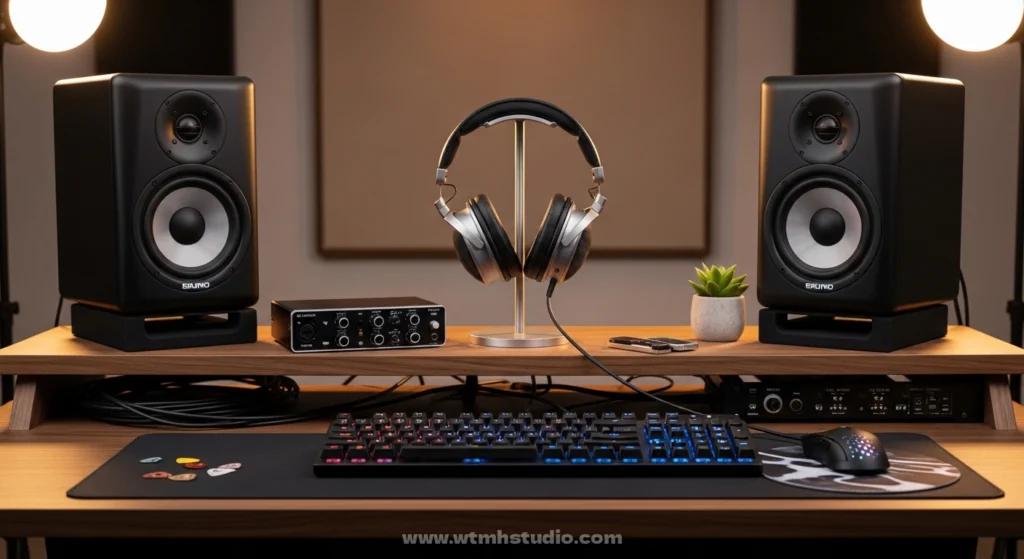
You have saved up your first serious production budget. Your home studio is coming together, but you face a critical decision that will shape your sound for years. Should you invest in studio monitors or high-quality headphones first? The music forums offer conflicting advice. Your producer friends have strong opinions. And the gear reviews only add to the confusion.
The debate between studio monitors vs headphones is one of the most hotly contested topics in home recording. Make the wrong choice, and you could spend months struggling with mixes that sound great in your room but fall apart everywhere else. Make the right choice, and you build a foundation for professional-quality work that translates consistently across every playback system.
This comprehensive guide reveals seven critical truths that cut through the marketing hype and forum debates. You will learn exactly which monitoring solution deserves your hard-earned money first, based on your unique situation, budget, and production goals. By the end, you will have a clear decision framework and actionable next steps for your home studio journey.
Understanding the Studio Monitors vs Headphones Debate
Before diving into which option you should buy first, you need to understand why this debate exists in the first place. Studio monitors and headphones serve the same fundamental purpose: accurate audio monitoring that allows you to make informed mixing decisions. However, they achieve this goal through completely different mechanisms, each with distinct advantages and limitations.
Studio monitors are speakers designed specifically for critical listening in a controlled environment. They aim to reproduce audio with minimal coloration, revealing the true character of your mix. Headphones, on the other hand, place drivers directly against your ears, eliminating room acoustics from the equation but introducing their own challenges related to stereo imaging, ear fatigue, and frequency perception.
The tension between studio monitors vs headphones is not about which is objectively better. It is about which solution aligns with your specific circumstances. Professional studios use both because each serves different purposes. But for producers building their first serious setup on a limited budget, choosing where to invest first requires careful consideration of several critical factors.
The Truth About Studio Monitors: Strengths and Limitations
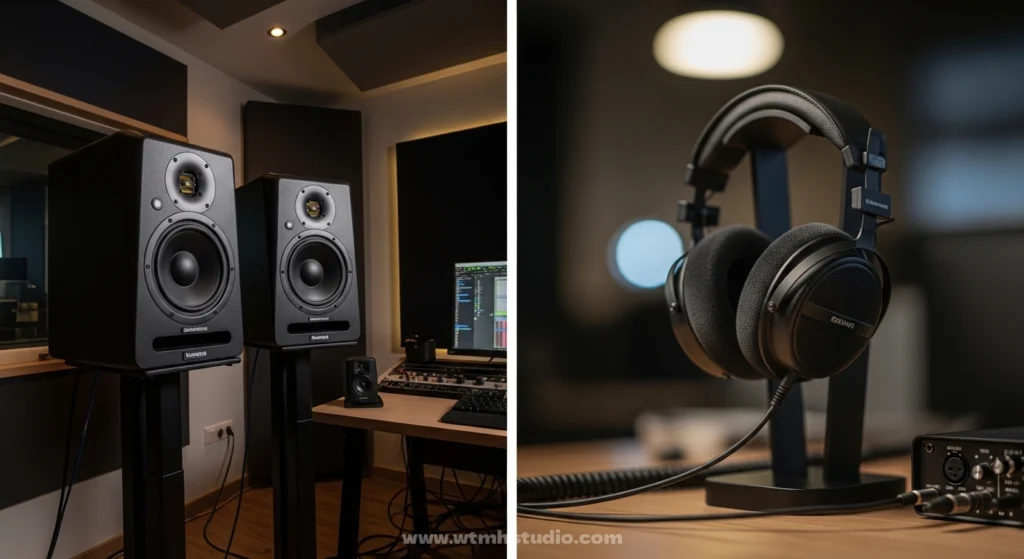
Studio monitors offer the most natural listening experience because they replicate how humans naturally hear sound. Sound waves travel through the air, interact with your room, and reach both ears simultaneously. This creates an accurate representation of how your mix will sound in real-world environments.
Strengths of Studio Monitors:
Natural stereo imaging: Monitors create a true stereo image where sounds appear in physical space between and around the speakers. Your brain processes subtle timing and level differences exactly as it would in a real listening environment, leading to more accurate panning decisions.
Physical impact: Low frequencies are felt as well as heard when using monitors. Kick drums and bass notes have physical weight that headphones cannot replicate. This tactile feedback is essential for genres where low-end impact defines the listening experience.
Less ear fatigue: Sound waves traveling through the air before reaching your ears reduces the direct pressure that causes ear fatigue. Producers can work longer sessions on monitors without experiencing the discomfort common with extended headphone use.
Translation accuracy: When your room is properly treated, monitors provide the most reliable representation of mix translation. What you hear is what listeners will hear on home speakers, car stereos, and club systems.
Limitations of Studio Monitors:
Room dependency: Monitors are only as accurate as your room allows. Untreated rooms with parallel walls, reflective surfaces, and bass buildup create frequency anomalies that make accurate mixing impossible. A 1000 set of monitors in a bad room sounds worse than 200 headphones.
Volume limitations: Monitors must be played at appropriate volumes to be effective. Apartment dwellers or producers with noise restrictions may struggle to use monitors effectively without disturbing neighbors or family members.
Higher initial investment: A proper monitor setup requires not just speakers but also stands or isolation pads, room treatment, and proper placement. The total investment often exceeds the cost of the monitors themselves.
For professional guidance on selecting monitors, consult this comprehensive studio monitor selection guide from Sound on Sound (external link, opens in new tab).
The Truth About Studio Headphones: Strengths and Limitations
Studio headphones offer a completely different monitoring experience. By isolating your ears from the room, they provide consistent, repeatable results regardless of your physical environment.
Strengths of Studio Headphones:
Room independence: Headphones eliminate room acoustics entirely. Whether you mix in a treated studio, a bedroom, or a hotel room, headphones deliver the same frequency response every time. This consistency is invaluable for producers in imperfect spaces.
Detail resolution: Headphones reveal microscopic details that monitors can mask. Background noise, reverb tails, and subtle distortion become immediately apparent, allowing for precision editing and critical listening.
Cost effectiveness: A professional set of studio headphones costs significantly less than entry-level monitors plus required treatment. Producers can achieve accurate monitoring for 200 to 400, compared to 500 to 1000 for a basic monitor setup.
Portability: Headphones travel with you. You can mix on the road, work late without disturbing anyone, and maintain consistent monitoring across different locations.
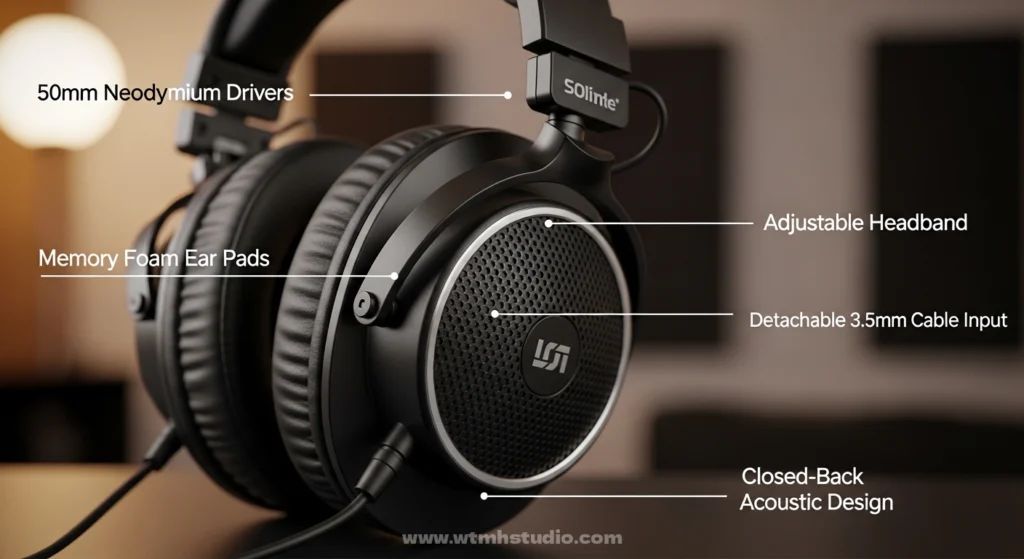
Limitations of Studio Headphones:
Unnatural stereo image: Headphones create an exaggerated stereo image with sounds appearing inside your head rather than in physical space. This leads to panning decisions that sound too wide on speakers and a false sense of separation.
Ear fatigue: Prolonged headphone use causes listening fatigue faster than monitors. The direct pressure on your ears and the lack of physical space for sound to breathe creates discomfort that limits productive session length.
Bass perception issues: Headphones provide bass information without the physical impact of monitors. Many producers compensate by mixing bass too loud, leading to mixes that lack low-end presence on speaker systems.
Standardized reference: The AES headphone measurement standards (external link, opens in new tab) highlight the variation between headphone models, making it essential to choose models designed specifically for mixing rather than consumer listening.
When selecting headphones for mixing, certain models are specifically designed for accurate frequency response and long session comfort. Check our guide on quality studio headphones for critical listening to make an informed purchase.
Studio Monitors vs Headphones Factor #1: Your Room Acoustics Reality
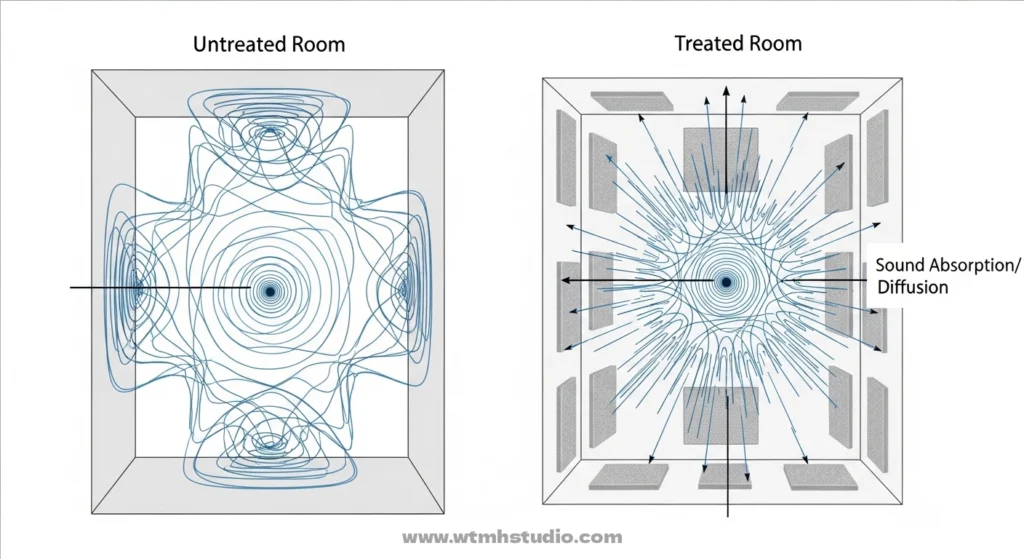
Your room acoustics represent the single most important factor in the studio monitors vs headphones decision. Monitors are only as accurate as your room allows. Headphones bypass room issues entirely.
Assess your room honestly:
- Is your room treated with acoustic panels and bass traps?
- Do you have parallel walls that create standing waves?
- Can you place monitors at ear level with proper distance from walls?
- Are you in a space where you can play monitors at reasonable volumes?
If your room is untreated or cannot be treated due to rental restrictions or budget limitations, headphones provide the more accurate monitoring solution. Mixing on monitors in an untreated room leads to inaccurate frequency perception. You will overcompensate for bass buildup, miss mid-range issues, and create mixes that sound completely different outside your room.
If your room has untreated acoustics, you may need to consider acoustic treatment before investing in studio monitors. Explore DIY acoustic treatment solutions to improve your listening environment.
For producers with properly treated rooms, monitors become the superior option. A good room with quality monitors provides the most reliable path to professional mix translation.
Studio Monitors vs Headphones Factor #2: Your Budget and Long-Term Investment
Your available budget significantly impacts which path makes sense. Consider not just the immediate purchase but the complete system cost.
Monitor setup total cost:
- Studio monitors: 300 to 1000 minimum for entry-level professional models
- Monitor stands or isolation pads: 100 to 200
- Acoustic treatment: 200 to 500 for basic coverage
- Total: 600 to 1700 for a capable setup
Headphone setup total cost:
- Professional studio headphones: 150 to 400
- Optional headphone amplifier: 100 to 300
- Total: 150 to 700
If your budget is under 500 total, headphones provide the more realistic path to accurate monitoring. Spending 400 on monitors without treatment creates a system that is fundamentally flawed. Spending 400 on quality headphones and a dedicated headphone amp delivers professional-grade monitoring immediately.
For budgets over 1000 with room for treatment, monitors become the superior long-term investment. A properly treated room with quality monitors scales with your career and serves as the foundation for professional work.
Studio Monitors vs Headphones Factor #3: Your Production Style and Genre
Your music genre and production workflow influence which monitoring solution serves you best.
Genres That Benefit Most From Monitors:
- Electronic music and EDM: bass impact and kick drum punch require physical monitoring
- Hip-hop and trap: low-end translation is critical for commercial viability
- Rock and live instrumentation: natural stereo imaging helps balance acoustic instruments
- Pop production: wide stereo effects and polished sound benefit from speaker monitoring
Genres That Can Thrive on Headphones:
- Acoustic and singer-songwriter: detail resolution for vocals and subtle performances
- Orchestral and film scoring: microscopic detail for complex arrangements
- Podcast and voice-over: vocal clarity and sibilance control
- Mixing and mastering work: clients often work primarily on headphones
Your production style also matters. If you produce primarily at night, share living space, or move between locations, headphones offer practical advantages regardless of genre. If you work during the day, have dedicated studio space, and prioritize low-end accuracy, monitors may justify the investment even with genre considerations.
Studio Monitors vs Headphones Factor #4: Mix Translation Across Playback Systems
Mix translation refers to how your mix sounds across different playback systems. Car stereos, phone speakers, Bluetooth speakers, and club systems all present your music differently. Your monitoring solution directly impacts how well your mixes translate.
Translation strengths of monitors:
- Provide accurate representation of how sound behaves in physical space
- Allow you to hear phase relationships and stereo imaging naturally
- Reveal how low frequencies interact and build up
- Enable you to feel the physical impact of bass and transients
Translation strengths of headphones:
- Eliminate room variables that distort translation
- Reveal microscopic details that affect translation
- Provide consistent reference point across locations
- Allow you to reference mixes without room coloration
The ideal scenario combines both. Many professional mixers start on monitors for overall balance and spatial decisions, then check on headphones for detail work and translation verification.
For advanced guidance on achieving consistent mix translation, explore mix translation best practices from iZotope (external link, opens in new tab).
Regardless of whether you choose monitors or headphones first, understanding advanced mixing techniques ensures your tracks translate properly. Our advanced mixing techniques for professional results guide provides actionable strategies for both monitoring scenarios.
Studio Monitors vs Headphones : Which Should You Buy First?
After analyzing all seven critical factors, the answer to the studio monitors vs headphones question depends entirely on your specific situation. Here is your decision framework:
Buy Studio Monitors First If:
- You have a dedicated room that can be acoustically treated
- Your budget allows for monitors plus treatment (minimum 800 total)
- You produce bass-heavy genres requiring physical low-end feedback
- You work primarily during hours when playing speakers is acceptable
- You plan to build a long-term professional studio space
Buy Headphones First If:
- Your room is untreated or cannot be treated
- Your budget is under 500
- You share living space or work late hours
- You travel or work from multiple locations
- You produce genres requiring extreme detail work
The Hybrid Approach:
Most professional producers eventually use both. If budget allows, consider:
- Purchase quality headphones first for immediate accurate monitoring
- Save for monitors and room treatment
- Add monitors when budget and space allow
- Use headphones for detail work and night sessions
- Use monitors for overall balance and low-end decisions
Choosing the right monitoring solution is a foundational step in building your home studio and advancing your production career. For producers committed to professional growth, explore our comprehensive guide on building a successful bedroom producer career for more foundational strategies.
Studio Monitors vs Headphones: Conclusion
The debate between studio monitors vs headphones does not have a universal answer because your situation is unique. The right choice depends on your room, your budget, your genre, and your production workflow. What works for a producer in a treated studio with a 2000 budget does not apply to someone building a first setup in an untreated bedroom.
The critical truth is that accurate monitoring matters more than the specific tool. Whether you choose monitors or headphones first, invest in quality equipment designed for professional mixing. Learn your monitoring system intimately. Reference commercial mixes regularly. And always check your work on multiple playback systems to ensure translation.
The most successful producers understand that monitoring is a skill, not just a purchase. Whichever path you choose, commit to learning how your monitoring system translates. Your mixes will improve dramatically when you understand the relationship between what you hear and what your audience hears.
[IMAGE PLACEMENT #9]https://studio-monitoring-setup-checklist.jpg
Image Description: Visual checklist summarizing key takeaways for monitoring setup
Studio Monitors vs Headphones: FAQ
Q1: Can I mix on consumer headphones or computer speakers?
Consumer headphones and computer speakers are designed for enjoyment, not accuracy. They apply frequency curve adjustments that misrepresent your mix. Professional studio monitors or dedicated studio headphones are essential for reliable mixing decisions.
Q2: Is it possible to get professional mix translation using only headphones?
Yes, many professional mixers work primarily on headphones, especially in genres like acoustic, orchestral, and podcast production. Success requires high-quality open-back headphones, experience understanding their translation, and regular reference checks on multiple systems.
Q3: What is the minimum budget for decent studio monitors?
Entry-level professional studio monitors start around 300 to 400 per pair from brands like KRK, JBL, Yamaha, and Adam. However, budget an additional 200 to 500 for stands, isolation, and acoustic treatment to achieve accurate results.
Q4: Why do my mixes sound different on Studio Monitors vs Headphones?
Headphones create an unnatural stereo image with sounds appearing inside your head, while monitors present sound in physical space. This perception difference affects panning decisions, depth perception, and low-frequency assessment. Professional mixers check on both to verify translation.
Q5: Should I buy studio monitors or headphones for mastering?
Mastering engineers typically use high-quality monitors in treated rooms because physical low-end response and natural stereo imaging are critical for final polish. However, many mastering professionals also use headphones as secondary reference tools.
Q6: Can I use both studio monitors and headphones together?
Absolutely. The hybrid approach using monitors for overall balance and spatial decisions combined with headphones for detail work and translation verification is considered best practice among professional producers.
Q7: How does studio monitors vs headphones affect my mixing workflow?
Monitors encourage natural listening habits and physical awareness of low frequencies. Headphones enable precision editing and work in imperfect environments. Your workflow should adapt to your primary monitoring tool while incorporating the other for verification.
Q8: What is the difference between open-back and closed-back headphones for mixing?
Open-back headphones provide a more natural, spacious sound with less ear fatigue, making them ideal for mixing. Closed-back headphones offer better isolation, making them suitable for tracking vocals or working in noisy environments. For mixing, open-back is generally preferred.