
A UK garage beat has a bounce you feel before you even think about it: skipping kicks, shuffled hats, warm organ stabs and vocals chopped into tiny, catchy pieces. Thirty years after it took over London’s pirate radio, the sound is back in clubs and charts around the world.
The problem is that most producers try to make it like house. They program a straight four-on-the-floor kick, quantize everything to the grid and wonder why the groove feels stiff. Garage lives in the swing and the space between the drums.
This guide fixes that. You will learn where UK garage and speed garage come from, the seven secrets behind the sound, a step-by-step 2-step drum pattern, how to build basslines, chords and vocal chops, a speed garage recipe, a DJ-friendly arrangement and how to mix it all.
What Is UK Garage?
UK garage is a London dance genre that grew in the early-to-mid 1990s. It blended New York garage house with jungle, ragga, dancehall and R&B, shaped by pirate radio and rave culture.
London Roots
DJs played American garage records faster than intended, at around 130 BPM instead of the usual 120, and a new sound grew from there. Producers such as MJ Cole and Artful Dodger, and vocalists like Craig David, carried it into the mainstream, with So Solid Crew’s “21 Seconds” reaching number one in 2001.
2-Step vs 4×4
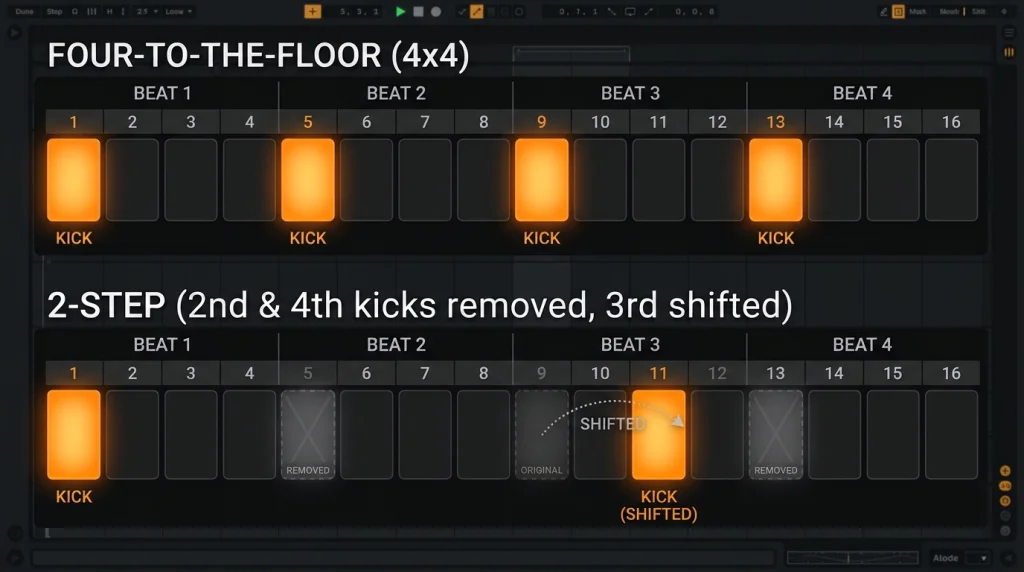
UK garage uses two main kick styles. 4×4 keeps a house-style kick on every beat. 2-step drops the second and fourth kicks and shifts the third, creating the skipping rhythm the style is famous for.
What Makes Speed Garage Different
Speed garage is the mid-90s strain that kept four-to-the-floor rhythms and added heavy, warped basslines influenced by jungle and reggae, time-stretched vocals and dub effects like sirens and gunshots. Armand Van Helden’s remix of Sneaker Pimps’ “Spin Spin Sugar” and Double 99’s “RipGroove” are classic examples.
The Modern Revival
In the 2020s, artists such as Fred again.., PinkPantheress, Disclosure and Interplanetary Criminal brought garage rhythms back to a new generation. Afro and amapiano producers are blending it too, a great example of genre-bending production.
The 7 Secrets of a UK Garage Beat
These seven ingredients separate an authentic UK garage beat from a sped-up house loop.
Secret 1: The Right Tempo
Most UK garage sits around 130 to 135 BPM. Start at 132 BPM, which sits comfortably in the middle of the range. Faster tempos feel more energetic and club-focused, while slightly slower tempos leave more room for vocals and swing.
Secret 2: Heavy Swing
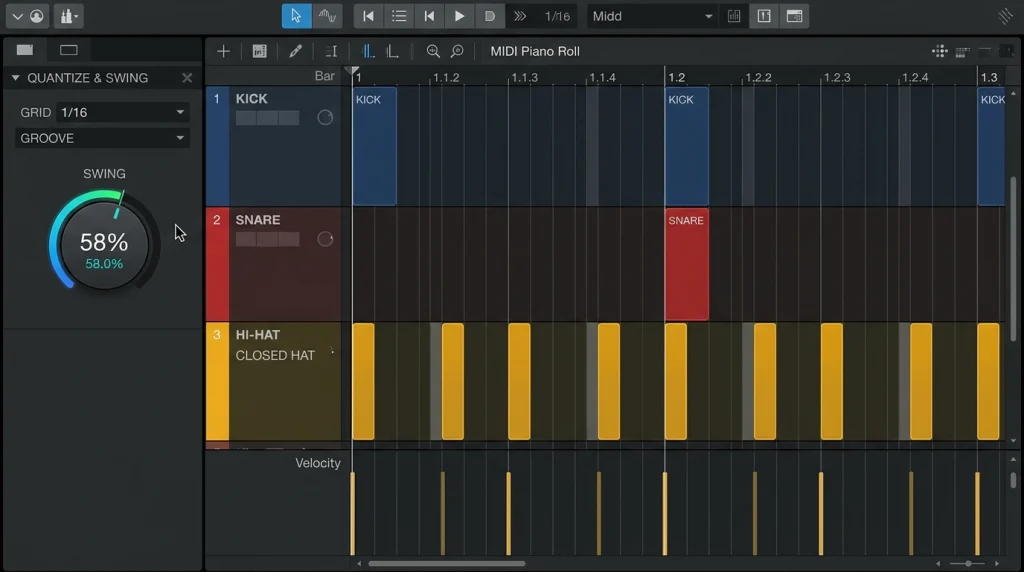
Swing is the single most important element. Delaying every second 16th note gives the hats and percussion their shuffle. Without swing, it is house.
Secret 3: A Skipping Kick
In 2-step, the kick avoids the obvious beats, creating the stop-start bounce. In speed garage, the kick goes back to every beat but the swing stays.
Secret 4: Crisp Snares and Claps
A tight snare or clap on beats 2 and 4 anchors the groove so the skipping kicks feel intentional rather than random.
Secret 5: A Rolling Bassline
Garage bass moves. Short, syncopated sub notes in 2-step, or a heavy, warped bass in speed garage, keep the low end bouncing.
Secret 6: Organ Stabs and Jazzy Chords
Short organ or electric piano stabs playing minor 7th and 9th chords are a classic garage signature.
Secret 7: Chopped, Pitched Vocals
Vocal phrases are cut into syllables, pitched and rearranged like an instrument. This is the hook that makes a UK garage beat instantly recognizable.
Setting Up Your UK Garage Beat Session
A few minutes of setup makes building every UK garage beat faster.
Tempo and Swing
Set the project to 132 BPM. Native Instruments’ UK garage guide starts at the same tempo and explains that playing 16th notes late creates the shuffle. Set your DAW’s global swing or groove to roughly 55 to 60 percent as a starting point, then adjust by ear.
The Sound List
- Drums: punchy kick, tight snare, clap, crisp closed hat, open hat, shaker, rim
- Bass: clean sub, plus a detuned saw or reese-style bass for speed garage
- Keys: organ, electric piano or bright chord synth
- Pads: soft strings or warm pad
- Vocals: a cleared acapella or your own recorded phrases
- FX: sirens, risers, reverse cymbals and vinyl noise
Choose Your Reference Tracks
Pick two or three classic records and one modern track in the style you want, and load them into your session. Match their tempo, compare the swing of their hats with yours and check how loud the sub sits. Referencing keeps your UK garage beat grounded in the real sound instead of a guess at it.
How to Program 2-Step Drums
This is the heart of any 2-step UK garage beat. Build it one element at a time and listen to the swing after every step.
The Kick Pattern
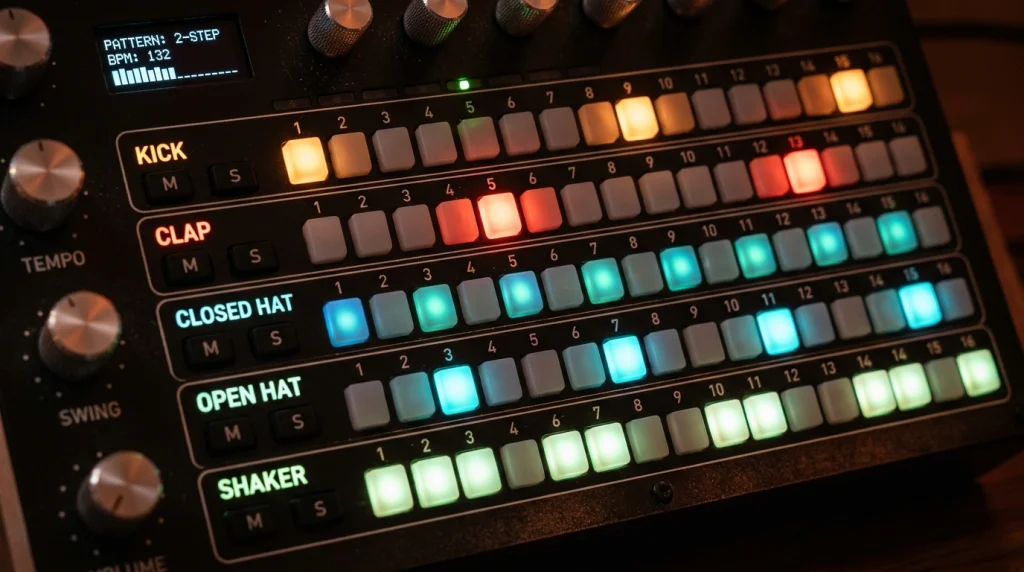
On a 16-step grid, place the first kick on step 1. Skip beat 2. Place the next kick just after the middle of the bar, around step 11, rather than directly on beat 3. Leave beat 4 empty. Add a light ghost kick before the next bar if you want more push.
Snares and Claps
Put a snare or clap on steps 5 and 13, beats 2 and 4. Layer a clap with the snare for width. Add an occasional ghost snare at low velocity to fill gaps.
Shuffled Hats and Percussion
Place closed hats on the off-beats, steps 3, 7, 11 and 15, plus extra 16th notes in between at lower velocity. With swing applied, these extra hats create the shuffle. Add an open hat on one off-beat per bar and a shaker running 16th notes. Reason Studios’ garage tutorial suggests a shuffle setting around 55 percent as a good starting point.
Humanize the Velocities
Garage grooves breathe because not every hit is the same. Vary hat velocities in a repeating pattern, such as loud, soft, medium, soft, and drop ghost snares well below the main hits. Small timing nudges of a few milliseconds on the open hat add life. These details make a programmed UK garage beat feel played by hand.
Pattern Grid
| Element | Steps (16-step bar) | Notes |
|---|---|---|
| Kick | 1, 11 | Optional ghost kick on 16 |
| Snare and clap | 5, 13 | Ghost snares at low velocity |
| Closed hat | 3, 7, 11, 15, plus soft 16ths | Swing applied |
| Open hat | 7 or 15 | Short decay |
| Shaker | Every 16th | Low level, swung |
Bass, Chords and Vocals
With the drums swinging, add the musical layers of your UK garage beat. Keep everything short and rhythmic so the groove stays in charge.
The Garage Bassline
Write a short, syncopated sub bass that plays in the gaps between kicks. Glide between notes occasionally for movement. Sidechain the bass to the kick so they never fight, using techniques from our advanced sidechain compression guide.
Organ Stabs and Jazzy Chords
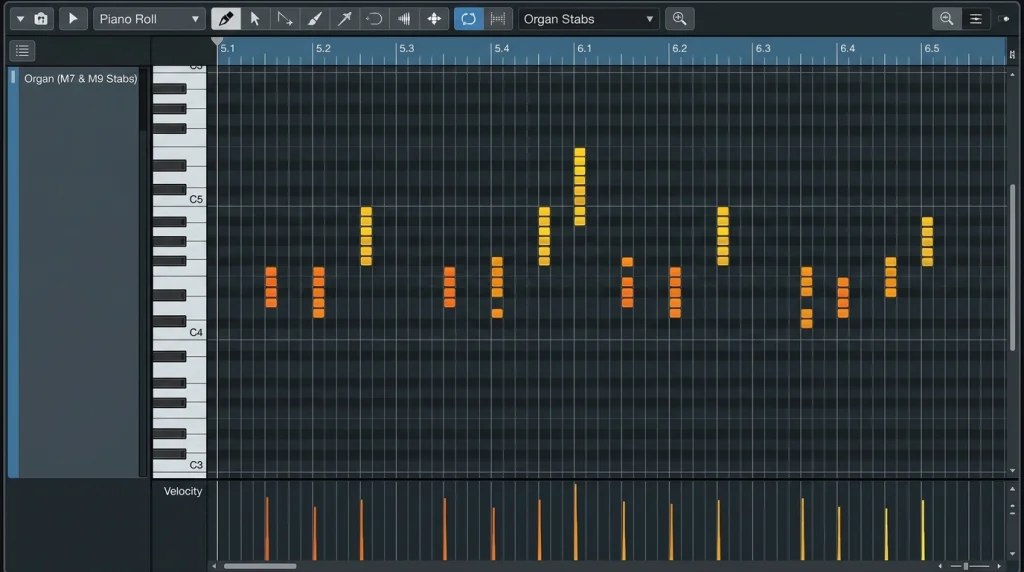
Program short stabs of minor 7th and minor 9th chords on off-beats and syncopated 16ths. A classic organ sound is the traditional choice, but electric piano and bright synths work too. Keep the stabs short so they bounce with the hats.
Layer Pads for Depth
Under the stabs, a soft string or warm pad holding the chord roots adds depth without cluttering the rhythm. Filter it gently so it sits behind the drums. In a UK garage beat, the pad is glue, not a lead, so keep it low and let the stabs carry the bounce.
Chopped Vocals the Todd Edwards Way
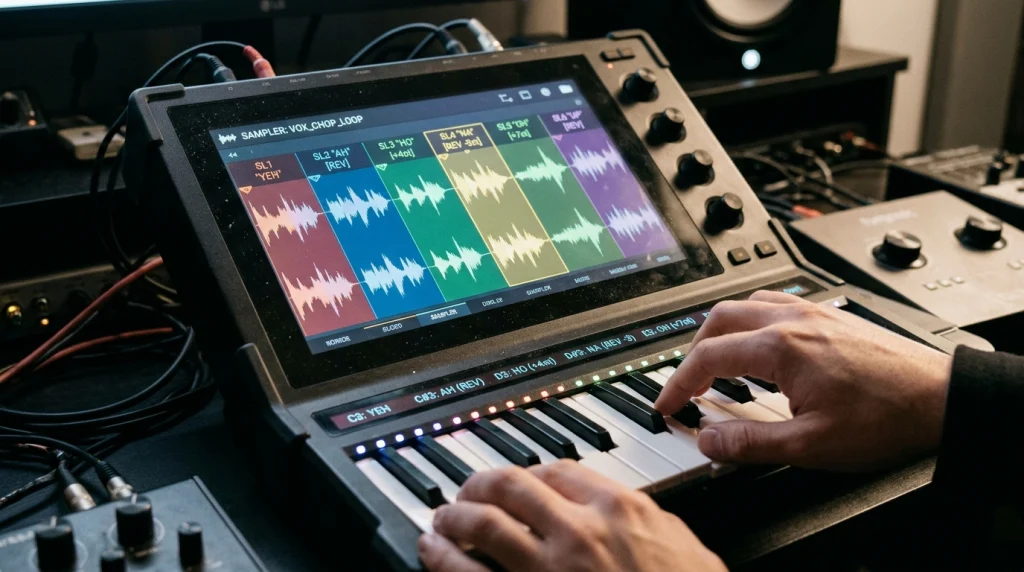
Producer Todd Edwards helped define garage vocals by cutting phrases into syllables and playing them like an instrument, often reversing or pitch-shifting single sounds. Load a cleared vocal into a sampler, slice it into syllables, map them across the keyboard and play a new rhythmic melody. Pitch some chops up and reverse others for that classic texture.
How to Make Speed Garage
Speed garage uses the same tempo and swing as a 2-step UK garage beat, but swaps the skipping kick for a driving four-to-the-floor and puts a huge bass in front.
Four-to-the-Floor Foundation
Place a kick on every beat, keep claps on 2 and 4, and keep the swung hats and shakers from your 2-step pattern. The swing on the tops is what stops it from sounding like plain house.
The Warped Bass
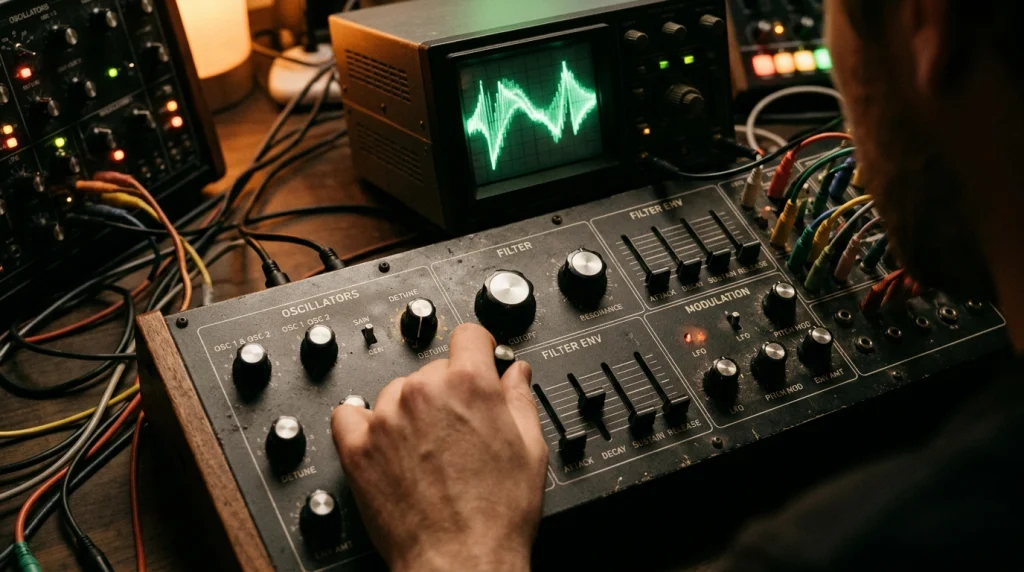
Speed garage basslines are heavy and moving. Start with detuned saw waves, add a low-pass filter with an envelope for a punchy attack, and modulate pitch or filter cutoff for a warping effect. Play short, repeating patterns that answer the kick.
Sirens, Ragga Samples and FX
Dub and jungle effects are part of the style. Add sirens, short ragga-style vocal shouts you have cleared, rewind effects and reverse cymbals at transitions. Use them sparingly so each one lands. A single siren before the drop or a short rewind effect at the end of a breakdown has more impact than effects on every bar.
Arranging a UK Garage Beat for DJs
Garage was built for DJs and MCs, so arrange every UK garage beat with mixing in mind.
The Arrangement Map
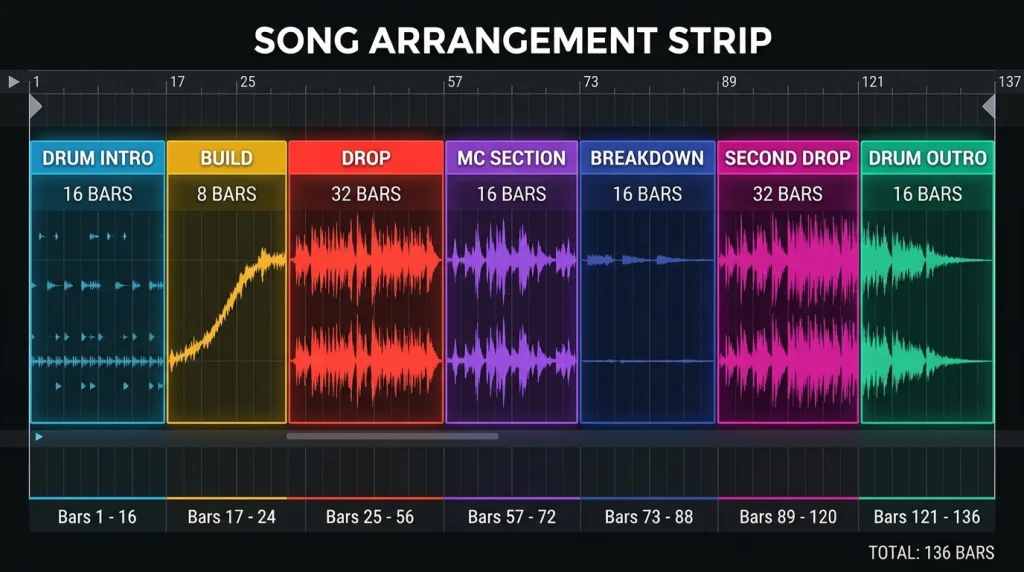
| Section | Bars | What Happens |
|---|---|---|
| Intro | 16 | Drums only, so DJs can mix in |
| Build | 8 | Add bass and filtered chords |
| Drop 1 | 16 | Full groove, vocal chops |
| MC section | 16 | Stripped-back groove with space |
| Breakdown | 8 | Chords and vocals, no kick |
| Drop 2 | 16 | Full energy with a new layer |
| Outro | 16 | Drums only for mixing out |
Leave Room for an MC
Garage and its pirate radio roots are tied to MC culture. Keep at least one section stripped back so an MC can ride the beat. For general structure principles, see our professional song structure blueprint.
Make a Dub and an Instrumental
Garage DJs love options. Export a vocal mix, a dub with only a few vocal chops, and a full instrumental. A dub version of a UK garage beat gives DJs and MCs more room to play, and it doubles the ways your track can be used in sets.
Mixing Garage Tracks
A UK garage beat mix should feel tight, bouncy and clear on club systems.
Keep the Swing Intact
Avoid heavy compression on the drum bus that flattens ghost notes and velocity changes. Those small details are what make the swing feel human.
Control the Low End
Keep the sub in mono, high-pass everything else that does not need low frequencies, and use sidechain so the kick and bass take turns.
Bright, Crisp Tops
Hats and shakers should be crisp but not harsh. Gentle high-shelf boosts and a little saturation help them cut through. For a complete workflow, follow our step-by-step beat mixing process, and for another walkthrough, see MusicRadar’s UK garage tutorial.
Test on a Big System
Garage lives on sound systems. Test your mix on full-range speakers or a club system if you can, and check that the kick and sub hit hard without booming. A UK garage beat that feels tight at volume will translate everywhere else.
5 Mistakes to Avoid
Steer clear of these and your UK garage beat will bounce from the first bar.
- No swing. Straight 16ths turn garage into house.
- Kick on every beat in 2-step. The skip is the point.
- Long, sustained chords. Short stabs keep the groove moving.
- Uncleared vocal samples. Use your own vocals or cleared material.
- No DJ intro. A drums-only intro and outro makes your track mixable.
Conclusion: Build Your First UK Garage Beat Today
A great UK garage beat comes down to swing, space and attitude. Get the shuffle right, let the kick skip, keep the stabs short and chop your vocals like an instrument, and the groove takes care of itself.
Here are the key takeaways:
- Work at 130 to 135 BPM with swing around 55 to 60 percent.
- Choose 2-step or 4×4, and keep claps on beats 2 and 4.
- Write rolling bass and short organ stabs, sidechained to the kick.
- Chop vocals into syllables and replay them as melodies.
- For speed garage, add a four-to-the-floor kick, a warped bass and dub effects.
Ready to start? Grab our mix-and-match sample kits, load up a crisp kit and build your first garage groove tonight.
FAQ: UK garage beat
What BPM is a UK garage beat?
Most UK garage sits around 130 to 135 BPM. Starting at 132 BPM is a safe choice.
What is the difference between 2-step and speed garage?
2-step removes the second and fourth kicks for a skipping rhythm. Speed garage keeps a four-to-the-floor kick and adds heavy, warped basslines and dub effects.
How much swing should a UK garage beat have?
Start around 55 to 60 percent swing on your 16th notes, then adjust by ear until the hats shuffle naturally.
Who are the key UK garage artists?
Classic names include Todd Edwards, MJ Cole, Artful Dodger, Craig David and So Solid Crew. Modern revival artists include Fred again.., PinkPantheress and Disclosure.
What makes speed garage bass different?
It is heavier and more warped, often built from detuned saws with filter and pitch modulation, and it sits at the front of the mix.
Can I make UK garage in any DAW?
Yes. Any DAW with swing or groove settings and a sampler for vocal chops works well.
Can Afro or amapiano producers blend garage elements?
Yes. Garage swing, shuffled hats and chopped vocals blend well with Afro and amapiano grooves, especially at faster tempos.